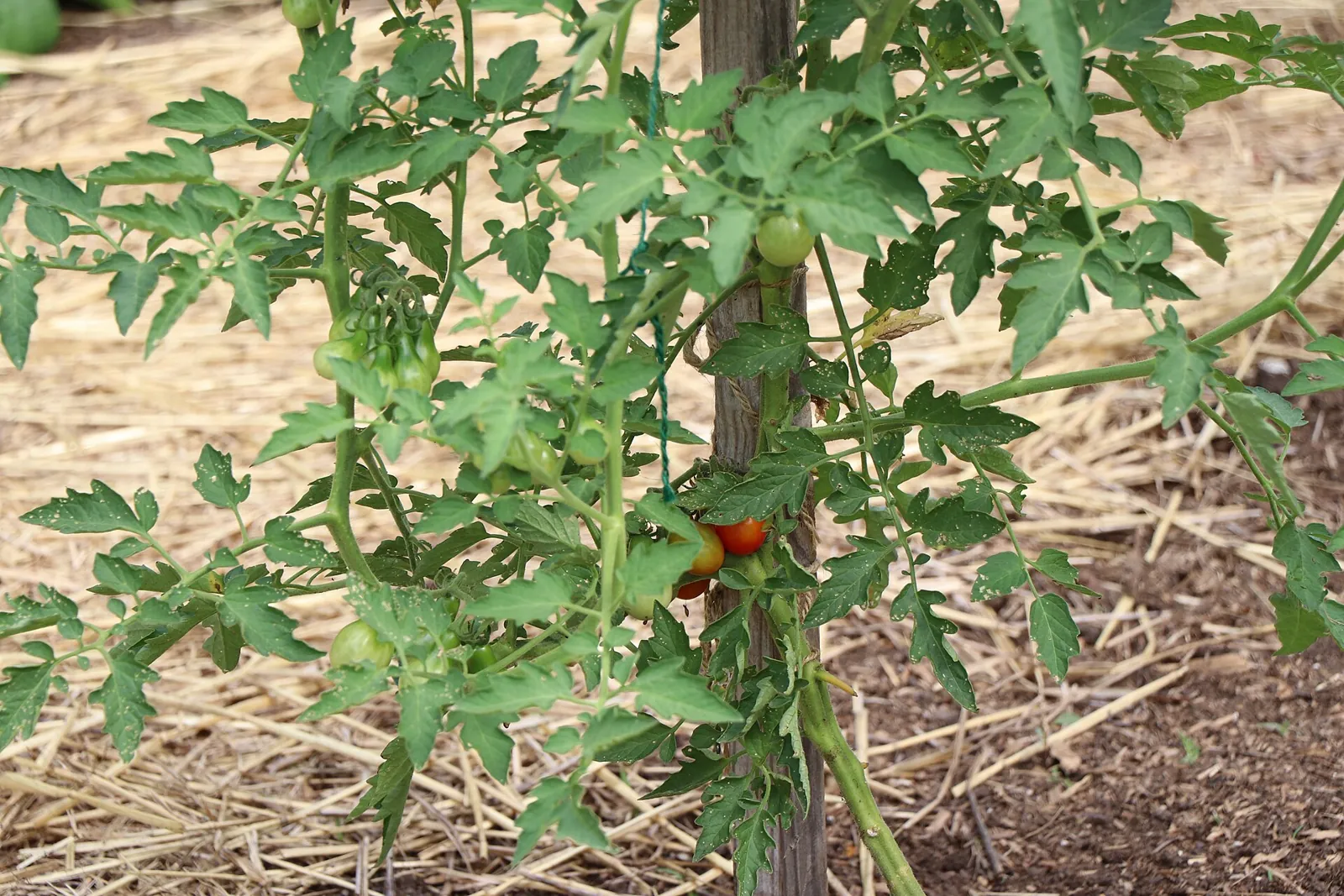
A tomato is either determinate or indeterminate. That one word on the label decides its spacing, its support, and when it stops. Everything else follows.
The label, and on it the word “determinate” or “indeterminate” (the variety name won’t tell you)
A support sized to that answer, either a short cage or something tall and strong
Patience about planting day, because tomatoes gain nothing from going out early
Determinate or indeterminate: which should I grow?
A determinate tomato grows to a fixed size of roughly 0.9–1.2 m3–4 ft, sets most of its fruit in one concentrated window, and stops. It suits a short season, a container, sauce-making (the harvest all arrives together), and a modest cage or a single stake. An indeterminate tomato never stops. It’s a vine, 1.8–3 m6–10 ft by late summer, flowering and fruiting right up until frost kills it. It needs a tall, strong support, and pays you back with months of picking instead of weeks.
Neither one is better. Almost every disappointment comes from treating one like the other. An indeterminate plant in a flimsy wire cone has swallowed it by July and collapsed by August. A determinate plant pruned like a vine has had half its one-and-only crop cut off. That’s why the planner asks which you’re growing: the spacing, the support, and the days to maturity it plans around all change with the answer.
When and how deep do I plant a tomato?
Tomatoes are very tender. Frost kills them, and cool days stunt them. A tomato set out too early sits in cold soil doing nothing, or dies to a late frost, while one planted once the days stay warm catches up and overtakes it almost every year. Start seeds indoors about six weeks before your last frost (the seed-starting guide covers the mechanics), and set plants out about two weeks after it. The planner gives you both dates for your own place.
Plant deep. A tomato is one of the few crops that roots along its buried stem, so a leggy seedling planted right up to its top leaves becomes a better-anchored plant.
Put the support in on planting day. A stake driven in beside a mature plant spears the roots you spent all summer growing, and that’s the whole argument of the staking guide.
How much should I water and feed?
Most tomato fruit problems are watering problems in disguise. Blossom-end rot, the black sunken patch on the bottom of the fruit, almost always comes from uneven watering and almost never from a soil deficiency (the blossom-end rot guide has the full story). Deep, regular watering at the base, plus a mulch to smooth out the swings, prevents more trouble than anything you can buy. Go easy on the nitrogen. An overfed tomato is a huge, dark-green, fruitless bush.
Why did my tomato stop setting fruit?
A healthy plant that flowers but sets nothing in high summer is usually reacting to temperature. Hot nights interrupt the pollen. That one has its own guide, because it’s the most-asked tomato question there is.
Can I plant tomatoes in the same spot next year?
Tomatoes are nightshades, and the diseases that end their season, such as early blight and Septoria, carry over in the ground they grew in. The corpus keeps nightshades off the same ground for three years:
Don't plant nightshades where nightshades grew in the last 3 years
If you skip this, you lose real yield. The planner warns you.
How it works: Alternaria solani (early blight) and Septoria lycopersici overwinter on tomato debris and solanaceous weeds; a 2-3 year break plus debris removal starves this inoculum. Fusarium has a very narrow host range, so rotating away from the host is effective. Verticillium is the exception. Its microsclerotia persist ~10 years and it infects 300+ host families, so a garden-scale rotation does not control it.
Evidence: checked against 5 sources in the research-based literature.
Verticillium wilt tends to affect a wide range of hosts and can infect many unrelated plants. Fusarium spp., on the other hand, have very narrow host ranges.
Remedy
Plant nightshades in different ground, or wait until 3 years have passed since this ground last held them. Clear and remove the old debris either way, because the inoculum overwinters on it.