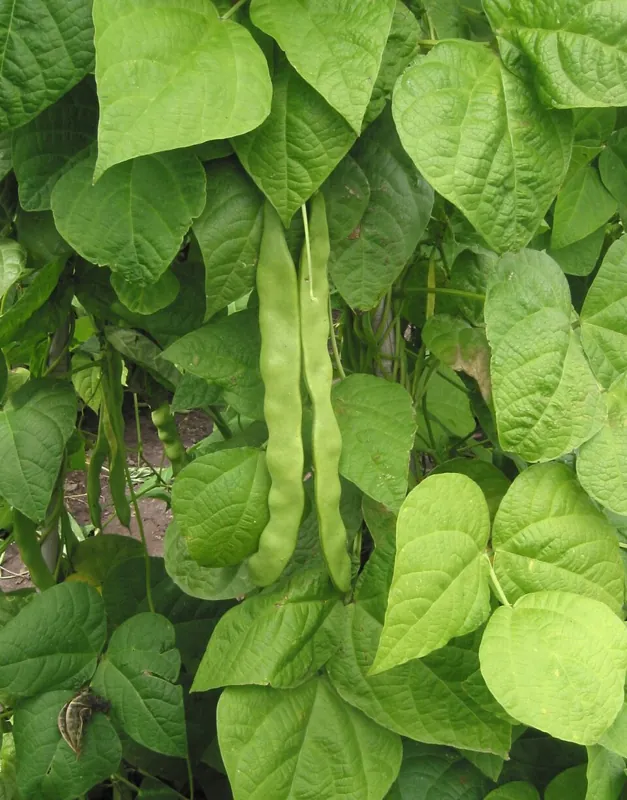
Growing beans: pole or bush, and what the roots leave behind
The same bean is a knee-high bush or an all-season climbing vine, and the packet says which. How to grow both, and the truth about the nitrogen everyone repeats.
Photo: Rainer Zenz (uploader), via Wikimedia Commons · CC BY-SA 3.0, via Wikimedia Commons.
The packet’s word, “pole” (a climbing vine) or “bush” (self-supporting)
For pole beans, a tripod, netting or trellis two meters6 feet or more, up before you sow
Warm soil. Beans sown into cold ground rot before they sprout
With beans, the packet’s first word matters more than everything else on it. Bush beans are compact, self-supporting plants that go seed-to-harvest in 50–60 days and then mostly finish. Sow a short row every few weeks and you’ve got beans all season (the succession guide is built for exactly this). Pole beans are vines 1.8–2.4 m6–8 ft long that have to climb. They take a couple of weeks longer to get going, then keep at it until frost: one sowing, one structure, months of picking.
Do pole beans need their support up before I sow?
A pole bean with nothing to climb is the textbook sprawl, with stems in the mud and pods rotting where they touch. It’s the whole reason the staking guide exists. The support goes in before or with the seed, never after: a tripod of poles, netting, or a trellis, two meters6 feet or more, because the vine will use all of it. In the planner, adding a pole bean to a bed says so out loud, and a trellis is one tap away. In a Three Sisters mound, the corn stalk is the pole.
When and how do I sow beans?
Beans are frost-tender, and they also hate cold soil. Seed sown into cold, wet ground rots before it can sprout. Sow them right where they’ll grow, since beans transplant badly, once frost is past and the soil has properly warmed. There’s nothing to gain from starting them indoors; a direct-sown bean overtakes a transplanted one within weeks.
A warm-season bean germinates from warm soil, whatever the calendar says. Sown into cold ground it rots or emerges weak, even after the frost has passed.
If you skip this, it still grows, just less well. The planner suggests it.
How it works: Warm-season legumes take up water fast at sowing (imbibition), and in cold soil that first rush of cold water injures the seed tissue before the seedling can establish (imbibitional chilling), so the seed rots or comes up damaged. Soil below about 15 °C (60 °F) at sowing depth is where this bites, and the frost-free date can arrive weeks before the soil is that warm.
Evidence: checked against 2 sources in the research-based literature.
Bean seed planted in cold soil may rot rather than germinate, and plant growth will be very slow in cooler weather
Remedy
Wait for the soil to warm to about 15 °C (60 °F) at sowing depth, which a soil thermometer reads in a minute, or start the beans in warm cells and set them out. Peas are the opposite and are out of scope here. Half-hardy, they germinate in cold soil and are sown early on purpose.
Beans are legumes. Bacteria in their root nodules pull nitrogen out of the air, which is why beans on ordinary ground need no nitrogen fertilizer at all. Feed them anyway and you get lush leaves and few pods. Pick pods young and often; a bean plant that ripens seed decides it’s finished, and picking is what keeps it going.
Do beans really add nitrogen to my soil?
Two claims about that fixed nitrogen go around, and they deserve to be pulled apart. The famous one, that beans feed the corn beside them this season, doesn’t hold up, and its own guide walks through why. The unglamorous one is real and useful. Most of the fixed nitrogen is in the plant itself, so what you leave behind matters.
Before any of that, new ground has a catch that’s easy to miss. Beans only fix nitrogen in partnership with specific soil bacteria, and a bed that has never grown that legume may not carry them yet.
Beans, peas and other legumes only fix nitrogen with the right soil bacteria. Ground that hasn't grown their kind recently may have too few, so they fix less.
If you skip this, it still grows, just less well. The planner suggests it.
How it works: Nitrogen fixation happens in root nodules formed by Rhizobium or Bradyrhizobium bacteria specific to each legume group. On ground that has not grown that legume group before (a new bed, a soil-less mix, a long gap in the rotation, a fumigated or strongly acid soil), the matching strain can be absent or sparse, so nodulation and fixation are reduced until a population builds.
Evidence: checked against 1 source in the research-based literature.
Rhizobia bacteria are fairly specific as to which legumes they will infect, form nodules on the roots of, and for which they will fix nitrogen
Remedy
On first-time legume ground, coat the seed at sowing with the inoculant matched to the crop's group (garden peas and beans, soybean, and clover each take a different one). Ground that has grown that legume recently usually needs none. It is a cheap one-time step, advised where the history is absent and never required.
If you skip this, it still grows, just less well. The planner suggests it.
How it works: A legume fixes atmospheric nitrogen into its tissue as it grows. When the crop is killed and its residue decomposes, soil microbes mineralize that organic nitrogen, converting a form plants can't use into one they can, and release it for the next crop. How much depends on how well the legume grew, and it is lower on sandy soils.
Evidence: checked against 2 sources in the research-based literature.
The nitrogen credit depends on the amount of crop growth and when the legume was planted. Nitrogen credits are 50 lb N/a lower on sandy, coarse-textured soils.
Cut spent bean plants off at the soil line and leave the roots in, so they and their nodules break down in place. The ground is then measurably better set up for next year’s heavy feeder. The planner’s rotation and fresh-bed suggestions read exactly this from your log.
Further reading
Good places to read more about the technique on this page. The grade on each card comes from that card’s own sources.