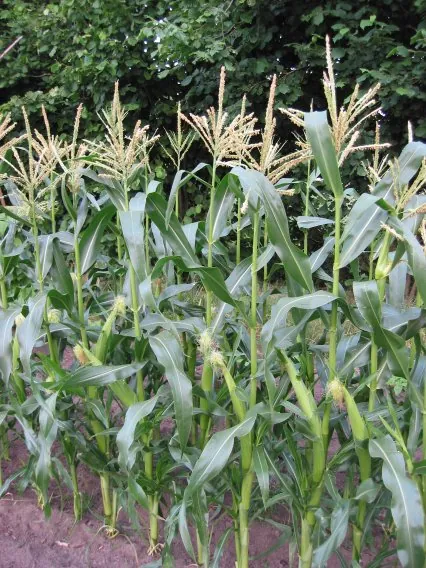
What the mound is for, how big to shape it, and the staggered order to plant corn, beans, and squash, plus the exact block the corn needs to pollinate.
Photo: Rasbak at Dutch Wikipedia · CC BY-SA 3.0, via Wikimedia Commons.
A sunny patch, worked soil, and room for a BLOCK of corn. A single row won’t do
Seed for a flint or dent corn, a POLE (not bush) bean, and a running winter squash or pumpkin
Soil warm enough for corn, around 13°C55°F, so this is a late-spring, after-frost planting
The Three Sisters is corn, beans, and squash grown together on a raised mound. The mound and the planting order are the parts people skip, and they are the parts that make it work. Here is how to shape one and plant it, and where its limits are.
What is the mound for?
A mound is a low, raised hill of soil. Raising the planting area a hand’s width above the ground warms it faster in spring and drains it better. The heat-loving corn and squash want both in cool, wet soils early in the season. In a dry climate the advice flips: a raised mound sheds the water you need it to hold, so growers there flatten the top and press a shallow saucer into it to pool irrigation. (Extension sources describe the warming and draining. Treat that as a sound reason to mound. It isn’t a precise, measured yield effect.)
How big should I shape the mound?
Two common sizes, both from extension guides. Pick by how much room you have:
A small hill: about 30 cma foot high and 45–90 cm18 inches to 3 feet across, holding 3-4 corn plants. Space hills 0.9–1.2 m3–4 feet apart, in every direction.
A larger mound: a few feet wide, holding 7-10 corn plants.
Whichever you build, the corn’s spacing inside it and the gaps between mounds are set so the whole patch reads as a block. The next section explains why that’s required.
How do the three crops get laid out?
This is a Three Sisters bed laid out by the planner. The corn sits in its block, the beans at the corn’s feet, and the squash fills the gaps between the mounds, exactly as the placement rules compute it:
36 × Corn
27 × Common bean
4 × Summer squash
The real placement on an example 10 ft bed, the same layout the planner draws.
Why does the corn have to be a block instead of a row?
This is the single mistake that ruins a first Three Sisters bed, so it comes first. Corn is wind-pollinated. Pollen falls from the tassel at the top and has to land on the silks below. A single decorative row lets the wind carry most of it away, and you get ears with gaps where kernels never formed. The fix is to plant corn in a block of several short rows so the pollen has neighbors to land on:
Corn needs a block of at least three short rows side by side for good kernel set, and four rows is better.
If you skip this, the planting fails. The planner won’t allow it.
How it works: Maize is wind-pollinated and protandrous (each plant sheds its pollen before its own silks are ready). Tassels shed pollen that must land on the silks of neighboring plants. In a single row much of the pollen blows out of the row, and each silk it misses is one missing kernel.
Evidence: checked against 5 sources in the research-based literature.
Always plant corn in blocks of at least four rows. Corn planted in a single row will have much of its pollen blown out of the row, and will produce ears that have blank areas where kernels did not form.
This crop is wind-pollinated; therefore, plant in blocks of several rows rather than 1 or 2 long rows to ensure full ears.
richmond.ces.ncsu.edu
Glass Gem CornNC State Extension, Richmond County Center
When tassels start dropping pollen, stalks can be gently shaken. This mimics wind and will release the pollen to float down to the silks.
Remedy
Plant corn in a block of several short rows rather than one long row; four rows is best. For a small patch, shake the stalks gently while the tassels shed pollen, or dust a cut tassel over the silks, every few days. Or leave corn out and give the beans a trellis.
Cluster your mounds together for the same reason. A tight block of hills pollinates; a line of them strung out does not.
Do I plant everything at the same time?
An established bed at the Mille Lacs Indian Museum, Minnesota - the corn up, the squash sprawling at its feet. Photo: Myotus · CC BY-SA 4.0, via Wikimedia Commons.
The three go in on different days. Each gets a head start before the next would crowd or shade it, and the corn in particular has to be strong enough to carry the beans before they climb:
A vine assigned to a living support must be sown after the support is established, when corn is ~6 in (~15 cm) tall, roughly 2-3 weeks in. Sowing both at the same time is too early.
If you skip this, you lose real yield. The planner warns you.
How it works: Load. A bean vine on an immature, poorly-anchored stalk pulls it over; extension guides key the delay to the support's height (corn ~6 in) as a proxy for it being rooted enough to bear the climbing load.
Evidence: checked against 2 sources in the research-based literature.
Corn first, once the soil is warm (around 13°C55°F). Sow 5-7 seeds per hill, about 3.8 cm1.5 in deep; thin to the sturdiest 3-4.
Beans next, when the corn is about 15 cm6 inches tall and can serve as a trellis. Sow a few pole-bean seeds in a ring around the corn.
Squash last, about a week after the beans. Put a few seeds at the mound’s edge, thinned to one, to run out across the ground between the hills.
Use pole beans and a running squash. Bush types won’t work here, because the whole structure depends on one climbing and one sprawling.
Is there a catch I should know before I start?
Everyone repeats the story that the beans feed the corn this season, and it is overstated. Most of a legume’s nitrogen reaches its neighbors only after its roots and leaves break down, largely the following year. The beans improve the ground for later; this year’s corn gets little of it. The guide what the evidence says about companion planting has the full picture, and the Three Sisters plant team page shows every claim graded. Grow it for the real structure: a living trellis, a living mulch, and a block that pollinates. The nitrogen transfer mostly isn’t happening yet.
Further reading
Good places to read more about the technique on this page. The grade on each card comes from that card’s own sources.