Some plants can't hold themselves up, and left on the ground they sprawl, rot, and yield poorly. Which crops need support, what kind, and why you put it in the day you plant.
To know which of your crops need support - not all do
Cages, stakes, poles, or a trellis sized to the plant’s full-grown height
To put the support in at planting time, before the roots are in the way
Some plants are built to climb or sprawl. Left to their own devices they collapse onto the soil, where the fruit sits in the wet and rots, the leaves stay damp and catch disease, and the whole plant yields a fraction of what it could. For these crops, support makes the difference between a good harvest and a mildewed mess. The planner treats it that way:
A plant that must climb needs an assigned support strong enough to carry it.
When you place a support-needing crop in the planner, support is a requirement, because the plant fails without it. Here’s what needs supporting and how.
How should I support a tomato - cage, stake, or string?
How much support a tomato needs depends on its type. A determinate (bush) tomato stays compact and gets by with a small cage or a single stake. An indeterminate tomato keeps growing and fruiting all season and can reach 1.8–3 m6–10 ft. It needs a tall, sturdy support: a heavy cage, a strong stake you tie the stem to every foot or so with soft ties, or a string trained up from above. The flimsy wire cones sold as “tomato cages” are too small for an indeterminate plant; it’ll swallow one by July. Put whatever you use in at planting time. Drive a stake in next to a mature plant and you spear its roots.
What do beans and peas need to climb?
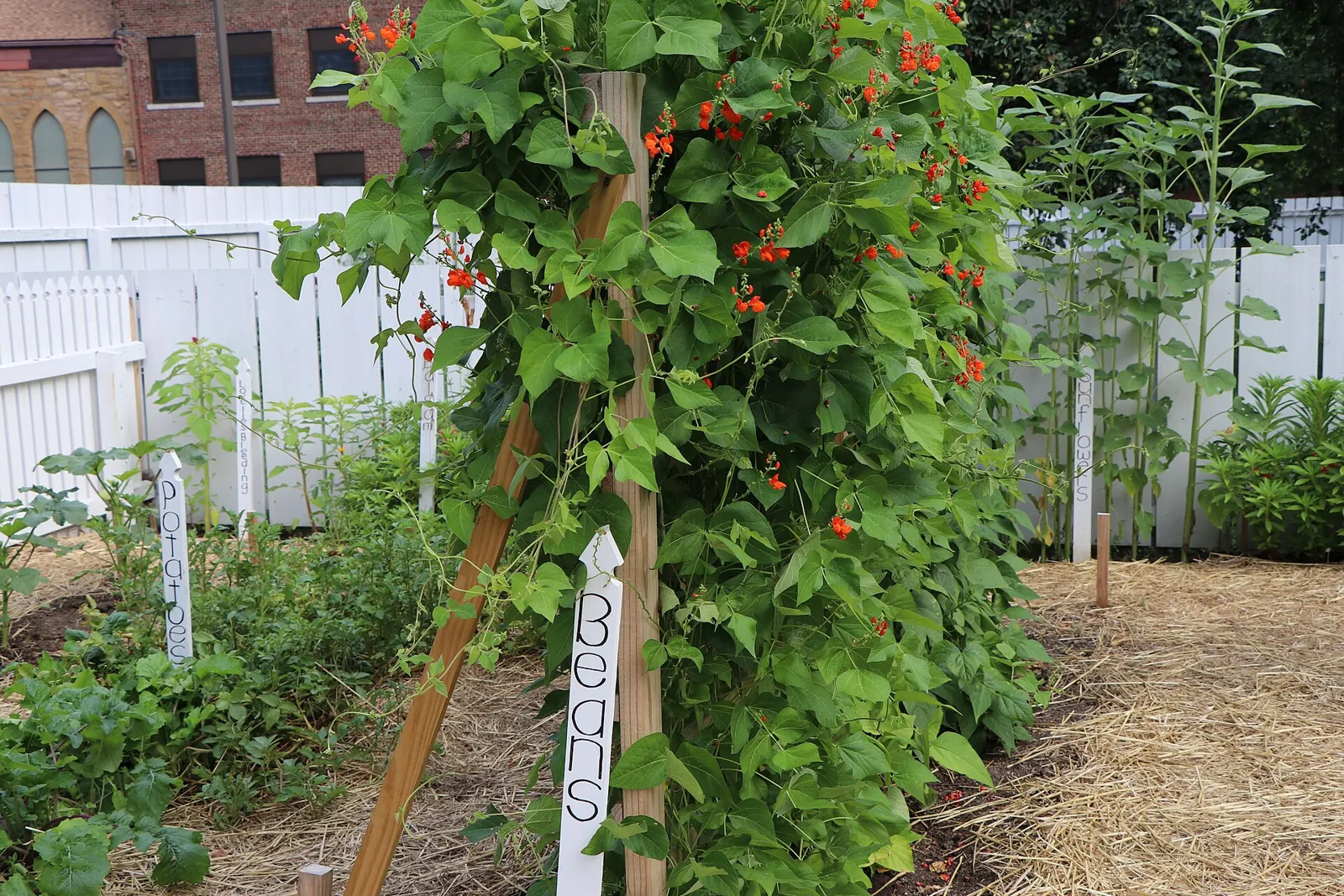
Climbing legumes are the clearest case of all. Pole beans send up vines 1.8–2.4 m6–8 ft long and must have a pole, a tripod, or a trellis to climb. Unsupported, they’re the textbook example of a crop that sprawls, rots, and disappoints. Bush beans are self-supporting and need nothing. Peas want a low trellis or netting to cling to with their tendrils. And the most elegant support of all is another plant: in the Three Sisters mound, the corn stalk is the bean’s pole, which is half the reason the planting works.
How do I support cucumbers and other vines?
Cucumbers, small melons, and vining squash will happily run across the ground, but a trellis turns them vertical. That saves enormous space, keeps the fruit clean, straight and easy to find, and moves air through the leaves so they dry faster and get less disease. In a small garden or a container, training a vine upward is often the only way to fit it at all.
What kind of support do grapes and brambles need?
A grape vine needs a strong support for its whole life: a real trellis or an arbor, set in place before the vine goes in and built to hold a woody plant that will only get heavier. Raspberries and blackberries ask for far less. Their canes mostly hold themselves, and a simple wire run between two posts keeps a row from flopping into the path and makes picking easier. The planner knows the difference. A grape without a trellis is refused; a bramble just gets a nudge.
What can I build a support out of?
For a seasonal vegetable bed the usual forms are a cattle panel (a stiff wire grid arched or stood on end; nearly indestructible, holds anything), a bamboo tripod (three poles lashed at the top; cheap, quick, right for pole beans), or a string trellis (twine run up from a frame, for tomatoes and cucumbers). All of them are a one-time cost that comes back out in autumn and works again next year. In the planner these all count the same way: a support strong enough for the plant that needs it, placed along the shaded edge of the bed so it doesn’t cast its shadow over the growing ground.
The two rules that save you trouble
Two things matter more than which style of support you choose:
Put it in early. Install the cage, stake, or trellis at planting, or right after. Added later, it damages roots going in, and the plant has usually already flopped and kinked its stems.
Size it to the full-grown plant. An indeterminate tomato reaching 1.8–3 m6–10 ft or a pole bean reaching 1.8–2.4 m6–8 ft needs support that tall and that strong from the start. Sized for the seedling, it gets outgrown and toppled at the worst moment, when the plant is heavy with fruit.
Match the support to the crop, put it in on day one, and the plants that need it will climb, stay clean, and carry far more than they ever could on the ground.
Further reading
Good places to read more about the technique on this page. The grade on each card comes from that card’s own sources.