You can grow real food in pots on a patio, balcony, or step. Here's how to pick the pot, what to fill it with, what to grow, and the one habit that decides whether it lives.
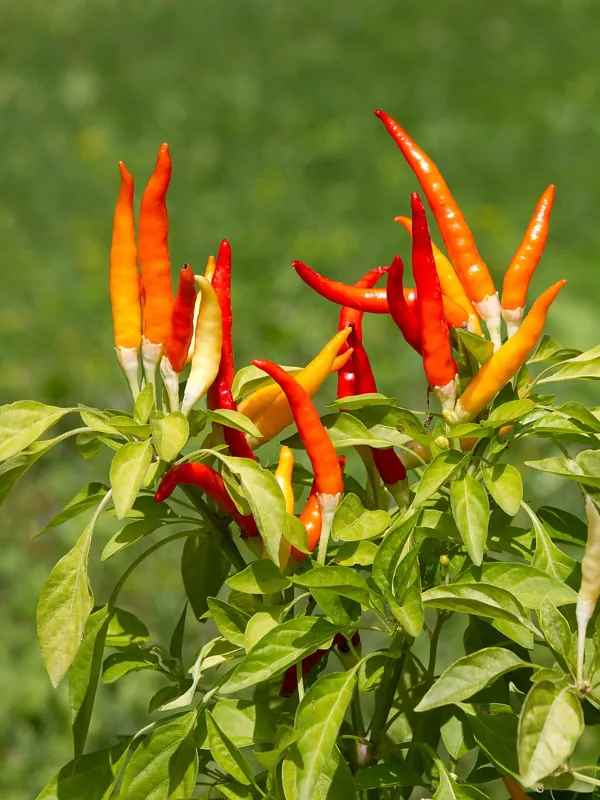
C. annuum covers sweet bell and hot chili types. Photo: PierreSelim · CC BY 3.0, via Wikimedia Commons.
What you need
Pots with drainage holes, bigger than you think, and at least one per crop
A bag of potting mix (garden soil packs down in a pot)
A spot with six or more hours of sun a day
A daily habit of checking the soil in summer
A container garden is the lowest-commitment way to grow food. A few pots on a patio, a balcony, a front step, or a rented yard you can’t dig up will grow herbs, salad, peppers, and more, and you can move them to chase the sun or dodge a late frost. If you’re still weighing pots against a bed in the ground, the garden types guide compares them. This one assumes you’ve picked pots and answers the four questions that decide whether they work: what pot, what soil, what to grow, and how to keep them alive.
How big should the pot be?
Almost every beginner’s container is too small. A bigger pot holds more soil, and more soil means a bigger water reservoir and more root room, which make the pot far more forgiving. Rough floors that work: a large leafy herb wants at least a 20–25 cm8–10 inch pot and a pepper one that holds 19 L5 gallons; a tomato wants a 40 cm15 inch pot or a bucket that holds 19 L5 gallons, and a bush squash one that holds 38 L10 gallons. The one thing you can’t skip is a drainage hole. A pot without one drowns roots in the first heavy watering. Material matters at the margins. Plastic and glazed ceramic hold moisture longer than unglazed terracotta, which wicks water out through its sides and dries fastest of all.
What's the hardest part of growing in a container?
This is the rule that kills container plants, and it’s the reason all the pot-size advice above matters:
A container dries out faster than the same plant in the ground, and it is the one place where a day's inattention can cost you the plant.
If you skip this, it still grows, just less well. The planner suggests it.
How it works: A container holds a small fixed volume of soil, its whole root zone sits above ground, cut off from the soil below, and a porous pot loses water from its sides as well as its surface. The reservoir is smaller and it empties faster.
Evidence: checked against 2 sources in the research-based literature.
Depending upon the size and material of the container, you may need to water more than once per day during hot, dry weather.
Plus one working note on how the sources were read.
Remedy
Check a container at least once a day, and twice when it is hot, dry or windy. In high summer it may need water more than once a day. A plastic pot holds moisture longer than an unglazed clay one, and a bigger pot longer than a small one.
A pot’s whole root zone sits above ground in a small, fixed volume of soil, cut off from the moisture of the earth below. It empties fast. In high summer a small pot in the wind can need water more than once a day. So the habit that keeps a container garden alive is this: check it every day, twice when it’s hot. Push a finger into the soil, and water when the top feels dry. The engine won’t hand you a watering schedule, because how much depends on the weather, the pot, and the day. It tells you to look, more often than you’d look at the ground.
Can I just use soil from the garden?
Reach for a bag of potting mix. Soil from the yard packs down hard in the closed space of a pot, holds too much water, and drains poorly, which is the opposite of what roots in a container need. Potting mixes are built light and open so they hold moisture but still drain. A pot is a closed system, and frequent watering washes nutrients out the bottom, so container plants also need feeding more regularly than the same plant in open ground. Follow the rate on whatever fertilizer you use. (For a plant in the ground the first step is a soil test. A bag of potting mix has no such history to read, so a balanced feed at the label rate is the standard.)
Should I put gravel in the bottom for drainage?
A common instruction is to put a layer of gravel or broken pot shards in the bottom “for drainage.” That advice doesn’t do what it’s sold to do, in either direction.
A layer of gravel or pot shards at the bottom of a container improves drainage.
The old "never put gravel in the bottom of a pot" rule is overstated. A 2025 controlled test found a bottom layer usually drained soil-less mixes better and almost never made things worse, though in loam-based compost it mostly made no difference. It's one study and it grew no plants, so treat a layer as an option. It isn't a fix. If you use one, a thicker layer of coarse sand did best.
What is known
This one is contested. The popular "it's a myth" answer rests on the perched water table. Water held in the fine mix by capillarity was predicted not to cross into a coarse layer, so a gravel bottom would raise the saturated zone and hold more water. A 2025 controlled experiment, using the potting mixes and drainage materials home gardeners actually use, found the opposite. A drainage layer almost always reduced or did not change the water a container held, and almost never increased it. In soil-less coir mixes every layer drained the mix; in loam-based compost most made no difference. Thicker layers did more, and 60 mm of coarse sand worked best across every mix. The study grew no plants, so whether a given plant benefits is still open.
Drainage layers were almost universally found to either decrease or have no effect on the water-holding capacity of containers
Drainage is governed by the mix and the hole. Fill the whole pot with good mix, make sure the hole is open, and skip the gravel. Add it if you like, but don’t count on it to rescue a soggy pot.
What grows well in a pot?
Favor the compact and the fast. Reliable in containers: leaf lettuce and other salad greens, most herbs, bush beans, radishes, chard, and peppers. A pepper is the classic patio crop, productive in a modest pot. Determinate (“bush”) or dwarf cultivars of tomato and squash are bred for exactly this and beat their full-size cousins in a pot. The sprawlers (full-size indeterminate tomatoes, winter squash, sweet corn) can be done, but only in the biggest containers, and corn in particular needs a block to pollinate that a few pots can’t give it. Start with the easy ones. When you’re ready to put a bed in the ground, the first bed walkthrough counts the timing from your frost dates.
Further reading
Good places to read more about the technique on this page. The grade on each card comes from that card’s own sources.