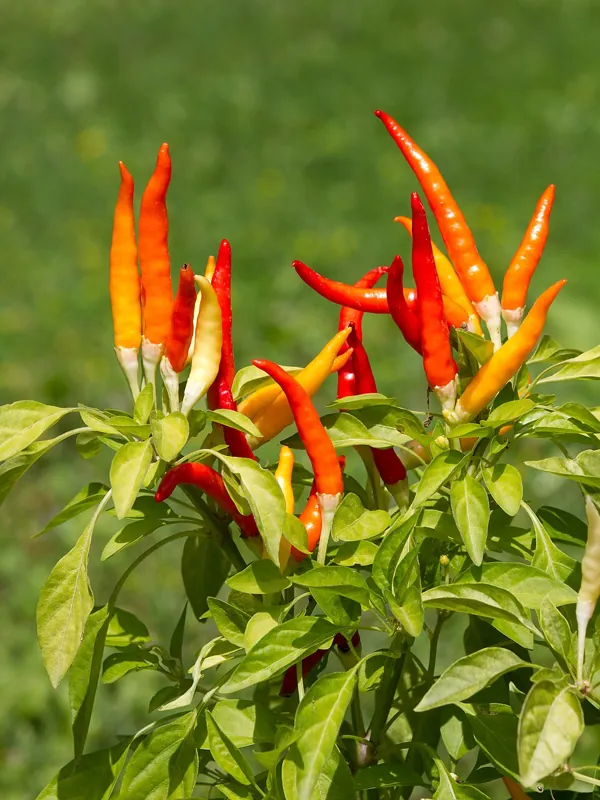
Not every pepper grows the same. These are its main types (its cultivar groups), and the planner sizes, times and supports each one by its own numbers.
Bell pepper — bush, spacing in row 45 cm18 in, mature height 45–75 cm18–30 in, mature spread 45 cm18 in, days to maturity 70–85
Hot pepper — bush, spacing in row 40 cm16 in, mature height 45–90 cm18–35 in, mature spread 40–45 cm16–18 in, days to maturity 70–100
Numbers we’re less sure of
Many of our estimates come from an extension page we’ve read that gets close without pinning the number down. Others are still our own best guess, and on some the sources disagree. Treat them all as a starting point.
Soil pH (in water) — an estimate
Sowing depth — an estimate
Hot pepper: days to maturity — an estimate
Bell pepper: spacing in row — an estimate
Hot pepper: spacing in row — an estimate
Bell pepper: mature height — an estimate
Bell pepper: mature spread — an estimate
Hot pepper: mature height — an estimate
+4 moreShow fewer
Hot pepper: mature spread — an estimate
Bell pepper: monthly temperatures it grows in — an estimate
Hot pepper: monthly temperatures it grows in — an estimate
Night temperature it stops setting fruit — sources disagree
Rules that apply to pepper
Don't plant nightshades where nightshades grew in the last 3 years Promising
Don't plant nightshades where nightshades grew in the last 3 years
If you skip this, you lose real yield. The planner warns you.
How it works: Alternaria solani (early blight) and Septoria lycopersici overwinter on tomato debris and solanaceous weeds; a 2-3 year break plus debris removal starves this inoculum. Fusarium has a very narrow host range, so rotating away from the host is effective. Verticillium is the exception. Its microsclerotia persist ~10 years and it infects 300+ host families, so a garden-scale rotation does not control it.
Evidence: checked against 5 sources in the research-based literature.
Verticillium wilt tends to affect a wide range of hosts and can infect many unrelated plants. Fusarium spp., on the other hand, have very narrow host ranges.
Remedy
Plant nightshades in different ground, or wait until 3 years have passed since this ground last held them. Clear and remove the old debris either way, because the inoculum overwinters on it.
Don't plant anything sensitive to walnut toxin (juglone) within a walnut tree's root zone. Nightshades are sensitive, and so are apple and cabbage. Well established
Don't plant anything sensitive to walnut toxin (juglone) within a walnut tree's root zone. Nightshades are sensitive, and so are apple and cabbage.
If you skip this, you lose real yield. The planner warns you.
How it works: Warm nights above ~21 °C (70 °F) weaken pepper growth and, together with hot days, leave flowers poorly pollinated so they drop before setting fruit. Pepper carries a second heat driver this night threshold does not see. Daytime highs above ~34 °C (93 °F) also abort the flowers, so this rule catches only the night half of a two-sided problem.
Evidence: checked against 2 sources in the research-based literature.
Excessively high or low air temperatures (higher than 94 degrees F or lower than 50 degrees F) can reduce fruit set of peppers by causing flowers to drop from the plant.
Remedy
Wait it out. Pepper sets fruit again once the nights cool. Shade cloth cools the day, but this drop comes from hot nights, so shade cloth will not fix it; keep the plants watered and unstressed so they carry the flush that follows.
If you skip this, the planting fails. The planner won’t allow it.
How it works: The season's accumulated growing degree days (a running total of its warmth) against the total the crop needs to mature, or the crop's days to maturity against the number of frost-free days.
Evidence: checked against 3 sources in the research-based literature.
Once you know the average dates of the last frost in spring and the first frost in fall, count the number of days between. If the “days to maturity” figure for a desired vegetable is a larger number of days and the “frost tolerance” column indicates “none,” the sad truth is that particular vegetable probably won’t grow to maturity.
… high elevation areas don’t accumulate enough “growing degree units” (GDUs, also called growing degree days and heat units) to support some of the most coveted warm season vegetables
Remedy
Start it indoors and transplant it, choose a variety with fewer days to maturity, or skip this crop at this site.
Blossom-end rot comes from uneven watering, which stops calcium reaching the fruit. It is usually not caused by too little calcium in the soil. Well established
Blossom-end rot comes from uneven watering, which stops calcium reaching the fruit. It is usually not caused by too little calcium in the soil.
If you skip this, it still grows, just less well. The planner suggests it.
How it works: Calcium reaches the fruit in the water the roots draw up, carried by the xylem along with that stream. When the supply of water is interrupted the supply of calcium is interrupted with it, and the enlarging fruit runs short at its tip, even where soil calcium is adequate.
Evidence: checked against 3 sources in the research-based literature.
Calcium is taken up from the soil through the plants
Plus one working note on how the sources were read.
Remedy
Keep the soil evenly moist, without letting it dry out and then soaking it, and mulch to hold that moisture steady. We are not naming a calcium amendment or a rate, because the sources disagree on whether adding calcium helps at all, and any amendment number would need a soil test first.
If you skip this, it still grows, just less well. The planner suggests it.
How it works: Resource concentration. A specialist locates and holds its host more efficiently at higher host density and continuity, so an unbroken run of one family across adjacent beds is an easier target than the same family separated by a non-host (associational resistance).
Evidence: checked against 2 sources in the research-based literature.
The 2 sources
Organization of a plant-arthropod association in simple and diverse habitats: the fauna of collards (Brassica oleracea) Root 1973
… the resource concentration hypothesis, which states that herbivores are more likely to find and remain on hosts that are growing in dense or nearly pure stands; that the most specialized species frequently attain higher relative densities in simple environments.
Flea beetle movement in a broccoli monoculture and diculture Elmstrom, Andow & Barclay 1988
… strong, direct support for the hypothesis that host plants are harder to find and easier to lose in vegetationally diverse habitats than in monocultures.
Remedy
Where one family fills adjacent beds in a single season, breaking the run with a non-host family between them lengthens the distance the specialist must travel to the next host. The app discloses this and never docks a score. A continuous single-family block can be the right call anyway (a wind-pollinated crop like corn sets better massed), so the app names the trade-off and leaves the choice to the gardener.
Cold-hardy annuals can be sown or transplanted before the last spring frost (hardy crops about three weeks before, half-hardy about two weeks before). Tender crops wait for the frost itself. Promising
Cold-hardy annuals can be sown or transplanted before the last spring frost (hardy crops about three weeks before, half-hardy about two weeks before). Tender crops wait for the frost itself.
If you skip this, it still grows, just less well. The planner suggests it.
How it works: Cold hardiness. Hardy crops tolerate hard frost and half-hardy crops tolerate light frost, so they can occupy the ground weeks before frost-tender crops are allowed in. The offset is measured from the last spring frost.
Evidence: checked against 2 sources in the research-based literature.
Long-season warm crops are started indoors several weeks before the last frost and set out after it. Tomato and tomatillo go about six weeks ahead, pepper and eggplant about eight, basil six. Promising
Long-season warm crops are started indoors several weeks before the last frost and set out after it. Tomato and tomatillo go about six weeks ahead, pepper and eggplant about eight, basil six.
If you skip this, it still grows, just less well. The planner suggests it.
How it works: A frost-tender crop with a long days-to-maturity cannot mature if it is only direct-sown after the last frost, because the frost-free window is too short. A head start under cover buys the weeks the season lacks; the seedling is set out only once frost has passed, so the transplant date is still frost-gated.
Evidence: checked against 3 sources in the research-based literature.
Very tender crops go out about two weeks after the average last spring frost: tomato, pepper, eggplant, lima beans, melons, watermelon, pumpkin and winter squash. Tender crops go in at the frost itself. Promising
Very tender crops go out about two weeks after the average last spring frost: tomato, pepper, eggplant, lima beans, melons, watermelon, pumpkin and winter squash. Tender crops go in at the frost itself.
If you skip this, it still grows, just less well. The planner suggests it.
How it works: Chilling. A very tender crop is hurt by cool weather as well as by frost: it needs daytime temperatures above 60 °F, and a week of days below 55 °F can stunt it. Setting it out about two weeks after the average last frost gives the days time to warm.
Evidence: checked against 2 sources in the research-based literature.
If you skip this, the planting fails. The planner warns you.
How it works: On a clear, still night leaves lose heat to the open sky, so a leaf can fall to freezing and ice can form in it while the thermometer, a couple of meters up, still reads a few degrees above.
Evidence: checked against 7 sources in the research-based literature.
Frost occurs when air is warmer than 32°F but plant tissues drop to 32°F or below because plants radiate (lose) heat into the atmosphere, especially during cool, clear nights.
Radiation frosts occur on calm clear nights that lack cloud cover to hold in heat.
Remedy
The evening before, cover the crops at risk with a sheet or frost cloth, never plastic, reaching the ground and loose at the bottom so the soil's warmth can rise under it, and take it off in the morning. A cover helps least in a long, hard freeze.
If you skip this, you lose real yield. The planner suggests it.
How it works: A crop grows and makes its harvest within a band of warmth: in months colder than its band it grows too slowly to finish, and in months hotter than it a cool-season crop bolts and turns bitter while a warm-season crop drops its flowers.
Evidence: checked against 9 sources in the research-based literature.
Hold the Tomatoes!UC Master Gardeners of Monterey, San Benito and Santa Cruz Counties, Jazmin Lopez
Average monthly temperatures for cool-season crops during their growing period: 60-65F. This includes, carrots, parsnips, spinach, lettuce, broccoli, and garlic to name a few.
Group D: These vegetables thrive in areas where the mean monthly temperatures range between 15 and 18°C. They are intolerant to temperatures between 21 and 24°C, and tolerate weak frosts. This group includes spinach, lettuce, broccoli, beetroot, Brussels sprout, cabbage, radish, rhubarb and watercress.
In the Top End climate lettuce plantings are restricted to the cooler months from April till July. Hot weather makes the plants to bolt, as they do not form a head but flower instead.
If you skip this, you lose real yield. The planner suggests it.
How it works: A crop grows at the pace its days to maturity assume only in months at least as warm as the low end of its band, and in cooler months it grows too slowly to finish, so a frost-free season of cool months can end before the crop is ready.
Evidence: not yet confirmed. It is cited to 8 sources, which a person has yet to read.
Hold the Tomatoes!UC Master Gardeners of Monterey, San Benito and Santa Cruz Counties, Jazmin Lopez
Average monthly temperatures for warm season crops during their growing period: 65-80F. This includes melons, corn, eggplant, peppers, squash, and tomatoes.
Eggplant needs warm conditions, and will not thrive during a cool season. There are varieties available that thrive in Minnesota’s short summer season.
Most seed packets and variety descriptions in catalogs estimate the days from planting to maturity. Add about 10 days to this estimate because of the cooler, shorter days in the fall.
Plus one working note on how the sources were read.
Remedy
Grow it under cover, in a greenhouse, tunnel or cloche; start it early indoors and choose its quickest variety; or grow a crop whose months these are.
A garden planner built on graded evidence. Every claim states its evidence grade and links its sources on the page. Cite it with the grade, and add the date you read it.