Milpa Gardens
Open the planner
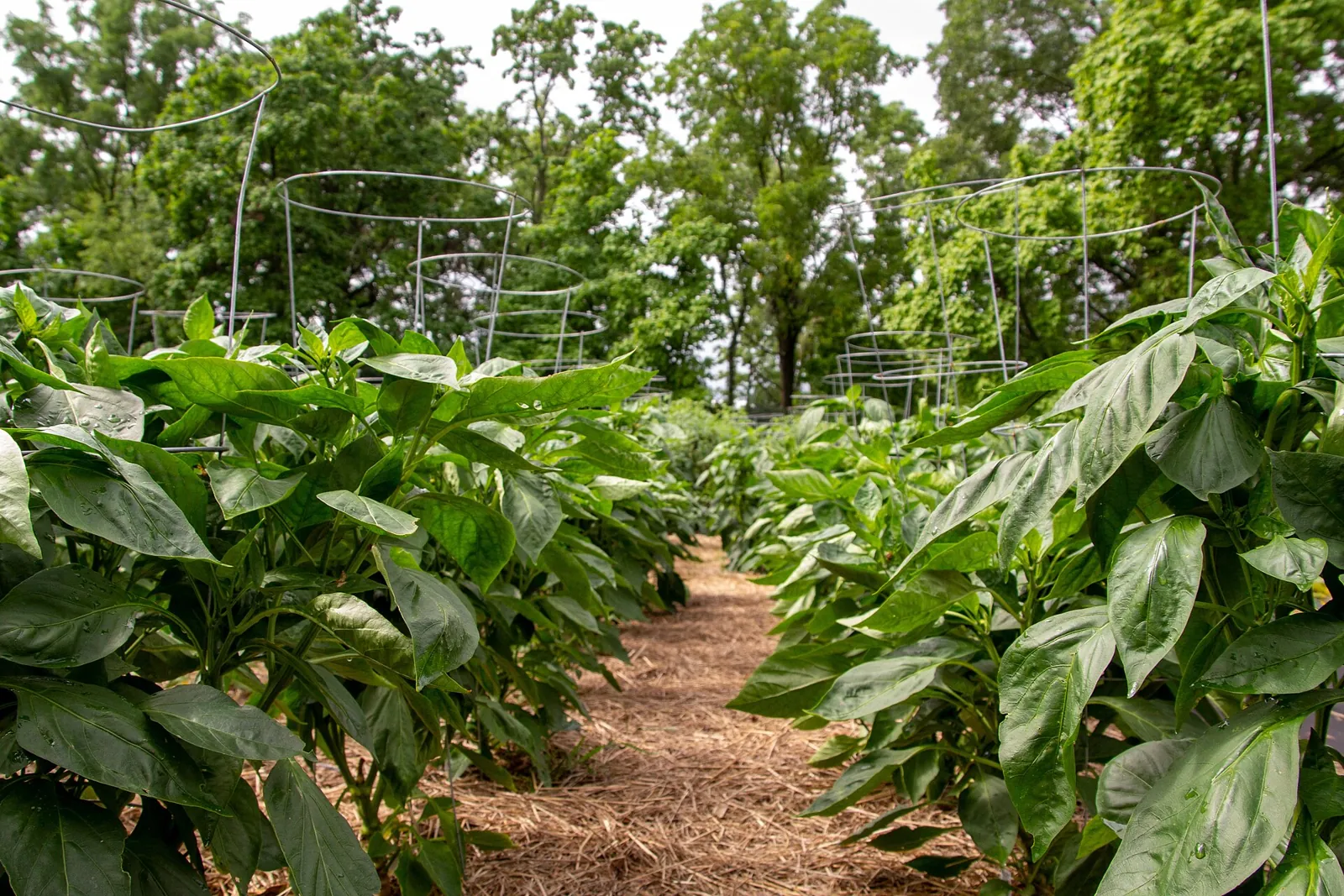
A vegetable garden of long planted rows in open ground, seen across the beds
Photo: Mary O'Neill · Public domain, via Wikimedia Commons.

Field, in-ground bed, raised bed, or container - which to choose

The four ways to hold a garden, what each one costs and buys, and how to pick the one that fits your yard, your soil, and how much work you want.

What you need

Before you plant anything you are choosing a container for it, even if the container is the open ground. There are four common ones, and the right choice is mostly a question about your soil and how much work you want to do up front.

The four, in one paragraph each

A field, or row garden is the oldest form: a large patch of the native soil, tilled and planted in rows with walking paths between them. It is the cheapest way to grow a lot, and the most space-hungry. It is the right call when you have room, decent soil already, and don't mind the tilling and weeding that come with it.

An in-ground bed is a defined bed worked into the native soil, planted densely with no lumber around it. It costs almost nothing and skips the wasted walkway space of rows. It works best when the soil you have is already good, because you are gardening in it directly.

A raised bed is a framed bed of imported soil sitting above the ground. It costs the most to set up and the frame and fill are real work, but it pays that back: the soil warms and drains faster in spring, you never step on it, and you can give it good soil even if the native ground is terrible. It is the standard answer for compacted, rocky, or poorly drained sites - and for backs that would rather not bend to the ground.

A container is any pot. It is the most portable and the lowest commitment, good for a patio, a balcony, a rental, or a first try. The trade is water: a pot dries out fast and needs watching.

Poor or wet soil points you to a raised bed

If the ground where you'd garden stays wet after rain, that is a problem to fix before you plant into it - and lifting the bed above the wet ground is one of the standard fixes:

Promising

Ground the gardener has observed to stand water after rain is a site problem to fix before planting, not a plant problem to select around.

costly if ignored → warn

Mechanism: Saturated soil has no air in it, so roots suffocate; and standing water lets Phytophthora release swimming zoospores, which need free water to reach a root or crown at all.

Evidence: confirmed against 5 sources in the research-based literature.

the 5 sources

UC Statewide IPM Program (UC IPM), 'Phytophthora Root and Crown Rot', Home and Landscape, ipm.ucanr.edu/home-and-landscape/phytophthora-root-and-crown-rot/ (fetched and read in-container 2026-07-25). The one written for gardens rather than orchards, and the source of this rule's scope: 'Almost all fruit and nut trees, as well as many ornamental trees and shrubs (including many California natives), can develop Phytophthora root or crown rot'; 'Tomatoes, peppers, eggplant and other vegetable plants can also be affected.' On the threshold: 'Phytophthora diseases can develop in as little to 4 to 8 hours of soil saturation.' On the remedy: 'Avoid prolonged saturation of the soil or standing water around the base of trees or other susceptible plants'; 'Raised beds can improve drainage in a vegetable garden'; 'Consider planting trees and shrubs on mounds. The mounds should be 8 to 10 inches high for annuals and up to 2 feet high with a gradual slope for trees and perennials.' And the warning the ruling_text repeats: 'Never cover the root crown or graft union with soil or mulch.'

UC IPM Pest Management Guidelines, 'Phytophthora Root and Crown Rot', PEACH, ipm.ucanr.edu/agriculture/peach/phytophthora-root-and-crown-rot/ (fetched and read in-container 2026-07-25): 'Periods of 24 hours or more of saturated soil favor Phytophthora infections. Conversely, good soil drainage and more frequent but shorter irrigations reduce the risk of root and crown rot.' 'The most effective ways to manage Phytophthora root and crown rot are to select a good planting site, select an appropriate rootstock, and properly manage irrigation water.' 'Planting on raised berms can also help with disease management.' NOTE THE THRESHOLD DISAGREES WITH THE HOME PAGE ABOVE - 24 hours here, 4 to 8 hours there. This rule quotes neither as a threshold and fires on the gardener's own observation of standing water instead, which is why the disagreement does not reach the ruling.

UC IPM Pest Management Guidelines, 'Phytophthora Root and Crown Rot', PLUM, ipm.ucanr.edu/agriculture/plum/phytophthora-root-and-crown-rot/ (fetched and read in-container 2026-07-25). Read specifically to test whether the corpus's four fruit trees differ, and they do: 'Plum rootstocks are less susceptible to Phytophthora infections than peach rootstocks, so plums grown on plum rootstock seldom have this disease'; 'In general, plum rootstocks are more resistant than are peach or apricot.' But also 'Rootstocks vary in susceptibility to the different Phytophthora species; none are resistant to all pathogenic species of the fungus.' THIS DIFFERENCE IS NOT MODELLED and the rule does not act on it: susceptibility here is a property of the ROOTSTOCK, which this corpus does not carry for plum, and 'less susceptible' is not 'safe in standing water' - the anoxia half of the mechanism does not care about rootstock at all. Recorded because it is the obvious next refinement and because a reader will otherwise wonder why plum is treated like peach.

WSU Hortsense, 'Raspberry: Phytophthora root rot', hortsense.cahnrs.wsu.edu/fact-sheet/raspberry-phytophthora-root-rot/ (fetched and read in-container 2026-07-25): 'Phytophthora root rot can be a problem in the Pacific Northwest when raspberries are planted in areas with poor drainage'; 'Do not plant in waterlogged, poorly drained, or frequently flooded areas'; 'Improve soil drainage by planting raspberries in raised beds (soil level at least 12 inches above the surrounding soil.)' The 12-inch figure in the ruling_text is this one. Also 'The fungus attacks the fine roots, which rot and die.'

Ohio State University Extension, 'Phytophthora Root and Crown Rot of Fruit Trees', Ohioline PLPATH-FRU-06, ohioline.osu.edu/factsheet/plpath-fru-06 (read 2026-07-26). PREVIOUSLY RECORDED HERE AS 403-ING FROM THIS CONTAINER AND CITED ONLY FROM A SEARCH SUMMARY; it was a 404, not a 403 - the URL carried in this pointer was wrong by one character (plpath-fru-6 for plpath-fru-06). The page fetches fine. THE MECHANISM SENTENCE THIS RULE NEEDED: 'Zoospores are released from sporangia only when soil is completely saturated with water (standing water).' That is the zoospore half of the mechanism stated outright, and it is also the justification for the TRIGGER: the rule fires on observed standing water because standing water is the condition the source names. AND IT RESOLVES THE THRESHOLD DISAGREEMENT rather than adjudicating it: 'The longer the period or periods of soil saturation, the greater the risk of infection.' Risk rises CONTINUOUSLY with duration, so UC IPM's 4-to-8 hours and 24 hours are not competing cut-offs but two points on a dose-response - there is no threshold to pick, and quoting neither was correct modelling rather than an evasion. On scope: 'In Ohio, apple, cherry, and peach trees are usually attacked'; 'Pear and plum trees appear to be relatively resistant'; 'Among stone fruits, plums are relatively resistant, whereas the remainder are susceptible to very susceptible'; 'Pears are the most resistant tree fruit crop'. This independently corroborates the UC IPM plum finding in the pointer above, from a second institution. STILL NOT MODELLED, for the same reason recorded there: the page ties resistance to ROOTSTOCK ('Among dwarfing-apple rootstocks, M-9, M-2, and M-4 are relatively resistant'; 'Mahaleb is the most susceptible cherry rootstock'), which this corpus does not carry, and the anoxia half of the mechanism does not care about rootstock at all. [read]

remedy

You told us this ground stands water after rain. Fix the site rather than the planting list: plant on a mound or berm, or build the bed up. UC IPM puts the mound at 8 to 10 inches for annuals and up to two feet, with a gradual slope, for trees and perennials; WSU asks for at least 12 inches for raspberries. Fruit trees and brambles have the most to lose, and tomatoes, peppers and eggplant are named as susceptible too. Never bury the root crown or graft union when you mound. We are not naming a drainage rate or a tile spacing - that is an engineering number and this is a garden app.

Read the full rule → · open in the planner ↗

A raised bed also lets you sidestep unknown or contaminated native soil entirely, since you fill it with soil you chose.

A container's one demand is water

The freedom of a pot comes with a cost the open ground doesn't charge:

Well established

A container dries out faster than the same plant in the ground, and it is the one place where a day's inattention can cost you the plant.

suboptimal if ignored → advise

Mechanism: A container holds a small fixed volume of soil, its whole root zone sits above ground rather than connected to the soil below, and a porous pot loses water from its sides as well as its surface. The reservoir is smaller and it empties faster.

Evidence: confirmed against 3 sources in the research-based literature.

the 3 sources

Clemson HGIC, 'Container Vegetable Gardening', hgic.clemson.edu/factsheet/container-vegetable-gardening (fetched in-container 2026-08-02, READ AND CONFIRMED BY THE MAINTAINER 2026-08-02): the mechanism and the outcome in one sentence - 'Because the volume of soil is relatively small, containers can dry out very quickly, especially on a concrete patio in full sun.' The second mechanism, which is why the remedy names pot material: 'Clay pots and other porous containers allow additional evaporation from the sides of the pots and watering must be done more often.' The cadence: 'Check containers at least once a day and twice on hot, dry or windy days', and 'Daily or even twice-daily watering may be necessary.' [read]

Univ. of Minnesota Extension, 'Fertilizing and watering container plants', extension.umn.edu/managing-soil-and-nutrients/fertilizing-and-watering-container-plants (fetched in-container 2026-08-02, READ AND CONFIRMED BY THE MAINTAINER 2026-08-02): corroborates the size-and-material dependency - 'Depending upon the size and material of the container, you may need to water more than once per day during hot, dry weather.' [read]

NOT CITED, AND RECORDED SO IT IS NOT RE-SOUGHT: a web search attributed the drying-rate claim to UMD Extension's 'Maintaining Container Grown Vegetables'. The page was opened and it makes NO comparison between containers and ground and offers NO mechanism - it says only that frequency 'will vary based on the plant type, the size of the plant, and size of the container'. This is the second misattributed quote in this arc (the first was a UC IPM page that did not contain the root-growth sentence credited to it). A quote is not a source until the page has been opened.

remedy

Check a container at least once a day, and twice when it is hot, dry or windy - in high summer it may genuinely need water more than once a day. A plastic pot holds moisture longer than an unglazed clay one, and a bigger pot longer than a small one.

Read the full rule → · open in the planner ↗

So containers reward big pots (they dry slower) and a habit of checking them daily in summer heat.

If you build a raised bed, build it to arm's reach

The one dimension that matters most on a raised bed is its width, and the reason is your arm: you should be able to tend the whole bed without stepping onto the soil and compacting it. That is why the classic raised bed is about four feet wide (reachable from both sides), or about half that against a wall. The planner enforces the same logic on any bed you draw:

Promising

A planted bed keeps every plant within arm's reach of a path, edge, or walkable row.

suboptimal if ignored → advise

Mechanism: A comfortable arm's reach is ~0.6 m (the same basis the draw-time reach nudge uses). Ground past that from any access line can only be tended by standing on the soil, compacting it. So a reach-from-edge bed wider than reach-from-both-sides (~1.2 m) is laid out as <=1.2 m planting strips separated by ~0.5 m paths; a field is worked from walkable rows ~0.75 m apart, not one solid block. Which model applies is read from the bed's declared structure: raised / in_ground / container are edge-reached (strips), field is walked (rows).

Evidence: confirmed against 4 sources in the research-based literature.

the 4 sources

Iowa State Univ. Extension, Yard & Garden FAQ, raised bed size (read 2026-07-21): 'Beds accessible on both sides can be 3 to 4 feet wide'; one-sided 'the maximum width should be 1 1/2 to 2 feet (i.e., approximately arm's reach)'; equipment pathways '~3' wide'.

Univ. of Minnesota Extension, Raised bed gardens (read 2026-07-21): 'the reach of your arm is generally a good metric ... If you can access both sides, the bed can be up to five feet wide.'

Field/row model: sweet-corn row spacing '30 to 36 inches ... so you can hoe, mulch, and harvest without breaking brace roots' (Univ. of Maryland / UMN / Illinois Extension, read 2026-07-21). Path 18-24 in foot-traffic minimum (garden extension consensus).

Container upper bound: the largest common vegetable container is a half-whiskey-barrel / 15-20 gal grow bag ~0.66 m across (Harvest to Table, harvesttotable.com, and the Old Farmer's Almanac container-size chart; read 2026-07-21). 75 cm is that with a small margin; past it the ground is a raised or in-ground bed.

Read the full rule → · open in the planner ↗

Keep the boards short enough not to bow, give the walkways between beds room for you and a wheelbarrow, and fill to the top - fresh soil settles in its first season.

Which one the planner assumes

When you place a bed in the planner, you tell it the structure - field, raised bed, in-ground, or container - and the rules adjust: a bed reserves its access paths, a field does not; a container is measured for what one pot can hold. The advice follows the ground you actually have, which is the whole point of choosing the ground first.

Sources for the technique on this page

Next in Start here → Plant your first bed, step by step

The rules this guide leans on:

All guides · Plan a bed