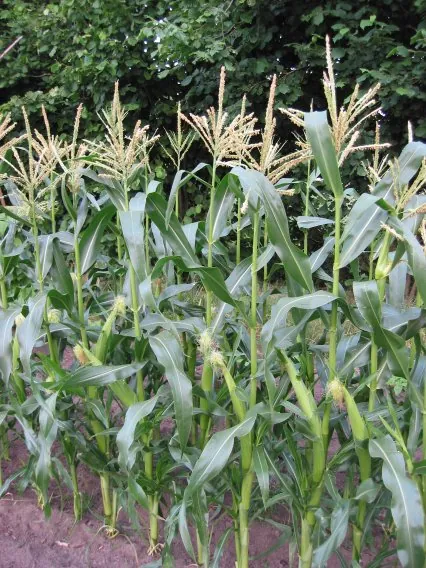
The same species behaves differently by cultivar group, so the planner resolves size, timing and support against the group rather than the species.
Sweet Corn — stalk, mature spread 45 cm18 in
Supersweet Corn — stalk, mature spread 45 cm18 in
Popcorn — stalk, spacing in row 20 cm8 in, mature spread 45 cm18 in, days to maturity 85–120
Ornamental Corn — stalk, mature spread 45 cm18 in
Which of these numbers are soft
Every number above carries a confidence tier. These are the ones the corpus does not stand behind — estimated from general knowledge, or contested between sources. They are shown because hiding them would be the dishonest half of showing the rest.
growing-degree days to maturity — estimated
how many vines it can carry — estimated
ph range — estimated
popcorn: days to maturity — estimated
popcorn: spacing in row — estimated
smallest block that pollinates — contested
Rules that apply to Corn
Well established
Corn requires a block of at least 4 rows (roughly 12 plants) for adequate kernel set.
fatal if ignored → block
Mechanism: Maize is wind-pollinated and protandrous. Tassels shed pollen that must land on silks of neighbouring plants. Below roughly 12 plants in a block of at least 4 rows, insufficient pollen reaches enough silks; each unfertilized silk is one missing kernel.
Evidence: confirmed against 4 sources in the research-based literature.
the 4 sources
UMN Extension, 'Growing sweet corn in home gardens', extension.umn.edu/vegetables/growing-sweet-corn (read 2026-07-11): 'Always plant corn in blocks of at least four rows. Corn planted in a single row will have much of its pollen blown out of the row, and will produce ears that have blank areas where kernels did not form.'
NC State Extension, 'Organic Sweet Corn Production' (Horticulture Information Leaflets), content.ces.ncsu.edu/organic-sweet-corn-production (read 2026-07-11): 'Corn is wind-pollinated and should be planted in blocks of at least 4 rows for good pollination to occur.'
UMD Extension, 'Growing Sweet Corn in a Home Garden', extension.umd.edu/resource/growing-sweet-corn-home-garden (read 2026-07-11): 'Plant in blocks of at least three to four short rows, rather than one or two long rows, to ensure good pollination; minimum of three rows side by side (preferably four rows).'
Clemson HGIC 1308, 'Sweet Corn' (updated 2023-01-23), hgic.clemson.edu/factsheet/sweet-corn (read 2026-07-11): 'This crop is wind-pollinated; therefore, plant in blocks of several rows rather than 1 or 2 long rows to ensure full ears.'
remedy
Plant in a block of at least 4 rows, or omit corn and substitute a trellis.
Two kinds of corn tasselling together spoil each other's kernels: sweet corn pollinated by popcorn, field or ornamental corn goes starchy, and supersweet pollinated by any other corn loses its sugar. Keep different corn types 250 feet apart or 14 days apart in tasselling.
costly if ignored → warn
Mechanism: Corn is wind-pollinated and the pollen parent sets the kernel's endosperm (xenia), so a sweet-corn ear fertilised by a starchy type stores starch, and a supersweet ear fertilised by any other type reverts to the toughness of field corn. Standard, sugary-enhanced and synergistic sweet corns need no isolation from each other.
Evidence: confirmed against 7 sources in the research-based literature.
the 7 sources
Iowa State Extension, 'Growing Sweet Corn in the Home Garden', yardandgarden.extension.iastate.edu/how-to/growing-sweet-corn-home-garden (fetched in-container 2026-09-02; read by the maintainer 2026-09-02): 'Sweet corn pollinated by popcorn will be tough and starchy'; 'Supersweet and augmented supersweet cultivars should be isolated from standard, sugary enhanced and synergistic sweet corn types'; 'Isolation can be achieved by planting different types at least 250 feet apart'; 'A minimum of 14 days should separate the tasseling time of different corn types.'
Iowa State Extension, 'Growing and Harvesting Ornamental Corn', yardandgarden.extension.iastate.edu/how-to/growing-and-harvesting-ornamental-corn (fetched in-container 2026-09-02; read by the maintainer 2026-09-02): 'Isolate ornamental corn from sweet corn and field corn to prevent cross-pollination. Isolation can be achieved by planting the different types of corn at least 250 feet from one another'; 'A minimum of 14 days should separate the tasseling times of the different types of corn.'
Illinois Extension, 'Corn' (Home Vegetable Gardening), extension.illinois.edu/gardening/corn (fetched in-container 2026-09-02; read by the maintainer 2026-09-02): 'Supersweets (Sh2) should be isolated from any other type of corn tasseling at the same time to ensure sweetness and tenderness'; 'Supersweet varieties pollinated by standard sweet corn, popcorn or field corn do not develop a high sugar content and are starchy'; 'Their pollen is weak and easily supplanted by other types, which causes the kernel to revert to a form with the toughness and starchiness of field corn.'
Utah State University Extension, 'Classes of Sweet Corn', extension.usu.edu/vegetableguide/sweet-corn/varietal-selection (fetched in-container 2026-09-02; read by the maintainer 2026-09-02): 'All sweet corn varieties should be isolated from field corn by 250 feet or 14 days' difference in pollen shed (tasselling dates)'; 'Isolate shrunken-2 varieties from standard and sugar enhanced types to minimize starchy kernels'; 'While isolation of sugar enhanced from standard types is not necessary, it does ensure full expression of the different sweetness characteristics.'
UMN Extension, 'Growing sweet corn in home gardens', extension.umn.edu/vegetables/growing-sweet-corn (fetched in-container 2026-09-02; read by the maintainer 2026-09-02): Shrunken (sh) 'Isolate from all other sweet corn types. Cross-pollination between Shrunken (sh) and any other types will result in starchy, tough kernels'; Sugary (su) 'Isolate from Shrunken (sh) and Synergistic (sy) types' - the stricter line, recorded and not enacted.
UMN Extension, 'Growing popcorn in home gardens', extension.umn.edu/vegetables/growing-popcorn (fetched in-container 2026-09-02; read by the maintainer 2026-09-02): 'Because popcorn takes a month or longer than sweet corn to mature, it is best to plant the popcorn first'; 'Wait three weeks before planting the sweet corn. The popcorn should produce tassels and silks before the sweet corn.'
NC State Extension, 'Organic Sweet Corn Production', content.ces.ncsu.edu/organic-sweet-corn-production (fetched in-container 2026-09-02; read by the maintainer 2026-09-02): 'If sweet corn is planted downwind of popcorn or field corn, kernels will be starchy instead of sweet.'
remedy
Grow one kind of corn per garden, or separate kinds by at least 250 feet, or stagger sowings so their tasselling is at least 14 days apart; popcorn takes a month longer, so sow it first.
Cold-hardy annuals can be sown or transplanted before the last spring frost — hardy crops about three weeks before, half-hardy about two weeks before. Tender crops wait for the frost itself.
suboptimal if ignored → advise
Mechanism: Cold hardiness. Hardy crops tolerate hard frost and half-hardy crops tolerate light frost, so they can occupy the ground weeks before frost-tender crops are allowed in. The offset is measured from the last spring frost.
Evidence: confirmed against 4 sources in the research-based literature.
the 4 sources
University of Illinois Extension, 'Time Your Vegetable Plantings by Cold Hardiness' (2018-03-26), extension.illinois.edu/blogs/ilriverhort/2018-03-26-time-your-vegetable-plantings-cold-hardiness: very hardy vegetables 'withstand freezing temperatures and hard frosts without injury' (planted earliest in spring); frost-tolerant vegetables 'can withstand light frosts, but not freezing temperatures' (planted a couple of weeks later). LLM-summarised from a read of the page; it establishes the CATEGORIES but states no week offsets.
Colorado State Univ. Extension, GardenNotes #720, 'Vegetable Planting Guide', extension.colostate.edu/resource/vegetable-planting-guide (read 2026-07-25): hardy vegetables go in 'As early as 2-4 weeks before the date of the average last spring frost'; semi-hardy 'As early as 0-2 weeks before the date of the average last spring frost'; tender from seed 'around the date of the average last spring frost'; very tender 'Typically 2+ weeks after'. This is the source that states the offsets in weeks.
Where this rule sits in that range: hardy at 3 weeks is mid-range of CSU's 2-4. Half-hardy at 2 weeks is the EARLIEST EDGE of CSU's 0-2 - the most aggressive planting CSU sanctions, not the middle of it. The rule is inside published guidance at both ends, but it leans early on the half-hardy side and a gardener following it in a cold spring is taking that boundary.
Do not import an offset from another publication's hardiness scheme without checking the category names: CSU has no 'very hardy' tier, so a '4-6 weeks before frost' figure written against a four-tier scheme does not describe CSU's 'hardy'. Categories are not comparable across sources.
Long-season warm crops are started indoors several weeks before the last frost and set out after it — tomato and tomatillo about six weeks ahead, pepper and eggplant about eight. Basil, six.
suboptimal if ignored → advise
Mechanism: A frost-tender crop with a long days-to-maturity cannot mature if it is only direct-sown after the last frost — the frost-free window is too short. A head start under cover buys the weeks the season lacks; the seedling is set out only once frost has passed — the transplant date is still frost-gated.
Evidence: confirmed against 2 sources in the research-based literature.
the 2 sources
University of Minnesota Extension, 'Starting seeds indoors', extension.umn.edu/planting-and-growing-guides/starting-seeds-indoors: seed-starting chart gives tomato '5-6 weeks' and pepper and eggplant '9 weeks' before the outdoor planting date (warm crops set out after the last frost). Read 2026-07-19 (LLM-summarised); read by the maintainer 2026-07-25, which is the read that promoted this rule. Note what the corpus's per-crop values do with the sources: tomato 6 sits at the top of Minnesota's '5-6 weeks' and inside Illinois's '6-8'; pepper and eggplant 8 sit BELOW Minnesota's '9 weeks' and at the top of Illinois's '6-8'. They are a reconciliation of two published ranges, not a figure either source prints.
Another 108 rules in the corpus apply by situation rather than by species — rotation intervals, frost windows, sun, spacing and soil. Read the full evidence page.
A garden-planning corpus: every claim states its evidence grade and links its sources on the page. Cite it with the grade, and add the date you read it.