Move crops by plant family so soil-borne pests and diseases can't settle in. What to rotate, how far apart, and what rotation can and can't do.
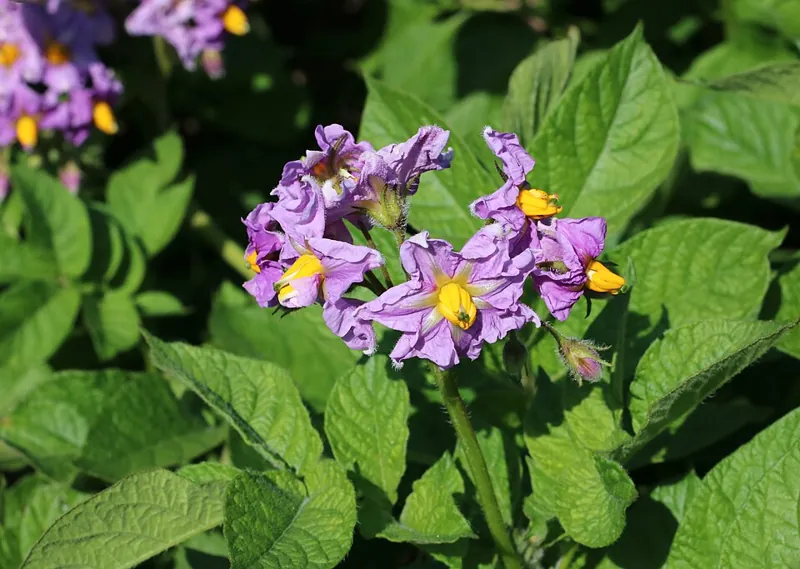
Grown for its tubers; the plant flowers above ground. Photo: George Chernilevsky · Public domain, via Wikimedia Commons.
What you need
A way to remember what grew where last year. The planner does this for you, or use a garden notebook.
Which plant family each of your crops belongs to (the short list is below)
Two or more places to grow, or one bed you can divide
Crop rotation means you don’t plant the same kind of vegetable in the same ground two years running. Why it matters is what decides how you do it.
Why does moving crops around stop disease?
A plant’s specialist pests and diseases build up in the ground it grows in. Rotate that plant away and its specialists lose their host and decline. Put a plant from a different family in its place and they have nothing to eat.
Soil-borne disease. Many fungi and bacteria overwinter in the soil and in last year’s plant debris, and each prefers certain plants. Growing the same crop in the same spot feeds them.
Insects and nematodes. Crops in the same family share pests. Moving the crop breaks the pest’s life cycle before it can settle.
Nutrients. Different crops draw a different mix of nutrients at a different pace, and legumes hand nitrogen back to the ground for whatever follows them.
The planner tracks the first of these for you, precisely, by family.
Don't plant nightshades where nightshades grew in the last 3 years
If you skip this, you lose real yield. The planner warns you.
How it works: Alternaria solani (early blight) and Septoria lycopersici overwinter on tomato debris and solanaceous weeds; a 2-3 year break plus debris removal starves this inoculum. Fusarium has a very narrow host range, so rotating away from the host is effective. Verticillium is the exception. Its microsclerotia persist ~10 years and it infects 300+ host families, so a garden-scale rotation does not control it.
Evidence: checked against 5 sources in the research-based literature.
Verticillium wilt tends to affect a wide range of hosts and can infect many unrelated plants. Fusarium spp., on the other hand, have very narrow host ranges.
Remedy
Plant nightshades in different ground, or wait until 3 years have passed since this ground last held them. Clear and remove the old debris either way, because the inoculum overwinters on it.
If you skip this, you lose real yield. The planner warns you.
How it works: Melittia cucurbitae overwinters as a pupa in the soil where its host grew and emerges the next summer; Anasa tristis overwinters as an adult in sheltered sites (plant debris, under boards or rocks) and flies to cucurbits in spring. A host-free break cuts local carryover, but both are strong fliers that re-invade from a distance, so rotation is only partial and works best paired with fall sanitation (destroy spent vines).
Evidence: checked against 4 sources in the research-based literature.
… squash vine borers spend the winter in the soil near their host plants ... Practice rotation ... planting cucurbits in different areas of your garden if possible, or alternate seasons
Crop rotation away from previously infested fields helps reduce local populations, as overwintering pupae remain in the soil. However ... fields often need to be rotated more than 5 miles away as SVB can fly into fields from long distances.
Squash bugs can live through the winter as adults in sheltered places, such as under plant debris, around buildings, or under rocks. When adults come out in the spring, they fly to growing cucurbit plants.
Plant cucurbits in different ground, or wait 3 years. Destroy the spent vines in autumn and clear debris and boards nearby. The pupae overwinter in the soil where the crop grew, the adults in the shelter around it. Rotation is only partial; both pests fly in from a distance.
If you skip this, you lose real yield. The planner warns you.
How it works: Plasmodiophora brassicae forms thick-walled resting spores that survive in soil more than 10 years. They germinate in wet, acidic soil (pH < 7); liming above ~7.2 suppresses infection. Spores outlast any garden rotation, so a host-free break reduces but does not clear inoculum.
Evidence: checked against 3 sources in the research-based literature.
Plant brassicas in different ground, or wait at least 4 years (extension recommends 4 to 7). Rotation alone is not a cure, because the resting spores outlast it. Raising soil pH above ~7.2 suppresses infection.
Alliums (onion, garlic) and the carrot family are unrelated to those three, so they can sit between them in a rotation. They still need their own rotation too.
Alliums and carrot family are unrelated to nightshades/cucurbits/brassicas and can break those families' rotation cycles. They are still not "low-pressure" and need their own rotation.
If you skip this, it still grows, just less well. The planner suggests it.
How it works: They host none of the big-three families' soilborne pathogens, so following those crops with an allium or apiaceous crop breaks the host cycle. They are not inherently low-pressure, though. Allium white rot (Sclerotium cepivorum) is allium-specific, its sclerotia persist 15+ years, and it cannot be eradicated once established; apiaceous crops carry their own soilborne diseases.
Evidence: checked against 1 source in the research-based literature.
Do I rotate by the exact vegetable, or by its family?
A tomato and a potato are sold under different names, but they are both Solanaceae, and a disease of one is a disease of the other. So you rotate whole families. These are the ones to track in a vegetable garden:
Carrot family (Apiaceae): carrot, parsnip, celery, parsley, dill
The standard advice is to grow a family in the same ground at most once every three years, and four to five years is better for the pests that are slow to fade. That interval is a rule of thumb. What the planner enforces is the corpus’s own rotation windows above, family by family.
Where does a mixed planting like the Three Sisters fit?
If you plant a team of crops together, such as a Three Sisters bed or a salsa garden, every family in it sets the rotation clock, across the whole area it covered.
For rotation, a plant team's crop families count across its whole bed
If you skip this, you lose real yield. The planner warns you.
How it works: Soilborne inoculum and overwintering pest stages disperse across the bed. A plant team dominated by one family forecloses that ground for that family's rotation interval.
Evidence: checked against 2 sources in the research-based literature.
Remedy
Rotate the whole bed the plant team occupied, including rows that family never grew in.
This is why rotation history in this planner attaches to the ground. When you rearrange the yard, the record of what grew where survives, because it was never pinned to a bed that no longer exists.
What problems will rotation not solve for me?
Rotation only helps against pests that stay in the soil where you left them. It does little against insects that fly in from a neighbor’s garden, against spores that blow on the wind, or against the broad-appetite diseases that attack hundreds of unrelated plants. Southern blight, for instance, hits more than 500 species across many families. No rotation partner is safe from it, though a grass like sweet corn is a better bet than another broadleaf crop.
So rotate for the pests it works on. For the ones it doesn’t, lean on resistant varieties, clean debris removal, good spacing and airflow. Rotation is one lever among several.
Does any of this matter if I only have one raised bed?
Yes. The pathogens live in the soil, so a raised bed needs rotating exactly as the open ground does. Digging out and replacing the soil every year is the expensive way to do what rotation does for free. There is a guide to that question of its own; this one is the why behind it.
Further reading
Good places to read more about the technique on this page. The grade on each card comes from that card’s own sources.