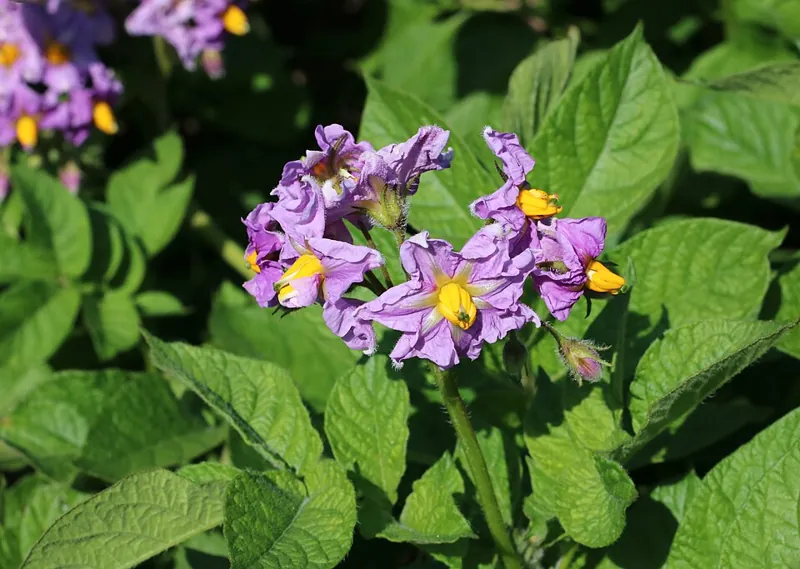
The same species behaves differently by cultivar group, so the planner resolves size, timing and support against the group rather than the species.
First Early Potato (New Potatoes) — bush, spacing in row 30 cm12 in, mature height 40–50 cm16–20 in, mature spread 40–50 cm16–20 in, days to maturity 70–90
Second Early Potato — bush, spacing in row 35 cm14 in, mature height 45–55 cm18–22 in, mature spread 45–55 cm18–22 in, days to maturity 90–110
Maincrop Potato (Storage) — bush, spacing in row 38 cm15 in, mature height 50–60 cm20–24 in, mature spread 50–60 cm20–24 in, days to maturity 110–135
Which of these numbers are soft
Every number above carries a confidence tier. These are the ones the corpus does not stand behind — estimated from general knowledge, or contested between sources. They are shown because hiding them would be the dishonest half of showing the rest.
ph range — estimated
first early: mature height — estimated
first early: mature spread — estimated
first early: days to maturity — estimated
second early: mature height — estimated
second early: mature spread — estimated
second early: days to maturity — estimated
maincrop: mature height — estimated
maincrop: mature spread — estimated
maincrop: days to maturity — estimated
Rules that apply to Potato
Promising
Do not plant nightshades in ground that held nightshades within 3 years.
costly if ignored → warn
Mechanism: Alternaria solani (early blight) and Septoria lycopersici overwinter on tomato debris and solanaceous weeds; a 2-3 year break plus debris removal starves this inoculum. Fusarium has a very narrow host range, so rotating away from the host is effective. Verticillium is the exception: microsclerotia persist ~10 years and it infects 300+ host families, so a garden-scale rotation does not control it.
Evidence: confirmed against 5 sources in the research-based literature.
the 5 sources
Clemson HGIC, 'Tomato Diseases & Disorders', hgic.clemson.edu/factsheet/tomato-diseases-disorders (read 2026-07-11): 'tomatoes and related vegetables, such as potatoes, peppers, and eggplants, should not be planted on the same land more than once in three years.'
NC State Extension, 'Septoria Leaf Spot of Tomato', content.ces.ncsu.edu/septoria-leaf-spot-of-tomato (read 2026-07-11): 'The fungus is known to overwinter on infected tomato debris and solanaceous weed hosts'; 'Rotate away from tomato for 2 or more years.'
NC State Extension, 'Verticillium Wilt of Tomato and Eggplant', content.ces.ncsu.edu/verticillium-wilt-of-tomato-and-eggplant (read 2026-07-11): 'The pathogen can survive in the soil without a host for up to 10 years in the form of structures called microsclerotia'; 'affects more than 300 host families.'
Plant nightshades in different ground, or wait until 3 years have passed since this ground last held them. Clear and remove the old debris either way — the inoculum overwinters on it.
Do not plant a juglone-sensitive species within the root zone of Juglans. The sensitive list is the hazard's own, and it is wider than the nightshades - it also carries apple and cabbage.
fatal if ignored → block
Mechanism: Juglans roots exude hydrojuglone, oxidized to juglone, a respiration inhibitor. nightshades are highly sensitive: wilt and death.
Evidence: confirmed against 2 sources in the research-based literature.
the 2 sources
UW-Madison / Wisconsin Horticulture (Joy, Hudelson & Jull, rev. 2024-02-28), 'Black Walnut Toxicity', hort.extension.wisc.edu/articles/black-walnut-toxicity (read 2026-07-13): 'Vegetables such as tomato, potato, eggplant and pepper ... are particularly sensitive to juglone'; 'The toxic effects of a mature black walnut tree can extend 50 to 80 feet from the trunk of the tree, with the greatest toxicity occurring within the tree's dripline.'
Iowa State Univ. Extension & Outreach, Yard and Garden FAQ, 'What plants are sensitive to the juglone produced by black walnuts?', yardandgarden.extension.iastate.edu (read 2026-07-13): juglone-sensitive plants include 'members of the tomato family (tomato, potato, eggplant, pepper).'
remedy
Plant it outside the walnut's root zone — the whole drip line and beyond. There is no soil treatment for juglone.
Limed ground is the wrong ground for the next potato crop: common scab worsens as soil pH rises, and lime raises it.
suboptimal if ignored → advise
Mechanism: Common scab (Streptomyces scabies) infects young tubers through the lenticels and is favoured as soil goes less acid; at about pH 5.2 and below it is largely suppressed. Lime raises pH and its effect lasts years, so ground limed for a crop that wants sweet soil carries a scab-prone pH into the seasons that follow.
Evidence: confirmed against 5 sources in the research-based literature.
the 5 sources
UMass Extension, 'Potato, Scab', umass.edu/agriculture-food-environment/vegetable/fact-sheets/potato-scab (fetched in-container 2026-09-02; read by the maintainer 2026-09-02): 'Common scab is controlled or greatly suppressed at soil pH levels of 5.2 or lower'; 'Avoid application of soil amendments that increase soil pH'; 'Increase rotation with nonhost crops to 3-4 years'; 'Maintain adequate soil moisture during and after tuber set.'
Wisconsin Horticulture Extension, 'Potato Scab', hort.extension.wisc.edu/articles/potato-scab (fetched in-container 2026-09-02; read by the maintainer 2026-09-02): 'Scab tends not to develop when the soil pH is less than 5.2'; 'For home gardens, keeping the soil pH at approximately 6.5 is a good compromise'; 'Avoid using fertilizers (e.g., lime, calcium and potassium nitrate, or fresh manure) that may increase soil pH'; the disease 'can also affect other root vegetables such as beets, carrots, parsnip, radish, rutabaga, salsify and turnip.'
Clemson HGIC, 'Irish Potato & Sweetpotato Diseases', hgic.clemson.edu/factsheet/irish-sweet-potato-diseases (fetched in-container 2026-09-02; read by the maintainer 2026-09-02), common scab: 'Soil pH should be between 5.0 and 5.2'; 'avoid alkaline materials, especially lime and wood ashes, but also avoid mushroom compost and leaf compost. All of these will raise the soil pH'; 'Scab is favored under low soil moisture conditions, so the garden soil must be kept moist during the active growing period of the tubers (particularly 4 to 9 weeks after planting)'; 'Do not plant Irish potatoes after beets, carrots, radishes, parsnips, rutabagas, or turnips, which are also susceptible to scab.'
Univ. of Maryland Extension, 'Common Scab of Vegetables', extension.umd.edu/resource/common-scab-vegetables, and 'Growing Potatoes in a Home Garden', extension.umd.edu/resource/growing-potatoes-home-garden (both fetched in-container 2026-09-02; read by the maintainer 2026-09-02): 'The disease is encouraged by soil pH above 5.5'; 'Where potato scab disease is a persistent problem, a soil pH of 4.8 to 5.8 is recommended'; 'It can also be a problem of beets, carrots, parsnips, turnips, and radish.'
Univ. of Maine Cooperative Extension, Bulletin 2077, 'Potato Facts: Growing Potatoes in the Home Garden', extension.umaine.edu/publications/2077e (fetched in-container 2026-09-02; read by the maintainer 2026-09-02): 'a soil pH of 5.3 to 6.0 is typical for potato production'; 'higher soil pH levels are more conducive to scab, a potato disease caused by a soil-borne pathogen'; 'Lime will also raise the pH of soil. A soil test will tell you how much lime to add.'
remedy
This ground has been limed, and potatoes want it sour. Scab is skin-deep - the tubers still eat - but where it has been a problem, put the potatoes on ground you have not limed, choose a scab-resistant variety, keep the soil evenly moist for the four to nine weeks after planting while the tubers set, and never lime or add wood ash where potatoes are going next. A later pH reading at or below about 5.2 on this ground would quiet this. We will not give a sulfur rate to get there: the amount needs your lab's buffer pH.
Late blight comes back from last year's potatoes, not from the soil: tubers left in the ground carry it through winter as volunteers, so ground that grew potatoes last season needs its volunteers pulled before this year's tomatoes or potatoes go in.
suboptimal if ignored → advise
Mechanism: Phytophthora infestans needs living tissue to overwinter. Infected tubers left in the ground, in a compost heap that does not freeze, or in a cull pile survive and sprout as volunteers that carry the blight into the new season; tomatoes do not carry it, because frost kills the whole plant and the seed is clean.
Evidence: confirmed against 2 sources in the research-based literature.
the 2 sources
UMass Extension, 'Late Blight Management for Fall, Winter and Spring', umass.edu/agriculture-food-environment/home-lawn-garden/fact-sheets/late-blight-management-for-fall-winter-spring (fetched in-container 2026-09-02; read by the maintainer 2026-09-02): 'Potato tubers that are infected with late blight and don't freeze or decay during the winter can carry the pathogen over the winter to next spring' - 'Left in the ground at harvest, down several inches in the soil'; 'Disposed of in a compost pile that does not fully decompose and does not freeze'; 'Tomatoes will not carry late blight over the winter, because freezing kills the whole plant'; 'Tomato seed, even from fruit that was infected with late blight, will not carry the pathogen'; 'In the spring (April - June), inspect last year's potato plot and any compost or cull piles for volunteer potato plants that might come up. If you find potato plants, pull them out and put them in the trash or destroy them.'
UMN Extension, 'Late blight of tomato and potato', extension.umn.edu/disease-management/late-blight (fetched in-container 2026-09-02; read by the maintainer 2026-09-02): 'P. infestans can overwinter in Minnesota if protected in potato cull piles'; 'The host range is typically limited to potato and tomato, but hairy nightshade (Solanum physalifolium) is a closely related weed that can readily become infected'; 'Control volunteer potato plants, as infected plants can grow from infected tubers.'
remedy
From April to June, walk last year's potato ground and any compost or cull pile, pull every volunteer potato and put it in the bin, not the compost. Then plant.
A specialist pest or pathogen finds and builds on a continuous single-family host patch more readily than one broken by non-host families.
suboptimal if ignored → advise
Mechanism: Resource concentration - a specialist locates and holds its host more efficiently at higher host density and continuity, so an unbroken run of one family across adjacent beds is an easier target than the same family separated by a non-host (associational resistance).
Evidence: confirmed against 2 sources in the research-based literature.
the 2 sources
Root 1973, 'Organization of a plant-arthropod association in simple and diverse habitats: the fauna of collards (Brassica oleracea)', Ecological Monographs 43:95-124 (abstract read by the maintainer 2026-08-21): proposes 'the resource concentration hypothesis, which states that herbivores are more likely to find and remain on hosts that are growing in dense or nearly pure stands; that the most specialized species frequently attain higher relative densities in simple environments.' This is another rule here's claim and mechanism verbatim.
Elmstrom, Andow & Barclay 1988, 'Flea beetle movement in a broccoli monoculture and diculture', Environmental Entomology 17(2):299-305 (read by the maintainer 2026-08-21): the empirical test on a brassica specialist (the flea beetle Phyllotreta cruciferae) - immigration ~1.3x faster into monocultures than into dicultures, emigration ~2x faster from dicultures - reported as 'strong, direct support for the hypothesis that host plants are harder to find and easier to lose in vegetationally diverse habitats than in monocultures.'
remedy
Where one family fills adjacent beds in a single season, breaking the run with a non-host family between them lengthens the distance the specialist must travel to the next host. Disclosed, never docked: a continuous single-family block can be the right call anyway - a wind-pollinated crop like corn sets better massed - so the app names the trade-off and leaves the choice to the gardener.
Cold-hardy annuals can be sown or transplanted before the last spring frost — hardy crops about three weeks before, half-hardy about two weeks before. Tender crops wait for the frost itself.
suboptimal if ignored → advise
Mechanism: Cold hardiness. Hardy crops tolerate hard frost and half-hardy crops tolerate light frost, so they can occupy the ground weeks before frost-tender crops are allowed in. The offset is measured from the last spring frost.
Evidence: confirmed against 4 sources in the research-based literature.
the 4 sources
University of Illinois Extension, 'Time Your Vegetable Plantings by Cold Hardiness' (2018-03-26), extension.illinois.edu/blogs/ilriverhort/2018-03-26-time-your-vegetable-plantings-cold-hardiness: very hardy vegetables 'withstand freezing temperatures and hard frosts without injury' (planted earliest in spring); frost-tolerant vegetables 'can withstand light frosts, but not freezing temperatures' (planted a couple of weeks later). LLM-summarised from a read of the page; it establishes the CATEGORIES but states no week offsets.
Colorado State Univ. Extension, GardenNotes #720, 'Vegetable Planting Guide', extension.colostate.edu/resource/vegetable-planting-guide (read 2026-07-25): hardy vegetables go in 'As early as 2-4 weeks before the date of the average last spring frost'; semi-hardy 'As early as 0-2 weeks before the date of the average last spring frost'; tender from seed 'around the date of the average last spring frost'; very tender 'Typically 2+ weeks after'. This is the source that states the offsets in weeks.
Where this rule sits in that range: hardy at 3 weeks is mid-range of CSU's 2-4. Half-hardy at 2 weeks is the EARLIEST EDGE of CSU's 0-2 - the most aggressive planting CSU sanctions, not the middle of it. The rule is inside published guidance at both ends, but it leans early on the half-hardy side and a gardener following it in a cold spring is taking that boundary.
Do not import an offset from another publication's hardiness scheme without checking the category names: CSU has no 'very hardy' tier, so a '4-6 weeks before frost' figure written against a four-tier scheme does not describe CSU's 'hardy'. Categories are not comparable across sources.
Potato tubers that catch light while growing - wherever soil settles or washes away and shallow tubers are left uncovered - turn green and become bitter and toxic, so the crop must be kept covered with soil rather than left exposed at the surface.
suboptimal if ignored → advise
Mechanism: Tuber tissue exposed to light produces chlorophyll and, in that same tissue, synthesises the toxic glycoalkaloids solanine and chaconine, so soil mounded over the developing tubers keeps light off them and prevents both the greening and the toxin from forming.
Evidence: confirmed against 2 sources in the research-based literature.
the 2 sources
Penn State Extension, 'Potatoes in the Garden and the Kitchen', extension.psu.edu/potatoes-in-the-garden-and-the-kitchen (read 2026-08-21): 'Tubers exposed to sunlight (both before and after harvest) will turn green and should not be eaten'; 'Sun exposure causes the potato''s skin to produce chlorophyll and, along with it, two toxic compounds, solanine and chaconine. These cause the potato to have a bitter taste ...'; 'When the plant stems are 8 to 12 inches tall, gently hill or mound the soil around the base of the plant, covering most of the stem. You may repeat this mounding practice two or three times as the plants grow.'
UMN Extension, 'Growing potatoes in home gardens', extension.umn.edu/vegetables/growing-potatoes (read 2026-08-21): 'Green skin occurs when potato tubers experience exposure to light'; 'Hilling also keeps any shallow tubers from exposure to light and turning green.'
remedy
Hill the crop: once the stems are roughly 8-12 inches (20-30 cm) tall, draw loose soil up around the base of the plants to cover most of the stem and bury any shallow tubers, and repeat two or three times through the season so the tubers stay covered. Green tubers are bitter and should not be eaten; the green signals the toxin is present and is not reliably removed by peeling, so the defence is to keep light off the tubers in the first place - in the ground, and again in dark storage.
Potatoes are grown from certified seed potatoes - disease-free seed tubers from a certified source - not from saved tubers or grocery-store potatoes. Large seed tubers are cut into blocky pieces, each with at least one eye, and the cut surfaces left to dry to a tough protective skin before planting. Grocery-store potatoes may be treated to stay dormant and can carry disease that persists in the soil.
suboptimal if ignored → advise
Mechanism: Potato is propagated vegetatively - the crop grows from a piece of tuber, not from true seed - so any virus or disease in the seed tuber is passed straight to the new plants and can remain in the soil for years; certified seed is inspected, disease-free stock, which is why saving one's own tubers or planting grocery potatoes risks introducing disease. Each planted piece must carry an eye, the bud the new shoot grows from. A freshly cut piece exposes moist flesh that storage and soil rots colonise; holding the cut pieces a few days until the surface dries and forms a corky protective layer (suberises) seals that wound before planting. Grocery tubers may additionally be treated with a sprout inhibitor, so they are slow to grow.
Evidence: confirmed against 2 sources in the research-based literature.
the 2 sources
UMN Extension, 'Growing potatoes in home gardens', extension.umn.edu/vegetables/growing-potatoes (read 2026-08-22): 'Buy disease-free seed tubers from a certified grower or seed distributor'; 'Every piece must have at least one "eye," an indentation that will produce the new shoot'; 'Place the cut pieces on a tray at room temperature (between 60 F and 70 F) for a few days until the cut surface has dried out and formed a tough protective layer'; 'Do not plant potatoes purchased at the grocery store, as the store may treat them with chemicals to keep tubers dormant, in which case they will be slow to grow. Diseases may also infect the potatoes, which can remain in the soil for a long time.'
Utah State Univ. Extension, 'How to Grow Potatoes in Your Garden', extension.usu.edu/yardandgarden/research/potatoes-in-the-garden (read 2026-08-22): 'When buying seed tubers, ask for certified seed as this will help reduce the potential for introducing disease into the garden'; 'When cutting, make sure the seed piece weighs at least 2 ounces and has one or more "eyes"'; 'saving your own seed potatoes leads to a buildup of viruses and diseases that eventually will cause serious problems in the garden. Whenever possible, purchase and plant certified seed to help control many of the problem diseases potatoes experience.'
remedy
Buy certified seed potatoes. Cut large ones into blocky pieces of about two ounces, each with at least one or two eyes; leave small tubers whole. Spread the cut pieces at room temperature (about 60-70 F) for a few days until the cut surface has dried and formed a tough skin, then plant. Do not plant grocery-store potatoes (possible sprout inhibitor, and disease that lingers in the soil) and do not replant your own saved tubers year to year (virus and disease build up).
Another 105 rules in the corpus apply by situation rather than by species — rotation intervals, frost windows, sun, spacing and soil. Read the full evidence page.
A garden-planning corpus: every claim states its evidence grade and links its sources on the page. Cite it with the grade, and add the date you read it.