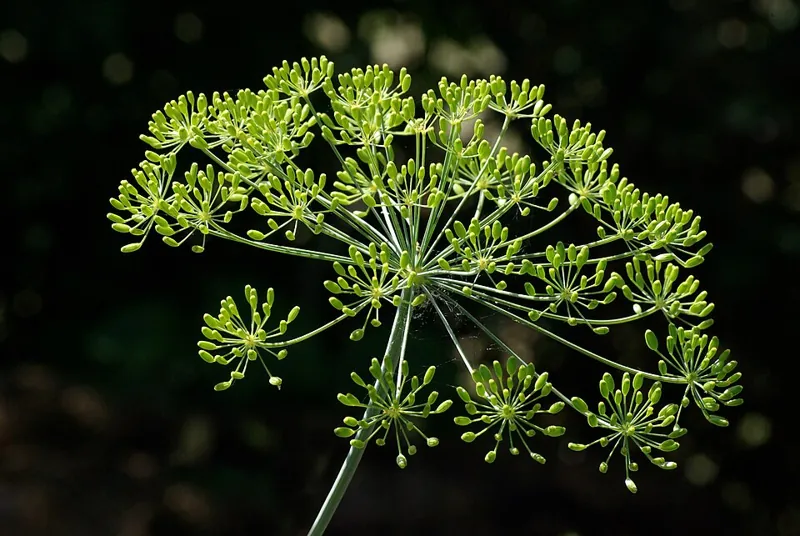
Dill (Anethum graveolens) is an annual in the carrot family.
Every number above carries a confidence tier. These are the ones the corpus does not stand behind — estimated from general knowledge, or contested between sources. They are shown because hiding them would be the dishonest half of showing the rest.
A good hunchAlliums and carrot family are unrelated to nightshades/cucurbits/brassicas and can break those families' rotation cycles — but they are not "low-pressure" and need their own rotation.
suboptimal if ignored → advise
Mechanism: They host none of the big-three families' soilborne pathogens, so following those crops with an allium or apiaceous crop breaks the host cycle. But they are not inherently low-pressure: allium white rot (Sclerotium cepivorum) is allium-specific, its sclerotia persist 15+ years, and it cannot be eradicated once established; apiaceous crops carry their own soilborne diseases.
Evidence: confirmed against 1 source in the research-based literature.
the source
UMass Extension, 'Alliums, White Rot', ag.umass.edu/vegetable/fact-sheets/alliums-white-rot (read 2026-07-11): 'Sclerotium cepivorum is specific to allium species'; sclerotia 'may remain viable in soil for 15 years or more without allium hosts'; 'Currently, there is no way to eradicate white rot from a field where it has become established.'
Read the full rule → · open in the planner ↗
PromisingDo not plant the carrot family in ground that held it within 3 years.
costly if ignored → warn
Mechanism: The carrot leaf blights (Alternaria dauci, Cercospora carotae and the bacterial blight) and celery's Septoria late blight survive on crop debris and die as it decomposes; a break of two to three years starves them. Alternaria radicina, the black-rot species, infects celery, celeriac, dill, fennel, parsley and parsnip as well, and can persist in soil for up to eight years, which is why the family rotates as one.
Evidence: confirmed against 5 sources in the research-based literature.
the 5 sources
UMass Extension, 'Carrot, Alternaria Leaf Blight', umass.edu/agriculture-food-environment/vegetable/fact-sheets/carrot-alternaria-leaf-blight (fetched in-container 2026-09-02; read by the maintainer 2026-09-02): 'Practice relatively long rotations of 3-4 years'; 'A. radicina infects celery, celeriac, caraway, dill, fennel, parsley, and parsnips'; 'The fungus survives in the soil on crop debris but dies when the residue decomposes'; A. radicina 'can persist in soil for up to 8 years.'
Cornell Vegetables, 'Carrot Leaf Blight Diseases and their Management', vegetables.cornell.edu/pest-management/disease-factsheets/carrot-leaf-blight-diseases-and-their-management (fetched in-container 2026-09-02; read by the maintainer 2026-09-02): 'it is important to practice a minimum of a 2-year rotation out of carrots to allow time for decomposition of crop residue'; 'All three pathogens can be transmitted through infected or contaminated seeds and can survive on crop residue, which can act as a source of inoculum in subsequent cropping years.'
Cornell Vegetables, 'Do Rotations Matter within Disease Management Programs?', vegetables.cornell.edu/pest-management/disease-factsheets/do-rotations-matter-within-disease-management-programs (fetched in-container 2026-09-02; read by the maintainer 2026-09-02): its rotation table gives carrot leaf blights (fungal and bacterial) 2-3 years and celery leaf blights 2 years.
UMass Vegetable Notes 2025 vol. 37:13, Septoria late blight of celery, umass.edu/agriculture-food-environment/vegetable/newsletters/vegetable-notes/vegetable-notes-2025-vol-3713 (fetched in-container 2026-09-02; read by the maintainer 2026-09-02): 'The pathogen survives in crop debris in soil for up to 18 months, or outbreaks may originate from seed-borne inoculum.'
Clemson HGIC, 'Crop Rotation', hgic.clemson.edu/factsheet/crop-rotation (fetched in-container 2026-09-02; read by the maintainer 2026-09-02): 'a crop should only be grown in the same spot a maximum of once every three years'; its family table puts carrot, parsley, celery, cilantro, fennel and dill in the parsley family (Apiaceae).
remedy
Plant carrot-family crops in different ground, or wait until 3 years have passed since this ground last held them. Clear and turn in the old tops promptly either way, and buy clean seed: all three carrot blights ride on seed.
Read the full rule → · open in the planner ↗
PromisingCold-hardy annuals can be sown or transplanted before the last spring frost — hardy crops about three weeks before, half-hardy about two weeks before. Tender crops wait for the frost itself.
suboptimal if ignored → advise
Mechanism: Cold hardiness. Hardy crops tolerate hard frost and half-hardy crops tolerate light frost, so they can occupy the ground weeks before frost-tender crops are allowed in. The offset is measured from the last spring frost.
Evidence: confirmed against 4 sources in the research-based literature.
the 4 sources
University of Illinois Extension, 'Time Your Vegetable Plantings by Cold Hardiness' (2018-03-26), extension.illinois.edu/blogs/ilriverhort/2018-03-26-time-your-vegetable-plantings-cold-hardiness: very hardy vegetables 'withstand freezing temperatures and hard frosts without injury' (planted earliest in spring); frost-tolerant vegetables 'can withstand light frosts, but not freezing temperatures' (planted a couple of weeks later). LLM-summarised from a read of the page; it establishes the CATEGORIES but states no week offsets.
Colorado State Univ. Extension, GardenNotes #720, 'Vegetable Planting Guide', extension.colostate.edu/resource/vegetable-planting-guide (read 2026-07-25): hardy vegetables go in 'As early as 2-4 weeks before the date of the average last spring frost'; semi-hardy 'As early as 0-2 weeks before the date of the average last spring frost'; tender from seed 'around the date of the average last spring frost'; very tender 'Typically 2+ weeks after'. This is the source that states the offsets in weeks.
Where this rule sits in that range: hardy at 3 weeks is mid-range of CSU's 2-4. Half-hardy at 2 weeks is the EARLIEST EDGE of CSU's 0-2 - the most aggressive planting CSU sanctions, not the middle of it. The rule is inside published guidance at both ends, but it leans early on the half-hardy side and a gardener following it in a cold spring is taking that boundary.
Do not import an offset from another publication's hardiness scheme without checking the category names: CSU has no 'very hardy' tier, so a '4-6 weeks before frost' figure written against a four-tier scheme does not describe CSU's 'hardy'. Categories are not comparable across sources.
Read the full rule → · open in the planner ↗
Another 110 rules in the corpus apply by situation rather than by species — rotation intervals, frost windows, sun, spacing and soil. Read the full evidence page.