Milpa Gardens
iniciar sesión

Traducción automática · Leer en inglés

Eneldo

Dill · Anethum graveolens · familia de las apiáceas · USDA PLANTS: ANGR2

De un vistazo

Luz
Pleno sol
Helada
Aguanta algo de frío
Distancia
25 cm10 in
Días a la cosecha
60–90
En esta página

Las reglas y las notas de cosecha de esta página están traducidas automáticamente del inglés; sus fuentes, algunas notas y los títulos de las guías siguen en inglés.

Eneldo (Anethum graveolens) es una planta anual (familia de las apiáceas).

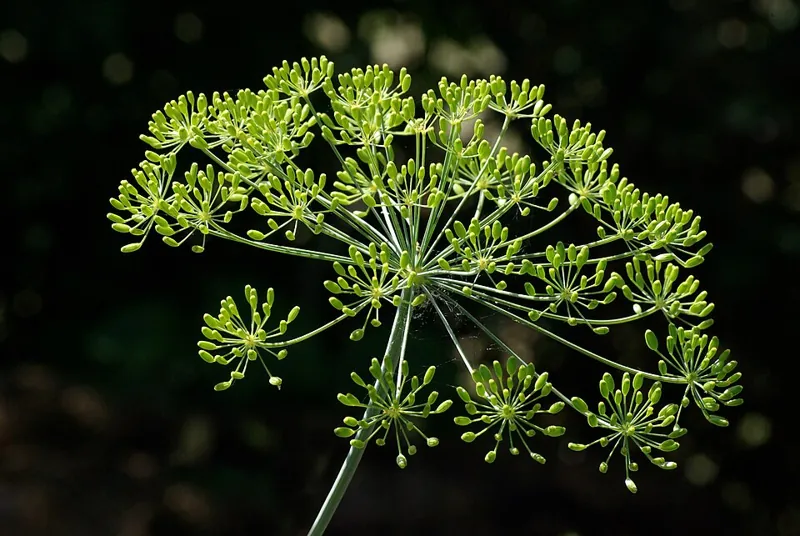
A dill flower head with its yellow umbels
Photo: JLPC · CC BY-SA 3.0, via Wikimedia Commons.

¿Cuándo siembro esto? →

Planéala en tu huerto →

Los números

Profundidad de siembra
0.3–0.6 cm0.1–0.2 in
Distancia en el surco
25 cm10 in
Altura adulta
90–150 cm35–59 in
Ancho adulto
30 cm12 in
Días a la cosecha
60–90
Luz
Pleno sol
Nutrientes
Poco exigente
Profundidad de la raíz
Media
Tolerancia a la helada
Aguanta algo de frío
Ciclo de vida
Anual
Forma de crecer
Tallo
Valor para los polinizadores
Alto
Da sombra a las plantas vecinas
Sí

Antes de sembrar

Lo que la semilla necesita antes de brotar.

Temperatura del suelo para germinar
18–21 °C64–70 °F
Días para germinar
7–14 días
Luz para germinar
necesita luz — siémbrala a poca profundidad, apenas cubierta

Iowa State Extension, 'Germination Requirements of Annuals and Vegetables' (Jauron & Steil, last reviewed Dec 2023), yardandgarden.extension.iastate.edu/how-to/germination-requirements-annuals-and-vegetables (fetched in-container 2026-09-20, read by the maintainer 2026-09-20 via the batch-3 germination review): the Dill row gives Germination Temperature 65-70 F = 18-21 C (stored). FLAGGED ESTIMATED: Iowa State labels this column 'Germination Temperature (°F)' and defines it as 'The ideal air temperature for germination' - an AIR temperature, not a soil temperature, and this field is germination_soil_temp_c. No source read gives dill a soil-germination temperature; this is the nearest published germination figure, stored with that caveat rather than dropped. No extension source read gives a pre-sow soak or scarification for dill, so no seed_treatment is recorded. [read]

Iowa State Extension, same page and fetch as germination_soil_temp_c (read by the maintainer 2026-09-20): the Dill row gives Days to Germination 7-14. Stored [7, 14]. [read]

Iowa State Extension, same page and fetch (read by the maintainer 2026-09-20): the Dill row carries the light code L, defined verbatim as 'L = Require Light for Germination. After sowing these seeds, lightly press them into the germination medium, but do not cover them.' So this species requires light to germinate (light_to_germinate true). [read]

En la cosecha, y en maceta

Tamaño de maceta
al menos 19 L (5 galones de EE. UU.)al menos 5 galones (unos 19 L)

University of Maryland Extension, 'Growing Vegetables in Containers and Salad Tables', extension.umd.edu/resource/growing-vegetables-containers-and-salad-tables (fetched in-container 2026-09-25, read by the maintainer 2026-09-25): 'Large-statured herbs (rosemary, bay leaf, sage, parsley, lavender, dill, and fennel) require 5-gallon or larger pots.' Stored is the minimum the sentence gives. [read]

Números de los que estamos menos seguros

These are estimates from general gardening knowledge, or the sources disagree on them, so treat them as a starting point rather than a firm figure.

Reglas que se aplican a Eneldo

Una buena corazonada Las aliáceas y la familia de la zanahoria no tienen parentesco con las solanáceas/cucurbitáceas/brasicáceas y pueden romper los ciclos de rotación de esas familias — pero no son de "baja presión" y necesitan su propia rotación.
Una buena corazonada

Las aliáceas y la familia de la zanahoria no tienen parentesco con las solanáceas/cucurbitáceas/brasicáceas y pueden romper los ciclos de rotación de esas familias — pero no son de "baja presión" y necesitan su propia rotación.

si no se sigue, igual funciona, pero peor · el planeador lo sugiere

Mecanismo: No hospedan ninguno de los patógenos del suelo de las tres grandes familias, así que poner una aliácea o una apiácea después de esos cultivos rompe el ciclo de hospederos. Pero no son de baja presión por naturaleza: la pudrición blanca de las aliáceas (Sclerotium cepivorum) es específica de las aliáceas, sus esclerocios persisten 15+ años y no se puede erradicar una vez establecida; las apiáceas tienen sus propias enfermedades del suelo.

Evidence: confirmed against 1 source in the research-based literature.

the source

UMass Extension, 'Alliums, White Rot', ag.umass.edu/vegetable/fact-sheets/alliums-white-rot (read 2026-07-11): 'Sclerotium cepivorum is specific to allium species'; sclerotia 'may remain viable in soil for 15 years or more without allium hosts'; 'Currently, there is no way to eradicate white rot from a field where it has become established.'

Lee la regla completa → · abrir en el planeador ↗

Prometedor No plantes la familia de la zanahoria en tierra que la tuvo en los últimos 3 años.
Prometedor

No plantes la familia de la zanahoria en tierra que la tuvo en los últimos 3 años.

si no se sigue, se pierde cosecha de verdad · el planeador te avisa

Mecanismo: Los tizones de la hoja de la zanahoria (Alternaria dauci, Cercospora carotae y el tizón bacteriano) y el tizón tardío por Septoria del apio sobreviven en los restos del cultivo y mueren a medida que estos se descomponen; un descanso de dos a tres años los mata de hambre. Alternaria radicina, la especie de la pudrición negra, infecta también el apio, el apio nabo, el eneldo, el hinojo, el perejil y la chirivía, y puede persistir en el suelo hasta ocho años, por eso la familia se rota como una sola.

Evidence: confirmed against 5 sources in the research-based literature.

the 5 sources

UMass Extension, 'Carrot, Alternaria Leaf Blight', umass.edu/agriculture-food-environment/vegetable/fact-sheets/carrot-alternaria-leaf-blight (fetched in-container 2026-09-02; read by the maintainer 2026-09-02): 'Practice relatively long rotations of 3-4 years'; 'A. radicina infects celery, celeriac, caraway, dill, fennel, parsley, and parsnips'; 'The fungus survives in the soil on crop debris but dies when the residue decomposes'; A. radicina 'can persist in soil for up to 8 years.'

Cornell Vegetables, 'Carrot Leaf Blight Diseases and their Management', vegetables.cornell.edu/pest-management/disease-factsheets/carrot-leaf-blight-diseases-and-their-management (fetched in-container 2026-09-02; read by the maintainer 2026-09-02): 'it is important to practice a minimum of a 2-year rotation out of carrots to allow time for decomposition of crop residue'; 'All three pathogens can be transmitted through infected or contaminated seeds and can survive on crop residue, which can act as a source of inoculum in subsequent cropping years.'

Cornell Vegetables, 'Do Rotations Matter within Disease Management Programs?', vegetables.cornell.edu/pest-management/disease-factsheets/do-rotations-matter-within-disease-management-programs (fetched in-container 2026-09-02; read by the maintainer 2026-09-02): its rotation table gives carrot leaf blights (fungal and bacterial) 2-3 years and celery leaf blights 2 years.

UMass Vegetable Notes 2025 vol. 37:13, Septoria late blight of celery, umass.edu/agriculture-food-environment/vegetable/newsletters/vegetable-notes/vegetable-notes-2025-vol-3713 (fetched in-container 2026-09-02; read by the maintainer 2026-09-02): 'The pathogen survives in crop debris in soil for up to 18 months, or outbreaks may originate from seed-borne inoculum.'

Clemson HGIC, 'Crop Rotation', hgic.clemson.edu/factsheet/crop-rotation (fetched in-container 2026-09-02; read by the maintainer 2026-09-02): 'a crop should only be grown in the same spot a maximum of once every three years'; its family table puts carrot, parsley, celery, cilantro, fennel and dill in the parsley family (Apiaceae).

solución

Planta los cultivos de la familia de la zanahoria en otra tierra, o espera a que pasen 3 años desde la última vez que esta tierra los tuvo. En cualquier caso, retira e incorpora pronto al suelo las hojas viejas, y compra semilla limpia: los tres tizones de la zanahoria viajan en la semilla.

Lee la regla completa → · abrir en el planeador ↗
Prometedor Los cultivos anuales resistentes al frío se pueden sembrar o trasplantar antes de la última helada de primavera — los resistentes unas tres semanas antes, los semirresistentes unas dos semanas antes. Los sensibles esperan a la propia helada.
Prometedor

Los cultivos anuales resistentes al frío se pueden sembrar o trasplantar antes de la última helada de primavera — los resistentes unas tres semanas antes, los semirresistentes unas dos semanas antes. Los sensibles esperan a la propia helada.

si no se sigue, igual funciona, pero peor · el planeador lo sugiere

Mecanismo: Resistencia al frío. Los cultivos resistentes toleran heladas fuertes y los semirresistentes toleran heladas ligeras, así que pueden ocupar la tierra semanas antes de que se permita la entrada a los cultivos sensibles a las heladas. El desfase se mide desde la última helada de primavera.

Evidence: confirmed against 4 sources in the research-based literature.

the 4 sources

University of Illinois Extension, 'Time Your Vegetable Plantings by Cold Hardiness' (2018-03-26), extension.illinois.edu/blogs/ilriverhort/2018-03-26-time-your-vegetable-plantings-cold-hardiness: very hardy vegetables 'withstand freezing temperatures and hard frosts without injury' (planted earliest in spring); frost-tolerant vegetables 'can withstand light frosts, but not freezing temperatures' (planted a couple of weeks later). LLM-summarised from a read of the page; it establishes the CATEGORIES but states no week offsets.

Colorado State Univ. Extension, GardenNotes #720, 'Vegetable Planting Guide', extension.colostate.edu/resource/vegetable-planting-guide (read 2026-07-25): hardy vegetables go in 'As early as 2-4 weeks before the date of the average last spring frost'; semi-hardy 'As early as 0-2 weeks before the date of the average last spring frost'; tender from seed 'around the date of the average last spring frost'; very tender 'Typically 2+ weeks after'. This is the source that states the offsets in weeks.

Where this rule sits in that range: hardy at 3 weeks is mid-range of CSU's 2-4. Half-hardy at 2 weeks is the EARLIEST EDGE of CSU's 0-2 - the most aggressive planting CSU sanctions, not the middle of it. The rule is inside published guidance at both ends, but it leans early on the half-hardy side and a gardener following it in a cold spring is taking that boundary.

Do not import an offset from another publication's hardiness scheme without checking the category names: CSU has no 'very hardy' tier, so a '4-6 weeks before frost' figure written against a four-tier scheme does not describe CSU's 'hardy'. Categories are not comparable across sources.

Lee la regla completa → · abrir en el planeador ↗

Prometedor Algunos tipos de semilla necesitan luz para germinar, y enterrarlas impide que broten. Siémbralas en la superficie - presionadas sobre tierra firme y húmeda y sin cubrir, o apenas espolvoreadas encima - en lugar de a la profundidad que llevaría una semilla más grande.
Prometedor

Algunos tipos de semilla necesitan luz para germinar, y enterrarlas impide que broten. Siémbralas en la superficie - presionadas sobre tierra firme y húmeda y sin cubrir, o apenas espolvoreadas encima - en lugar de a la profundidad que llevaría una semilla más grande.

si no se sigue, igual funciona, pero peor · el planeador lo sugiere

Mecanismo: Estas semillas tienen el pigmento que detecta la luz, el fitocromo, que tiene que captar luz para activar la cascada hormonal que libera a la semilla para germinar, así que una semilla enterrada a más de unos pocos milímetros se queda a oscuras, con ese interruptor sin activar, y permanece latente.

Evidence: confirmed against 1 source in the research-based literature.

the source

North Carolina Extension Gardener Handbook, ch. 13 'Propagation' / Anthony V. LeBude & Frank A. Blazich (NC State Extension, 2022), content.ces.ncsu.edu/extension-gardener-handbook/13-propagation (fetched in-container 2026-09-20, read 2026-09-20): 'When sowing light-requiring seeds, sow them on the soil surface'; the plants it lists as requiring light for germination are 'ageratum, begonia, browallia, impatiens, lettuce, and petunia'; and 'Extremely fine seeds such as carrot, petunia, and snapdragon should not be covered, but simply dusted on the surface of the germinating medium and watered with a fine mist.' The page states the practice, not the phytochrome mechanism.

solución

Presiona la semilla que necesita luz sobre tierra o sustrato firme y húmedo y déjala sin cubrir o apenas espolvoreada, y luego mantén la superficie húmeda - una semilla que queda encima se seca rápido, y una nebulización fina en lugar de un riego fuerte la mantiene en su lugar. La página de la planta dice si necesita luz; una semilla que necesita oscuridad es lo contrario y se cubre como de costumbre.

Lee la regla completa → · abrir en el planeador ↗

Otras 119 reglas dependen de tu huerto y no de la planta — rotación de cultivos, fechas de helada, sol, distancia entre plantas y suelo. Velas todas.

Equipos de plantas que la incluyen

Cita esta página

Milpa Gardens. "Eneldo (Anethum graveolens)." https://milpa.garden/es/plants/anethum-graveolens/

A garden-planning corpus: every claim states its evidence grade and links its sources on the page. Cite it with the grade, and add the date you read it.

Todas las plantas