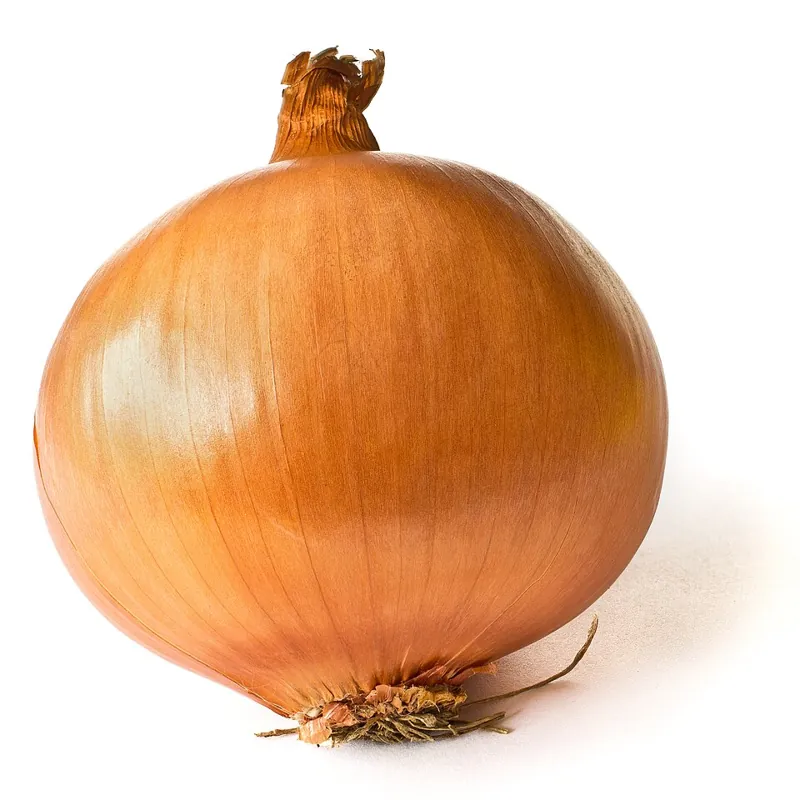
Onions (Allium cepa) and garlic (Allium sativum) are close cousins on opposite calendars - onions go in early in spring, garlic in autumn.
Onions and garlic are close relatives, but they keep very different calendars. Onions go in early in spring and have one decision that makes or breaks them: choosing the right type for your day length. Garlic goes in in autumn, sits through the winter, and is ready by early summer.
Allium cepa, Allium sativum and their relatives
The onion is Allium cepa, and garlic is Allium sativum. Both are alliums, a group of related plants in the amaryllis family (Amaryllidaceae). The rest of the group is familiar:
- Shallots are the same species as the onion, Allium cepa, grown for a cluster of smaller bulbs.
- Leeks are Allium ampeloprasum. So is elephant garlic, which is a kind of leek, not a true garlic.
- Bunching onions and scallions are Allium fistulosum, grown for their green stalks.
- Chives are Allium schoenoprasum, a perennial that comes back every year.
Being one group matters most for rotation, because the alliums share their soil diseases (more on that at the end).
Onions: choose by day length
An onion starts forming its bulb when the days reach a certain length, and that length depends on the type. Short-day onions start bulbing at about 10 to 12 hours of daylight, intermediate-day onions at about 12 to 14, and long-day onions at about 14 to 16. That makes your latitude the key question:
Well establishedOnion cultivar group must match site latitude.
ignored, the planting fails · the planner refuses it
Mechanism: Bulbing fires when daylength crosses a cultivar's critical threshold (short ~10-12h, intermediate ~12-14h, long ~14-16h). A short-day cultivar grown too far north crosses its low threshold early and bulbs prematurely on small plants, so bulbs stay small. A long-day cultivar grown too far south never reaches its high threshold and fails to bulb. Changeover is around the 35th-38th parallel.
Evidence: confirmed against 2 sources in the research-based literature.
the 2 sources
NC State Extension, 'Bulb Onions', content.ces.ncsu.edu/bulb-onions (read 2026-07-11): 'onions will not form bulbs until daylength reaches the cultivar's critical threshold. Short-day onions bulb at approximately 10-12 hours of daylength ... Intermediate-day onions bulb at approximately 12-14 hours ... Long-day onions bulb at 14-16 hours of daylength.'
Univ. of Illinois Extension (The Humble Gardener), 'Growing Onions in Central Illinois', extension.illinois.edu/blogs/humble-gardener/2018-03-19-growing-onions-central-illinois (read 2026-07-11): 'Long day varieties are for northern growing areas (above the 35th latitude); short-day varieties are for southern. If short-day varieties are grown in our zone, they won't do well. They will not form bulbs of any decent size. And since the long day onions need more daylight, they will not do well' (in the south).
remedy
Choose long-day onions in the north and short-day in the south; the planner picks the group from your plot's latitude.
Read the full rule → · open in the planner ↗
When you tell the planner where you garden, it says which onion country you're in: long-day, short-day, or the changeover band between them, where intermediate-day onions are the safe choice. The frost dates, zones and day length guide explains why this is latitude and not your hardiness zone.
Two things to watch when buying. Sweet, mild onions are usually short-day types, so in the north they tend to stay small. Onion sets (the little bulbs sold by the bag) can be short-day too: in Minnesota, most of the sets on sale are short-day types, even though long-day onions suit the climate there. Check the type on the label.
Planting onions: seed, transplants or sets
Onions are hardy, so they go in on the planner's early window, weeks before the last frost:
PromisingCold-hardy annuals can be sown or transplanted before the last spring frost — hardy crops about three weeks before, half-hardy about two weeks before. Tender crops wait for the frost itself.
ignored, it still works, just worse · the planner suggests it
Mechanism: Cold hardiness. Hardy crops tolerate hard frost and half-hardy crops tolerate light frost, so they can occupy the ground weeks before frost-tender crops are allowed in. The offset is measured from the last spring frost.
Evidence: confirmed against 4 sources in the research-based literature.
the 4 sources
University of Illinois Extension, 'Time Your Vegetable Plantings by Cold Hardiness' (2018-03-26), extension.illinois.edu/blogs/ilriverhort/2018-03-26-time-your-vegetable-plantings-cold-hardiness: very hardy vegetables 'withstand freezing temperatures and hard frosts without injury' (planted earliest in spring); frost-tolerant vegetables 'can withstand light frosts, but not freezing temperatures' (planted a couple of weeks later). LLM-summarised from a read of the page; it establishes the CATEGORIES but states no week offsets.
Colorado State Univ. Extension, GardenNotes #720, 'Vegetable Planting Guide', extension.colostate.edu/resource/vegetable-planting-guide (read 2026-07-25): hardy vegetables go in 'As early as 2-4 weeks before the date of the average last spring frost'; semi-hardy 'As early as 0-2 weeks before the date of the average last spring frost'; tender from seed 'around the date of the average last spring frost'; very tender 'Typically 2+ weeks after'. This is the source that states the offsets in weeks.
Where this rule sits in that range: hardy at 3 weeks is mid-range of CSU's 2-4. Half-hardy at 2 weeks is the EARLIEST EDGE of CSU's 0-2 - the most aggressive planting CSU sanctions, not the middle of it. The rule is inside published guidance at both ends, but it leans early on the half-hardy side and a gardener following it in a cold spring is taking that boundary.
Do not import an offset from another publication's hardiness scheme without checking the category names: CSU has no 'very hardy' tier, so a '4-6 weeks before frost' figure written against a four-tier scheme does not describe CSU's 'hardy'. Categories are not comparable across sources.
Read the full rule → · open in the planner ↗
There are three ways to start them:
- Seed - sow as soon as the soil can be worked, 6–12 mm¼–½ inch deep in a band, then thin the seedlings to 8–10 cm3–4 inches apart.
- Transplants - bought, or raised indoors from seed 10 to 12 weeks ahead. They take light frost. Set them 5 cm2 inches deep and 8–10 cm3–4 inches apart.
- Sets - plant as soon as the soil can be worked.
Where winters are mild, onions can also be planted in autumn or late winter and grow on through the cool months. Don't plant too early in autumn, though: a plant that gets big before winter can bolt (send up a flower stalk), and a bolted onion makes a small bulb with a thick neck that won't cure well.
Onions have shallow roots, so they need steady moisture. If a week goes by without about 2.5 cman inch of rain, soak the bed thoroughly; sandy soil needs it more often. Stop watering once the bulbs are full size and the tops start to fall. Weed with a shallow hoe, because a nicked bulb is more likely to rot, or mulch with weed-free straw. For feeding, go by a soil test. Too much nitrogen gives soft bulbs with thick necks that don't store well.
Garlic goes in in autumn
Garlic works the other way round from onions. You plant it in autumn so the winter cold can do its job:
PromisingGarlic is planted in autumn, not spring - the cloves go in the ground several weeks before it freezes, root, and overwinter. The weeks of winter cold below about 40 F vernalize the clove, and that cold is what triggers it to form a bulb the following spring as the days lengthen. Planted in spring, garlic misses the cold and bulbs poorly.
ignored, it still works, just worse · the planner suggests it
Mechanism: A garlic clove will not form a bulb until it has been vernalized - held for roughly six to eight weeks below about 40 F. The bulb itself does not develop during that cold; it is only induced by it, and forms in spring as days lengthen and temperatures rise. Fall planting delivers the cold naturally over winter with the clove already rooted, so growth resumes early and a full bulb sizes up by early summer. It is the same biennial vernalization that prematurely bolts a spring-sown cool-season crop, but with the sign reversed: there the accumulated cold buttons the plant into an early flower and ruins it; here, in a crop sown in autumn to be harvested as a bulb, that same cold is the intended trigger.
Evidence: confirmed against 2 sources in the research-based literature.
the 2 sources
UGA Extension, 'Garlic Production for the Gardener' (C854), fieldreport.caes.uga.edu/publications/C854 (read 2026-08-22): 'Late September through November is the time to plant garlic in Georgia'; 'Garlic cloves require a period of 6-8 weeks of cool weather after planting (below 40 F) to undergo vernalization ... by low winter temperatures'; 'Although vernalized, no inflorescence or lateral buds (that later form the bulb) are developed until early spring with the onset of lengthening days and suitable temperatures'; 'Hard-necked garlics may grow in Georgia but generally prefer the cold winters and long, cool springs of more northern climates. Soft-necked garlics are well-adapted to the more temperate climate of the South.'
Iowa State Univ. Extension, 'Growing Garlic in the Home Garden', yardandgarden.extension.iastate.edu/how-to/growing-garlic-home-garden (read 2026-08-22): 'Plant cloves ... in the fall (October to early November)'; 'The highest yields are obtained from the largest cloves planted in the fall'; 'Plant large cloves 1 to 1.5 inches deep with the pointed side up, 3 to 5 inches apart within rows spaced 18 to 24 inches apart'; 'Fall-planted garlic should be mulched in November with a 4- to 6-inch layer of weed-seed-free straw to help prevent winter injury.'
remedy
Plant cloves in the fall - roughly late September through November in most regions, several weeks before the ground freezes so they root before winter - pointed end up, about 1 to 3 inches deep and 4 to 6 inches apart, using the largest cloves for the largest bulbs. Once the ground has chilled, mulch with a few inches of weed-free straw to blunt winter heaving and injury. Match the type to the winter: hard-necked garlics prefer cold-winter regions, soft-necked are better adapted to mild-winter areas.
Read the full rule → · open in the planner ↗
In a cold-winter place like Minnesota, that means planting about a week or two after the first killing frost. The cloves put down roots before the ground freezes, and the shoots usually don't come up until spring. Split the bulb into cloves a day or two before planting. Set each clove pointed end up, with its base 5–8 cm2–3 inches below the surface and 10–15 cm4–6 inches apart, then mulch with 8–10 cm3–4 inches of straw or leaves.
Plant cloves from a garlic grower or seed company, not garlic from the grocery store. Supermarket garlic is mostly a softneck type grown in mild climates, and it often does poorly in cold-winter gardens like Minnesota's. Plant only firm, healthy cloves, because many garlic diseases come in on the cloves themselves. After your first crop, you can save your own: keep the biggest cloves to plant the next autumn.
Hardneck or softneck
Garlic comes in two main types, and the planner knows both:
- Hardneck garlic (Rocambole, Purple Stripe, Porcelain) grows a flower stalk called a scape. Snap the scapes off just after they start to curl, and eat them. Hardnecks are the type for cold-winter regions.
- Softneck garlic (Artichoke, Silverskin) doesn't make a scape, usually has more cloves, and is easy to braid. It's better suited to mild winters.
Harvesting and curing
Onions are ready when about half the tops have fallen over and dried. Loosen them with a garden fork and lift them.
Garlic is usually ready between late June and late July, depending on the type and your climate. Start when the lower leaves have turned brown but about half of the upper leaves are still green, or pull one bulb and cut it in half: if the cloves fill their skins, the crop is ready. Dig too early and the bulbs are small; too late and the cloves start to split apart. Stop watering garlic about two weeks before you harvest it.
Both need curing before they'll keep:
PromisingOnions and garlic lifted for storage are cured first - dried down in a warm, airy, shaded place for about two to four weeks until the neck is tight and dry and the outer scales are papery. Bulbs stored uncured, or poorly cured, rot in storage instead of keeping.
ignored, it still works, just worse · the planner suggests it
Mechanism: At harvest the bulb's neck and outer scales are still moist living tissue and the neck is an open channel into the bulb, so curing in warm moving air dries the neck shut and the outer scales to a papery protective skin, removing the wet tissue that storage rots colonise and sealing the neck they enter by; an uncured bulb goes into storage with a moist open neck and soft scales, and decays.
Evidence: confirmed against 2 sources in the research-based literature.
the 2 sources
UMN Extension, 'Growing onions in home gardens', extension.umn.edu/vegetables/growing-onions (read 2026-08-21): 'Curing is essential if you plan to store your onions'; 'Keep the onions in a warm (75F - 90F), well-ventilated area for two to four weeks, until outer bulb scales are dry and the neck is tight'; 'Poor curing will result in decay during storage.'
Clemson HGIC, 'Onion, Leek, Shallot, & Garlic', hgic.clemson.edu/factsheet/onion-leek-shallot-garlic (read 2026-08-21): onion - 'Thoroughly air-dry bulbs in a shaded area before storage', 'To avoid storage diseases, be sure onions are well-cured before storing'; garlic - 'Cure in a warm, shady place with good air movement', 'Allow bulbs to dry until the neck is dry and the outer skin is papery, approximately two to three weeks', 'Bulb rot can also occur in storage from bruising and insufficient drying.'
remedy
After lifting, spread the bulbs in a single layer or hang them in bundles in a warm, shaded, well-ventilated place out of direct sun and rain, and leave them until the neck is dry and tight and the outer skin is papery - roughly two to four weeks for onions (a warm 75-90 F speeds it), two to three weeks for garlic. Only then trim, and keep the cured bulbs in mesh bags or shallow boxes in a cool, dry, well-ventilated spot. Handle gently throughout, as bruising also seeds storage rot.
Read the full rule → · open in the planner ↗
Once cured, onions can be braided or trimmed and stored somewhere cool and dry, but not freezing. Above 4°C40°F they start to sprout. For garlic, cut the stems about 1–2.5 cm½–1 inch above the bulb and trim the roots close. The harvest and keeping guide covers storage for the whole garden.
Next year's bed
Onions, garlic, leeks, shallots and chives all share the same soil diseases, so rotate them as one group:
PromisingDo not plant alliums in ground that held alliums within 4 years, and know that the worst allium disease outlasts any rotation.
ignored, real yield is lost · the planner warns you
Mechanism: Fusarium basal rot (Fusarium oxysporum f. sp. cepae) and pink root survive in soil as spores and on other plants' roots, and their inoculum builds where alliums repeat; a four-year break starves them. White rot (Sclerotium cepivorum) is allium-specific and its sclerotia stay viable 15 to 40 years, so rotation reduces but cannot clear it.
Evidence: confirmed against 4 sources in the research-based literature.
the 4 sources
UMass Extension, 'Alliums, Fusarium Basal Rot', umass.edu/agriculture-food-environment/vegetable/fact-sheets/alliums-fusarium-basal-rot (fetched in-container 2026-09-02; read by the maintainer 2026-09-02): 'Rotate away from alliums for at least 4 years'; 'Fusarium oxysporum f. sp. cepae is a soil-borne pathogen that overwinters as chlamydospores (thick-walled survival spores) buried in the soil'; affects garlic, leeks and onion.
Colorado State University Extension, 'Soil-Borne Diseases of Onion', extension.colostate.edu/resource/soil-borne-diseases-of-onion (fetched in-container 2026-09-02; read by the maintainer 2026-09-02): 'Do not plant onions more than once every five years in a field'; its Table 1 lists a rotation of less than 4 years as favouring damping-off, smut, pink root, Fusarium basal rot and stem and bulb nematode; 'Soil-borne fungal pathogens and nematodes can persist for many years in previously infected onions.'
Univ. of Maryland Extension, 'White Rot of Onion and Garlic', extension.umd.edu/resource/white-rot-onion-and-garlic (fetched in-container 2026-09-02; read by the maintainer 2026-09-02): 'Rotation alone will not control white rot because sclerotia can survive in the soil for 20-40 years'; 'white rot only infects Allium species.'
UMass Extension, 'Alliums, White Rot', umass.edu/agriculture-food-environment/vegetable/fact-sheets/alliums-white-rot (fetched in-container 2026-09-02; read by the maintainer 2026-09-02): 'White rot survives in soil in the form of sclerotia, which are dense masses of fungal tissue. They may remain viable in soil for 15 years or more without allium hosts.'
remedy
Plant alliums in different ground, or wait until 4 years have passed since this ground last held them. If white rot has ever shown here, treat this ground as lost to alliums and grow them elsewhere.
Read the full rule → · open in the planner ↗
The one disease rotation can't fix is white rot. If it has ever turned up in a bed, grow your alliums somewhere else from then on. The crop rotation guide helps you fit a four-year break into the beds you have.