Many of our estimates come from an extension page we’ve read that gets close without pinning the number down. Others are still our own best guess, and on some the sources disagree. Treat them all as a starting point.
Hardiness zone — an estimate
Frost tolerance — an estimate
Mature height — an estimate
Mature spread — an estimate
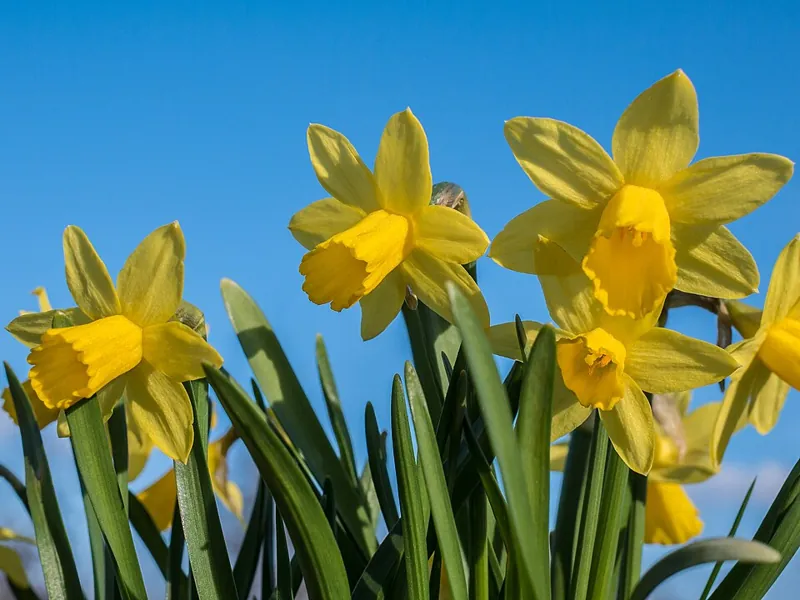
Rules that apply to daffodil
Alliums and carrot family are unrelated to nightshades/cucurbits/brassicas and can break those families' rotation cycles. They are still not "low-pressure" and need their own rotation. A good hunch
Alliums and carrot family are unrelated to nightshades/cucurbits/brassicas and can break those families' rotation cycles. They are still not "low-pressure" and need their own rotation.
If you skip this, it still grows, just less well. The planner suggests it.
How it works: They host none of the big-three families' soilborne pathogens, so following those crops with an allium or apiaceous crop breaks the host cycle. They are not inherently low-pressure, though. Allium white rot (Sclerotium cepivorum) is allium-specific, its sclerotia persist 15+ years, and it cannot be eradicated once established; apiaceous crops carry their own soilborne diseases.
Evidence: checked against 1 source in the research-based literature.
If you skip this, it still grows, just less well. The planner suggests it.
How it works: Zones encode average annual minimum winter temperature, which governs whether a woody perennial survives to spring. It is the wrong quantity for an annual, which never sees winter.
A zone that is too warm is a second, different mechanism. Mild winters do not kill a perennial; they fail to chill it. Deciduous fruit crops need a winter dormancy period to break bud and set fruit, so in a zone milder than a plant is adapted to it may survive and never crop. Only the cold end is enforced, because only winter survival follows from what a zone measures; the warm end gets advice and is never refused.
That warm limit is a property of the cultivar, and that limits what this rule can do. Chill requirement is published per variety and varies enormously within a species, so a species-level ceiling says "the modeled range does not reach your zone", never "no plant of this kind will crop for you". So above its range the planner still offers the plant, with advice to choose a cultivar rated for your zone.
Evidence: checked against 1 source in the research-based literature.
Winter cold-hardy cultivars adapted to the colder regions of Oregon (such as zones 5 to 7), may not grow normally in regions of the Willamette Valley (zone 8) where winters are warmer and plants receive less winter chill.
Plus 2 working notes on how the sources were read.
If you skip this, you lose real yield. The planner warns you.
How it works: Fusarium basal rot (Fusarium oxysporum f. sp. cepae) and pink root survive in soil as spores and on other plants' roots, and their inoculum builds where alliums repeat; a four-year break starves them. White rot (Sclerotium cepivorum) is allium-specific and its sclerotia stay viable 15 to 40 years, so rotation reduces but cannot clear it.
Evidence: checked against 4 sources in the research-based literature.
White rot survives in soil in the form of sclerotia, which are dense masses of fungal tissue. ... They may remain viable in soil for 15 years or more without allium hosts.
Remedy
Plant alliums in different ground, or wait until 4 years have passed since this ground last held them. If white rot has ever shown here, treat this ground as lost to alliums and grow them elsewhere.
If you skip this, it still grows, just less well. The planner suggests it.
How it works: Narcissus bulbs and tissue contain lycorine and related alkaloids, which are toxic to eat. Rodents avoid them accordingly. Field mice rarely touch daffodils even where they readily eat tulips and crocus, so a ring of narcissus tends to be left alone. It works by avoidance. It discourages feeding on the bulbs but is no barrier and no guarantee against every rodent.
Evidence: checked against 3 sources in the research-based literature.
If you skip this, the planting fails. The planner warns you.
How it works: On a clear, still night leaves lose heat to the open sky, so a leaf can fall to freezing and ice can form in it while the thermometer, a couple of meters up, still reads a few degrees above.
Evidence: checked against 7 sources in the research-based literature.
Frost occurs when air is warmer than 32°F but plant tissues drop to 32°F or below because plants radiate (lose) heat into the atmosphere, especially during cool, clear nights.
Radiation frosts occur on calm clear nights that lack cloud cover to hold in heat.
Remedy
The evening before, cover the crops at risk with a sheet or frost cloth, never plastic, reaching the ground and loose at the bottom so the soil's warmth can rise under it, and take it off in the morning. A cover helps least in a long, hard freeze.
If you skip this, it still grows, just less well. The planner suggests it.
How it works: Soil warmed by the sun by day is the heat source at night; a covering low to the ground traps that heat around the plants on calm, clear nights, keeping them a few degrees above the open air through the light frosts at each end of the season.
Evidence: checked against 6 sources in the research-based literature.
The ground and frame of the cold frame are heated by the sun during the day and radiate that heat during the night, keeping the inside warmer. They are used to extend the growing season by two to four weeks in both the fall and the spring, allowing you to start plants outdoors earlier and continue growing them later in the season.
In trials in Fort Collins, Colorado, a plastic cover on a frame typically provides 3°F to over 6°F of frost protection. It works well for cool season crops that are somewhat tolerant of frosty nights and adds two to six weeks or more on both ends of the growing season.
Soil warmed by the sun in the daytime, is the source of heat for frost protection at night. Moist, smooth soil absorbs more heat. To trap heat from the soil around young vegetables at night, place a covering that is low to the ground and spreading. To recharge the heat source for the next night, any covering must allow sunlight to shine through to the soil or must be removed in the daytime.
Low = Plant 1–2 weeks before suggested planting date; Medium = 2–4 weeks before suggested planting date; High = 4–8 weeks before average planting date
hort.extension.wisc.edu
Floating Row CoverUniversity of Wisconsin-Madison Extension, Wisconsin Horticulture, Susan Mahr
Depending on the weight of the covering you choose, you can gain between 2 and 8 degrees of frost protection or warm the local environment sufficiently to harvest certain crops a week or two early.
Clear plastic is useless in providing frost protection because the radiant energy released from the soil on those frosty nights passes right through the covering and never warms the air around the plants.
Remedy
Sow or set out cool-season crops under the cover that many weeks ahead of the open-ground date, and keep autumn crops covered past the usual last call. Vent on sunny days, keep plastic off the leaves, and close the cover before sunset.
A garden planner built on graded evidence. Every claim states its evidence grade and links its sources on the page. Cite it with the grade, and add the date you read it.