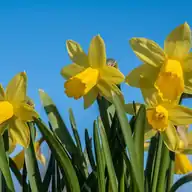
bulb ring suppresses turfgrass competition at the stem
Mechanism: Resource competition and physical occupancy of the root collar zone.
Evidence: settled without a trial - competition.
A perennial guild - a standing planting, not lifted between seasons.
The ring pattern, reduced to what an acid bed can hold.
The corpus partly backs this planting with 2 graded mechanisms its members share:
At least 3 m²32.3 ft². A bed smaller than that does not get this guild quietly substituted for something else — the planner greys it out, says why, and offers the nearest adaptation that does fit.
The guild is the standing planting; it is not lifted at all.
Mechanism: Resource competition and physical occupancy of the root collar zone.
Evidence: settled without a trial - competition.
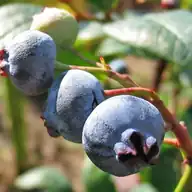
Blueberry requires an acid bed (pH 4.5-5.5). The guild's usual neutral-soil companions — clover, yarrow, comfrey — cannot share it, so this ring carries only an acid-tolerant bulb ring. Site an insectary and a fixer in a separate neutral bed, not here. That constraint is why the ring bands partial where the currant bands backed: the acid soil, not the plant, is what the corpus is recording.
A role is filled by whatever satisfies its predicate, not by a fixed species list. The canonical filler is the default; the alternatives are priced.
Mechanism: A tree's root zone expands for a decade and extends well past the canopy edge.
Evidence: settled without a trial - root architecture.
Mechanism: Juglans roots exude hydrojuglone, oxidized to juglone, a respiration inhibitor. nightshades are highly sensitive: wilt and death.
Evidence: confirmed against 2 sources in the research-based literature.
UW-Madison / Wisconsin Horticulture (Joy, Hudelson & Jull, rev. 2024-02-28), 'Black Walnut Toxicity', hort.extension.wisc.edu/articles/black-walnut-toxicity (read 2026-07-13): 'Vegetables such as tomato, potato, eggplant and pepper ... are particularly sensitive to juglone'; 'The toxic effects of a mature black walnut tree can extend 50 to 80 feet from the trunk of the tree, with the greatest toxicity occurring within the tree's dripline.'
Iowa State Univ. Extension & Outreach, Yard and Garden FAQ, 'What plants are sensitive to the juglone produced by black walnuts?', yardandgarden.extension.iastate.edu (read 2026-07-13): juglone-sensitive plants include 'members of the tomato family (tomato, potato, eggplant, pepper).'
Plant it outside the walnut's root zone — the whole drip line and beyond. There is no soil treatment for juglone.
Mechanism: Many fruit trees carry self-incompatibility alleles at a single locus: when a pollen grain shares an allele with the pistil it lands on, the pistil rejects it and no seed sets. A plant's own pollen always shares its alleles, so it cannot fertilize itself — and neither can a second tree of the identical variety, which is genetically the same. Fertilization needs pollen from a genetically distinct plant.
Evidence: confirmed against 2 sources in the research-based literature.
Penn State Extension, 'Pollination Requirements for Various Fruits and Nuts', extension.psu.edu/pollination-requirements-for-various-fruits-and-nuts (read 2026-07-11): 'Apple: Cross-pollination is always needed to produce adequate fruit crop'; 'Cherry: Sweet: Most varieties are self-unfruitful'; 'Those fruits listed as self-fertile will set fruit with their own pollen.'
'Pollen-Pistil Interaction in Response to Pollination Variants in Subtropical Japanese Plum (Prunus salicina Lindl.) Varieties', PMC9692414, pmc.ncbi.nlm.nih.gov/articles/PMC9692414 (read 2026-07-11): 'Japanese plum exhibits gametophytic self-incompatibility (GSI), a prezygotic reproductive barrier where genetically related pollen is rejected by the pistil ... governed by a polymorphic locus (S) ... Self-incompatibility occurs when the same S-allele is expressed in the haploid pollen grain and the diploid pistil.'
Plant at least two, and where the species needs a second cultivar make them different varieties — two of the same will not pollinate each other.