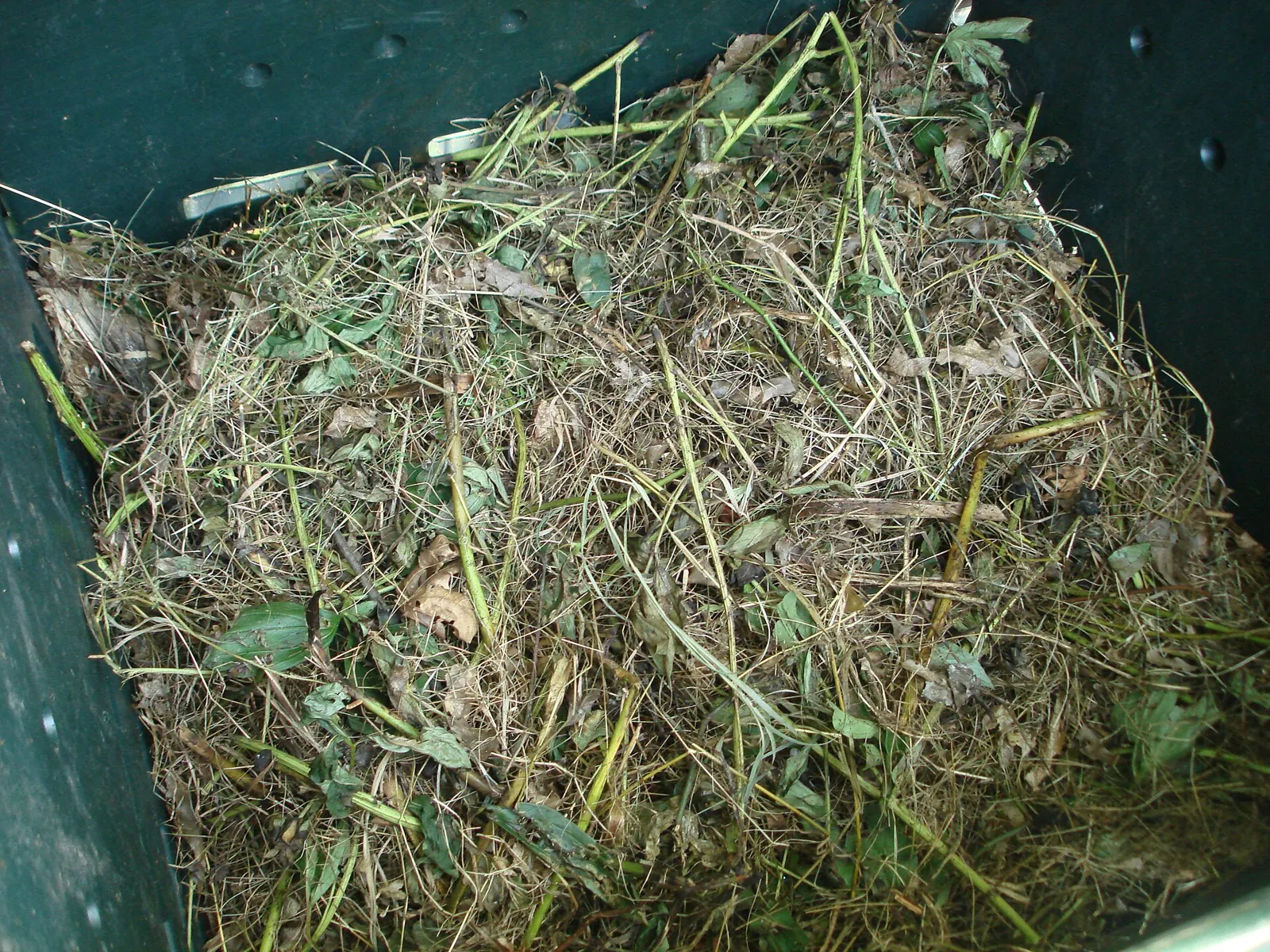
Compost is what you get when you pile up the garden’s leftovers and let the decomposers do their work, and it’s the cheapest soil improvement there is. Guide after guide on this shelf tells you to add it. This one tells you how to make it, fast or slow, and what to keep out of the pile so it doesn’t turn into a hazard.
What is compost, really?
A compost pile is a slow fire run by microorganisms. Feed them right and they’ll burn through a heap of scraps and leaves in a season; starve them and the same heap sits there going slimy.
Their diet has two halves. Browns are the dry, carbon-rich half: autumn leaves, straw, shredded plain newspaper, twigs thinner than a pencil. Greens are the moist, nitrogen-rich half: vegetable and fruit scraps, coffee grounds, fresh grass clippings, spent plants. Wisconsin Horticulture’s rule of thumb is about two parts browns to one part green. You don’t need to weigh anything. Just notice what the pile is getting. All scraps and no leaves turns wet and smelly; all leaves and no scraps sits cold and still.
The other thing they need is water. A working pile should feel like a wrung-out sponge, damp all the way through and never dripping. In a dry spell, water it like anything else you’re growing.
Should I run a hot pile or a cold one?
There are two ways to run a pile, and both of them end in compost. The difference is speed, and what the heat does along the way.
A hot pile is the managed version. Build it at least 1 m3 feet in each direction, because smaller piles can’t hold their heat. Mix browns and greens, keep it damp, and the center will climb to 54-71°C130-160°F within days. Turn it with a fork every week or two as the center cools, moving the outside in, and you can have finished compost in two to five months. Held above 54°C130°F, the heat kills most weed seeds, insect eggs and plant diseases in the middle of the pile.
A cold pile is the patient version. Heap things up as they come, and walk away. There’s no turning and no recipe. It works, but it takes a year or more, and it never gets hot enough to kill anything. Weed seeds and diseases come through a cold pile alive, which is why the what-stays-out list below matters more if this is your speed. Most gardeners run something in between, and that’s fine too.
What can I compost, and what should stay out?
In: vegetable and fruit scraps, coffee grounds, eggshells, dead flowers and spent plants, autumn leaves, straw, shredded plain newspaper, small twigs. Grass clippings are good material, but on their own they pack into airless mats, so mix them in with looser stuff.
Out, each for a concrete reason:
Meat, bones, grease, dairy, whole eggs. They rot instead of composting, and they draw rodents and every other animal in the neighborhood.
Pet waste. Dog and cat feces can carry diseases that pass to people, and a home pile can’t reliably get hot enough to make them safe.
Badly diseased plants, and weeds gone to seed. A properly hot pile kills these; a cold or half-tended one doesn’t. If your pile isn’t properly hot, send them off with the municipal yard waste instead. Those piles run far hotter than yours.
Persistent perennial weeds. Quackgrass and bindweed can treat a cool pile as a propagation bed.
Do compost tea, coffee grounds, or banana peels do what people say?
Compost attracts folklore the way it attracts worms. Most of the myths end the same way. The ingredient belongs in the pile, but it can’t do everything the story claims for it.
Compost tea isn't the tonic or disease cure it's sold as. The effects in the field are patchy, and aerated teas have no documented disease protection. Additives like molasses can grow E. coli and Salmonella, so keep it off food crops unless you're sure of the method. Spreading the compost itself as mulch is the better bet.
What is known
Compost tea, made by steeping mature compost in water, is a source of nutrients, but its disease claims are weak. Batches vary widely; results that look good in the laboratory are more variable in the field; aerated teas have no scientifically documented effect as pathogen suppressors, while non-aerated teas show a trend to reduce how often foliar diseases appear, though not how severe they are. There is a real food-safety downside too. Sugars and other additives commonly put into aerated teas can feed E. coli and Salmonella, so unless the brewing method keeps human pathogens down, extension advice is to save the tea for plants you will not eat. Using the compost itself as mulch is simpler, and composted mulch has documented disease suppression of its own.
The old-fashioned compost tea is made by adding mature compost to unheated water and allowing the mixture to steep or brew. This serves as a source of nutrients.
Coffee grounds haven't been shown to reliably lower soil pH, so they won't durably acidify your soil or make it blueberry-friendly. Put them in the compost, where they feed soil life; to lower pH, use elemental sulfur guided by a soil test.
What is known
Coffee grounds have not been shown to consistently lower soil pH, so they will not durably acidify soil to blueberry range. They make a good compost input, carrying carbon and nitrogen that feed soil organisms. To actually lower pH, use elemental sulfur guided by a soil test.
Banana peels do give up their potassium quickly, but a few peels are an unknown and probably small dose, and nothing shows roses need it. If you think a plant is short of potassium, get a soil test; otherwise just compost the peels.
What is known
A banana peel's potassium is not locked away until the peel rots. Potassium in plant tissue is dissolved in water, so it washes out of plant residues quickly. In one study, 90% of a straw's potassium was released within three days. The weakness in the belief is the dose. Nothing we have read shows buried peels supply meaningful potassium to roses or anything else, and a soil test is how to find out whether a plant is short of it.
Potassium recycling is much more affected than P because K in plant tissue is soluble in water, because little or no K is incorporated into organic compounds, and plant P is mostly present in organic forms.
Crushed eggshells haven't been shown to deter slugs. Use beer traps, hand-pick at night, or put down iron-phosphate bait, which is safer around pets and wildlife. Put the shells in the compost for the organic matter. Their calcium releases too slowly to matter.
What is known
The claim is that sharp shell edges form a barrier slugs won't cross, but crushed eggshells have not been shown to deter slugs. Nor are the shells much use for their calcium, because they break down too slowly to supply it, and many soils already have plenty. Their real value is as organic matter in the compost. For slugs, what works is trapping, hand-picking at night and iron- phosphate bait, and bait alone will not control them in the long term.
Buying good soil doesn't let you ignore the ground underneath. A few inches of good mix over poor soil keeps roots in that thin layer, so plants need more watering and feeding. Work amendments into your soil. Don't just lay them on top, and in shallow raised beds mix in the ground below.
What is known
Good compost or a bagged mix helps, but a thin layer of it over poor ground is not a fix. With a few inches of good soil on top, roots stay mostly in that layer, which shrinks the soil they draw water and nutrients from and means more watering and feeding. Plants do best in deep soil that is similar in texture throughout, so amendments need to be mixed down into the soil, and a raised bed shallower than 18 inches should have the original soil mixed in. Over time, roots grow down into the native soil and organic matter improves it. (For permanent plantings such as trees and shrubs the advice differs. There, topdress with mulch and don't dig amendments in.)
Do not incorporate organic amendments into landscapes destined for permanent installations; topdress with mulch instead
Can compost ever harm my garden?
There’s one way a batch of compost can wreck a garden, and you should know it by name. A family of pasture and lawn herbicides (aminopyralid, clopyralid, picloram) passes intact through grazing animals and survives composting. Clopyralid can stay active in manure, hay or compost for several years, and composting contaminated material isn’t a fix; as the pile shrinks, the concentration can rise.
Bring it in through treated lawn clippings, sprayed hay or straw, or manure from animals fed treated forage, and the damage shows up in exactly the crops a vegetable garden is full of: tomatoes, peppers, potatoes, peas and beans twist, cup their leaves, and stall.
The defense is boring and effective. Know your inputs. Your own untreated clippings and leaves are safe by construction. For manure, straw or hay from elsewhere, ask what was sprayed on the pasture or the field. If nobody can tell you, don’t build your vegetable compost out of it.
How do I know it's done, and how much do I use?
Finished compost doesn’t look like what went in. It’s dark brown, moist, smells like forest floor, and the ingredients have stopped being recognizable. If you can still tell what something was, give it longer.
Then use it generously. Work a layer about 5 cm2 inches deep into a vegetable bed before planting, or spread 5-8 cm2-3 inches around established plants as a mulch and let the worms do the incorporating. It’s the same organic-matter medicine the soil test and last year’s raised-bed soil guides keep prescribing. Here you make the medicine yourself.
Further reading
Good places to read more about the technique on this page. The grade on each card comes from that card’s own sources.