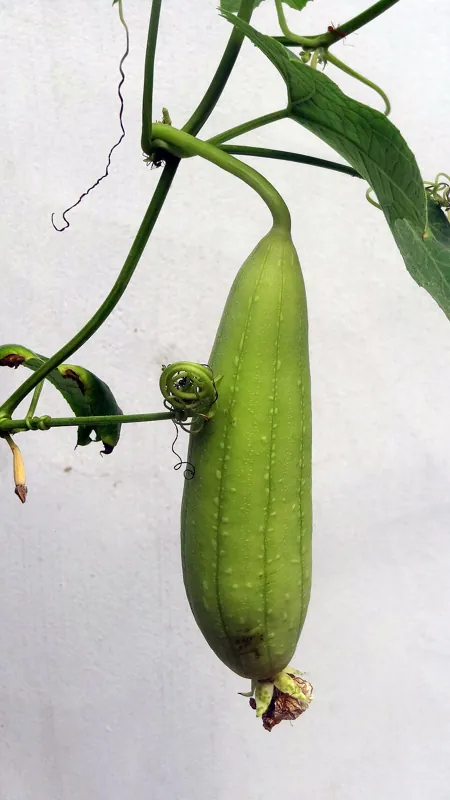
Cucumbers grow fine on the ground and better up a trellis, with straighter fruit in less space. Vining or bush, why you pick daily, and why a bitter one is stressed.
Photo: Maathavan · CC BY-SA 3.0, via Wikimedia Commons.
The packet’s word, “vining” (wants a trellis, or a meter or more3 feet or more of ground) or “bush” (a compact mound)
Warm soil and a frost-free forecast, because cucumbers stall in cold
The habit of picking every day or two once fruit starts
A cucumber is a vine that will happily sprawl 1.2–2 m4–7 ft across the ground, and nothing in the garden pays you back for a trellis more visibly. The same plant grown upward takes a quarter of the space and hangs straight fruit instead of curled, yellow-bellied ones. The fruit stays clean and easy to find, and the leaves dry faster, which matters because cucumbers are prone to mildew.
Should I grow a vining or a bush cucumber?
The packet’s word decides the plan, exactly as it does with squash. A vining cucumber is the classic. Give it a trellis and it climbs with tendrils, or give it ground and it runs. The planner marks it better with a support: the vine survives on the ground, and the trellis upgrades the harvest. A bush cucumber stays a compact mound, needs nothing, and is the sensible pick for a container or the smallest beds. The staking guide covers what the trellis itself can be. Tendrils grip mesh or netting far better than a smooth pole.
What do cucumbers need to get going?
Cucumbers are frost-tender and stall in cold soil, so sow direct once frost is past and the ground has warmed. They’re quick (50–70 days seed-to-harvest, a bush type 50–65) and gain little from an indoor head start. Then water evenly. A cucumber is mostly water, and a drought-stressed plant makes the bitter fruit the crop is notorious for. Deep, regular watering and a mulch are the actual fix (the watering guide applies in full), and modern varieties bred low in bitterness do the rest.
My cucumber has flowers but no fruit. Is something wrong?
The first flush of flowers often sets nothing. Cucumbers carry separate male and female flowers, the males usually open first, and only the females (the ones with a tiny fruit already behind the bloom) turn into cucumbers. A week of males-only is the plant getting started. Real fruit set needs insects moving pollen between the two, and the pollination guide covers what that means for a quiet bed.
How often should I pick, and what comes after?
Once fruit comes, pick every day or two at eating size. A single cucumber left to yellow and ripen its seed tells the whole vine to shut down, so never let one get away. Cucumbers are also cucurbits, one of the families the planner rotates.
Do not plant cucurbits in ground that held cucurbits within 2-3 years.
If you skip this, you lose real yield. The planner warns you.
How it works: Melittia cucurbitae overwinters as a pupa in the soil where its host grew and emerges the next summer; Anasa tristis overwinters as an adult in sheltered sites (plant debris, under boards or rocks) and flies to cucurbits in spring. A host-free break cuts local carryover, but both are strong fliers that re-invade from a distance, so rotation is only partial and works best paired with fall sanitation (destroy spent vines).
Evidence: checked against 4 sources in the research-based literature.
… squash vine borers spend the winter in the soil near their host plants ... Practice rotation ... planting cucurbits in different areas of your garden if possible, or alternate seasons
Crop rotation away from previously infested fields helps reduce local populations, as overwintering pupae remain in the soil. However ... fields often need to be rotated more than 5 miles away as SVB can fly into fields from long distances.
Squash bugs can live through the winter as adults in sheltered places, such as under plant debris, around buildings, or under rocks. When adults come out in the spring, they fly to growing cucurbit plants.
Plant cucurbits in different ground, or wait 3 years. Destroy the spent vines in autumn and clear debris and boards nearby. The pupae overwinter in the soil where the crop grew, the adults in the shelter around it. Rotation is only partial; both pests fly in from a distance.