Milpa Gardens Open the planner

Rhubarb

Rheum rhabarbarum · Polygonaceae

Rhubarb (Rheum rhabarbarum) is a perennial in the Polygonaceae.

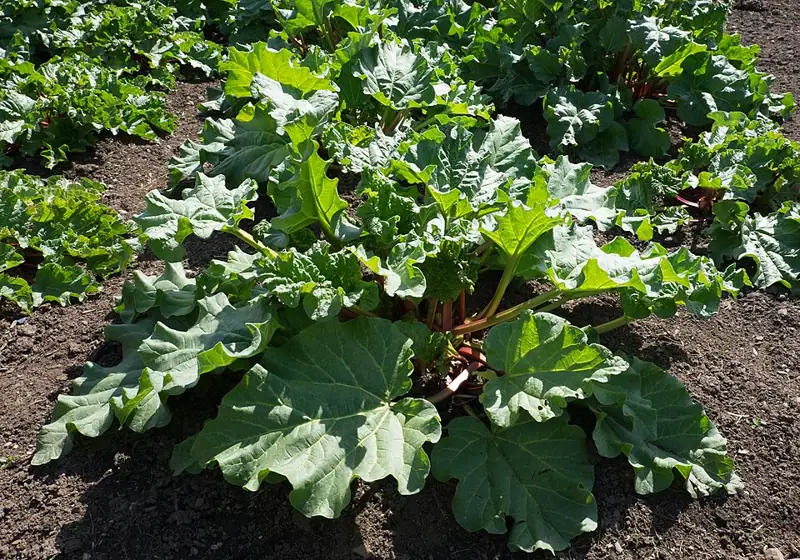
A rhubarb plant with large leaves and red stalks
Photo: DeFacto · CC BY-SA 4.0, via Wikimedia Commons.

When do I plant this? →

Open this plant in the planner →

What the corpus records

Spacing in row
91 cm
Mature height
61–122 cm
Mature spread
60–91 cm
Years to bearing
2
Hardiness zone
3–8
Light
Full sun
Feeding
Heavy feeder
Frost tolerance
Hardy
Lifespan
Perennial
Habit
Rosette
Value to pollinators
Low
Casts shade on neighbours
yes

Which of these numbers are soft

Every number above carries a confidence tier. These are the ones the corpus does not stand behind — estimated from general knowledge, or contested between sources. They are shown because hiding them would be the dishonest half of showing the rest.

Rules that apply to Rhubarb

Hardiness zone is the correct variable for perennials, and only for perennials.

Well established · suboptimal if ignored → advise

Mechanism: Zones encode average annual minimum winter temperature, which governs whether a woody perennial survives to spring. It is the wrong quantity for an annual, which never sees winter. THE CEILING IS A SECOND AND DIFFERENT MECHANISM, and until 2026-07-26 this rule enforced it without naming it. A zone too WARM does not kill a perennial; it fails to chill it. Deciduous fruit crops need a winter dormancy period to break bud and set fruit, so in a zone milder than a plant is adapted to it may survive and never crop. Until ISSUES #13 was decided the band was enforced at both ends; now (option E) only the cold end gates — it alone follows from the definition of the zone system — and the warm end is carried as an ADVISORY, not a refusal. AND THE WARM END IS A CULTIVAR'S ANSWER, NOT A SPECIES', which is the honest limit of what this rule can do. Chill requirement is published per variety and varies enormously within a species, so a species-level ceiling says "the modelled range does not reach your zone", never "no plant of this kind will crop for you". So the engine offers the plant above its band and advises choosing a cultivar rated for the zone rather than refusing it — the same move invariant 3 makes for soil, applied to chill.

Evidence: confirmed against 3 sources in the research-based literature.

the 3 sources

THE FLOOR IS TRUE BY DEFINITION and needs no citation: the USDA system defines a zone AS a band of average annual minimum winter temperature, so 'a plant colder-hardy than your zone survives your winter' is the definition restated. This rule was `verified_trivially` on that basis alone until 2026-07-26. THE CEILING WAS NEVER COVERED BY IT - a minimum-temperature definition says nothing about a plant failing for want of chill - and that gap is why ISSUES #13 exists. The pointer below closes it.

OSU Extension EC 1303, 'Growing blackberries in your home garden' (Bernadine Strik), catalog.extension.oregonstate.edu/sites/catalog/files/project/pdf/ec1303.pdf (read 2026-07-26). THE CEILING'S MECHANISM, STATED: 'Winter cold-hardy cultivars adapted to the colder regions of Oregon (such as zones 5 to 7), may not grow normally in regions of the Willamette Valley (zone 8) where winters are warmer and plants receive less winter chill.' A plant failing in a WARMER zone for want of chill - which is what this rule's upper bound enforces and what no source said until now. THE SAME PAGE MAKES IT A CULTIVAR PROPERTY: 'Even cultivars within the same type (trailing, erect or semierect) differ in fruit quality and flavor, appearance, tolerance to pests, cold hardiness, and plant longevity', and the remedy it gives is the one this rule's rejection text now repeats: 'Minimize risk by choosing types and cultivars that are adapted to your hardiness zone.' The page then publishes a table of sixteen cultivars EACH WITH ITS OWN ZONE RANGE, which is the strongest available evidence that a species-level band is an approximation. [read]

WHAT THIS DOES NOT SETTLE. The mechanism is now named, but the corpus still carries ONE band per species where the source carries one per cultivar, and 12 of 25 perennial zones have no citation at all. So the ceiling is explained without being precise. ISSUES #13 stays open on that, and the rejection text is deliberately phrased as 'the modelled range does not reach your zone' rather than as a prediction that nothing will crop.

Read the full rule · see it fire on your bed

Rhubarb leaf blades are poisonous and must never be eaten - only the leafstalks (the petioles) are edible. Harvest the stalks and cut the leaves off.

Well established · suboptimal if ignored → advise

Mechanism: The leaf blades hold a toxic concentration of oxalic acid - and, per NDSU, anthraquinone glycosides - which the edible petioles carry only in trace amounts. Oxalic acid binds calcium and can damage kidney function; eating the blades causes cramping, nausea and, in quantity, can be fatal. The stalks are safe because the toxins concentrate in the leaf, not the petiole.

Evidence: confirmed against 5 sources in the research-based literature.

the 5 sources

UW-Madison / Wisconsin Master Gardener (Susan Mahr), 'Rhubarb, Rheum rhabarbarum', mastergardener.extension.wisc.edu/files/2018/04/rhubarb.pdf (read 2026-08-05): 'The leaves, however, contain a toxic amount of oxalic acid and are poisonous. The ensuing cramps, nausea and sometimes death from ingestion suppressed interest in the plant for about two hundred years.'

NDSU Extension, 'Dakota Gardener: Is Frost-Damaged Rhubarb Toxic?', ag.ndsu.edu/news/columns/dakota-gardener/dakota-gardener-is-frost-damaged-rhubarb-toxic (read 2026-08-05), names BOTH compounds and the edible/toxic split outright: 'The leaves contain oxalic acid which can damage kidney function'; 'recent scientific studies show the presence of other compounds such as anthraquinone glycosides that may contribute to the toxicity of the leaves'; 'Rhubarb stems (petioles) which resemble celery stalks are the edible portion of the plant because they contain only trace amounts of toxic compounds.' The SAME page is why the frost->toxin belief is excluded: 'A hard freeze is widely believed to cause the movement of toxic compounds from the leaves into the stems' ... 'I could not find any scientific studies to confirm or disprove this belief.'

U. of Illinois Extension (Good Growing), 'To rhubarb or not to rhubarb?', extension.illinois.edu/blogs/good-growing/2023-06-08-rhubarb-or-not-rhubarb (read 2026-08-05): 'Do not consume leaf blades, they contain large amounts of oxalic acid which can limit the body's ability to take up calcium.'

UMN Extension, 'Growing rhubarb in home gardens', extension.umn.edu/vegetables/growing-rhubarb (read 2026-08-05): 'Rhubarb leaves are toxic. Do not eat them.'

NC State Extension Gardener Plant Toolbox, 'Rheum rhabarbarum', plants.ces.ncsu.edu/plants/rheum-rhabarbarum/ (read 2026-08-05): Poison Severity 'Medium'; Poison Parts 'Leaves'; Toxic Principle 'Anthraquinone glycosides and soluble oxalates'; Poison Symptoms 'TOXIC ONLY IF LARGE QUANTITIES EATEN. Abdominal cramps, burning of mouth and throat, headache, weakness, nausea and vomiting, coma; may be fatal'.

remedy

Cut the leaf blades off and discard them; eat only the stalks. Never cook or eat the leaves.

Read the full rule · see it fire on your bed

Another 61 rules in the corpus apply by situation rather than by species — rotation intervals, frost windows, sun, spacing and soil. Read the full evidence page.

All plants