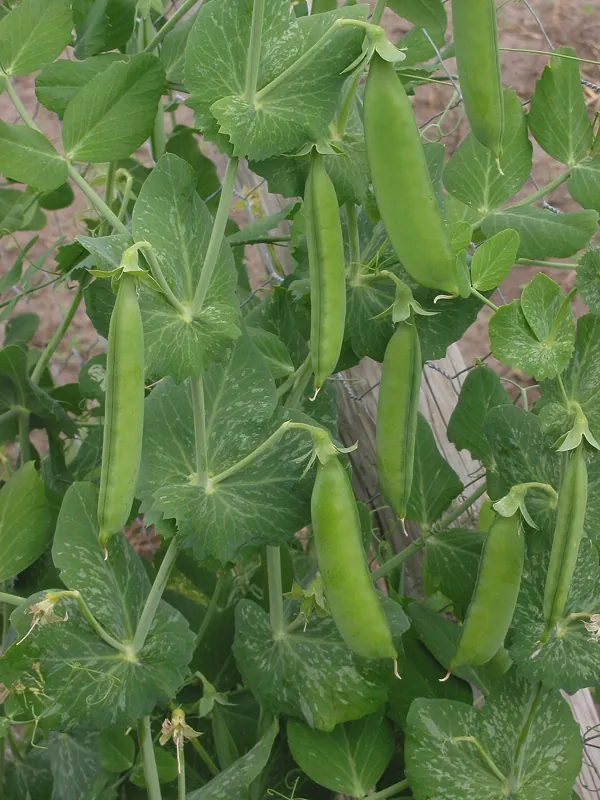
Needs a sturdy stake, cage or trellis (depends on the variety)
Cultivar groups
The same species behaves differently by cultivar group, so the planner resolves size, timing and support against the group rather than the species.
Bush Pea — bush, spacing in row 5 cm2 in, mature height 45–75 cm18–30 in, mature spread 20 cm8 in, days to maturity 55–65
Climbing Pea — vine, spacing in row 8 cm3 in, mature height 150–200 cm59–79 in, mature spread 20 cm8 in, days to maturity 60–70
Which of these numbers are soft
Every number above carries a confidence tier. These are the ones the corpus does not stand behind — estimated from general knowledge, or contested between sources. They are shown because hiding them would be the dishonest half of showing the rest.
ph range — estimated
Rules that apply to Pea
Promising
Do not plant legumes in ground that held legumes within 3 years; the root rots build where they repeat, and the worst of them outlast any garden rotation.
costly if ignored → warn
Mechanism: Bean and pea root rots (Fusarium solani, Rhizoctonia, Pythium, Aphanomyces) and white mold (Sclerotinia sclerotiorum) survive in soil as spores and sclerotia and build where legumes follow legumes; a three-year break holds the common ones down. Fusarium needs longer, and Aphanomyces oospores and white mold's sclerotia persist for many years, so rotation reduces but cannot clear them.
Evidence: confirmed against 4 sources in the research-based literature.
UMN Extension, Fruit and Vegetable News, 'Crop planning deep dive: Mind your Peas and Beans' (2021), blog-fruit-vegetable-ipm.extension.umn.edu/2021/04/2021-consideration-minding-your-peas.html (fetched in-container 2026-09-02; read by the maintainer 2026-09-02): 'Rotate away from legumes for more than 3 years'; 'More than 6 years is needed for some diseases (Fusarium, some damping off pathogens).'
UConn IPM, 'Molds and Mildews of Beans in Connecticut', ipm.cahnr.uconn.edu/molds-and-mildews-of-beans-in-connecticut (fetched in-container 2026-09-02; read by the maintainer 2026-09-02): white mold - 'Rotate away from susceptible crops for 7 years', it affects beans and 'practically all vegetable crops'; downy mildew - 'Rotate with other crops for 2 years.'
NDSU Agriculture, 'Field Pea and Lentil Root Rot Risk, Diagnosis and Resources', ndsu.edu/agriculture/ag-hub/field-pea-and-lentil-root-rot-risk-diagnosis-and-resources (fetched in-container 2026-09-02; read by the maintainer 2026-09-02): 'Fields with a long history of pulses in close rotations (every 2-3 years) are at greatest risk'; 'Chickpea, soybean, and faba bean are not susceptible to Aphanomyces euteiches and thus can be included in a rotation with pea and lentil to break up the disease cycle.'
remedy
Plant legumes in different ground, or wait until 3 years have passed since this ground last held them. Where root rot has shown, make it longer, and keep the ground draining freely: every one of these rots is worse in wet soil.
Cold-hardy annuals can be sown or transplanted before the last spring frost — hardy crops about three weeks before, half-hardy about two weeks before. Tender crops wait for the frost itself.
suboptimal if ignored → advise
Mechanism: Cold hardiness. Hardy crops tolerate hard frost and half-hardy crops tolerate light frost, so they can occupy the ground weeks before frost-tender crops are allowed in. The offset is measured from the last spring frost.
Evidence: confirmed against 4 sources in the research-based literature.
the 4 sources
University of Illinois Extension, 'Time Your Vegetable Plantings by Cold Hardiness' (2018-03-26), extension.illinois.edu/blogs/ilriverhort/2018-03-26-time-your-vegetable-plantings-cold-hardiness: very hardy vegetables 'withstand freezing temperatures and hard frosts without injury' (planted earliest in spring); frost-tolerant vegetables 'can withstand light frosts, but not freezing temperatures' (planted a couple of weeks later). LLM-summarised from a read of the page; it establishes the CATEGORIES but states no week offsets.
Colorado State Univ. Extension, GardenNotes #720, 'Vegetable Planting Guide', extension.colostate.edu/resource/vegetable-planting-guide (read 2026-07-25): hardy vegetables go in 'As early as 2-4 weeks before the date of the average last spring frost'; semi-hardy 'As early as 0-2 weeks before the date of the average last spring frost'; tender from seed 'around the date of the average last spring frost'; very tender 'Typically 2+ weeks after'. This is the source that states the offsets in weeks.
Where this rule sits in that range: hardy at 3 weeks is mid-range of CSU's 2-4. Half-hardy at 2 weeks is the EARLIEST EDGE of CSU's 0-2 - the most aggressive planting CSU sanctions, not the middle of it. The rule is inside published guidance at both ends, but it leans early on the half-hardy side and a gardener following it in a cold spring is taking that boundary.
Do not import an offset from another publication's hardiness scheme without checking the category names: CSU has no 'very hardy' tier, so a '4-6 weeks before frost' figure written against a four-tier scheme does not describe CSU's 'hardy'. Categories are not comparable across sources.
A legume fixes atmospheric nitrogen only in symbiosis with rhizobia specific to its cross-inoculation group; ground with no recent history of that group may carry too few of them to nodulate well.
suboptimal if ignored → advise
Mechanism: Nitrogen fixation happens in root nodules formed by Rhizobium or Bradyrhizobium bacteria specific to each legume group. On ground that has not grown that legume group before - a new bed, a soil-less mix, a long gap in the rotation, a fumigated or strongly acid soil - the matching strain can be absent or sparse, so nodulation and fixation are reduced until a population builds.
Evidence: confirmed against 1 source in the research-based literature.
the source
Penn State Extension, 'Inoculation of Forage and Grain Legumes', extension.psu.edu/inoculation-of-forage-and-grain-legumes (read 2026-08-14): 'Rhizobia bacteria are fairly specific as to which legumes they will infect, form nodules on the roots of, and for which they will fix nitrogen'; 'Legumes effectively nodulated by the same Rhizobia species are termed cross-inoculation groups'; 'Inoculation is recommended when the legume being planted has not been grown in that field in the past three years or with every planting of a high-value crop'; 'Inside the nodule, an enzyme called nitrogenase drives the N fixation reaction.'
remedy
On first-time legume ground, coat the seed at sowing with the inoculant matched to the crop's group (garden peas and beans, soybean, and clover each take a different one). Ground that has grown that legume recently usually needs none. It is a cheap one-time step - advised where the history is absent, never required.
Another 110 rules in the corpus apply by situation rather than by species — rotation intervals, frost windows, sun, spacing and soil. Read the full evidence page.
A garden-planning corpus: every claim states its evidence grade and links its sources on the page. Cite it with the grade, and add the date you read it.