Milpa Gardens
iniciar sesión

Traducción automática · Leer en inglés

Chícharo

Pea · Pisum sativum · leguminosas · USDA PLANTS: PISA6

De un vistazo

Luz
Pleno sol
Helada
Aguanta algo de frío
Soporte
Necesita un tutor firme, una jaula o una espaldera (depende de la variedad)
Ciclo de vida
Anual
En esta página

Las reglas y las notas de cosecha de esta página están traducidas automáticamente del inglés; sus fuentes, algunas notas y los títulos de las guías siguen en inglés.

Chícharo (Pisum sativum) es una planta anual (leguminosas).

También se conoce como Bush Pea, Climbing Pea.

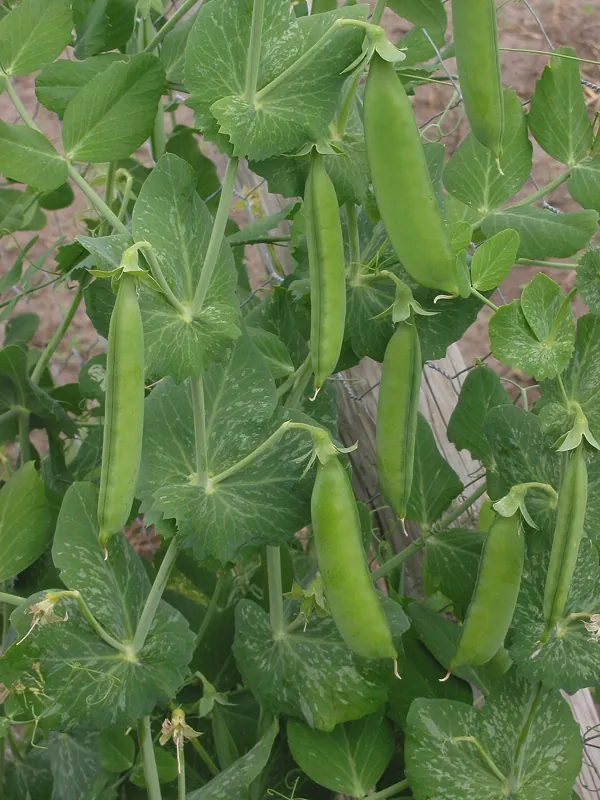
A pea plant with green pods on the vine
Photo: Rasbak · CC BY-SA 3.0, via Wikimedia Commons.

¿Cuándo siembro esto? →

Planéala en tu huerto →

Los números

Profundidad de siembra
2.5 cm1 in
pH del suelo
6–7
Luz
Pleno sol
Nutrientes
Produce su propio nitrógeno
Profundidad de la raíz
Poco profunda
Tolerancia a la helada
Aguanta algo de frío
Ciclo de vida
Anual
Valor para los polinizadores
Bajo
Fija nitrógeno
Sí
Soporte
Necesita un tutor firme, una jaula o una espaldera (depende de la variedad)

Antes de sembrar

Lo que la semilla necesita antes de brotar.

Temperatura del suelo para germinar
4–24 °C39–75 °F
Días para germinar
14–27 días

OSU Extension, J. F. Harrington 'Soil temperature conditions for vegetable seed germination', extension.oregonstate.edu/gardening/soil-compost/soil-temperature-conditions-vegetable-seed-germination (published 2013, reviewed 2024; fetched in-container 2026-09-19, NOT YET READ BY A HUMAN - evidence stays unverified until the maintainer reads it, invariant 4): the Pea row gives minimum 40 F, optimum range 40-75 F, optimum 75 F, maximum 85 F. Stored here is the OPTIMUM RANGE 40-75 F = 4-24 C (rounded from 4.4 and 23.9); the absolute maximum 85 F (29 C) is the failure edge and is not stored. U of Illinois Extension Hort Answers, web.extension.illinois.edu/hortanswers/plantdetail.cfm?PlantID=638&PlantTypeID=9 (fetched 2026-09-19) corroborates a practical floor: 'soil temperature is 45 degrees farenheit or higher' [sic]. NEGATIVE FINDING recorded here so it is not re-added by folk knowledge: the same U of I page advises AGAINST pre-soaking pea seed - 'Do not plant pea seeds in soaking soils ... as the seeds are liable to cracking before germination' - so no seed pre-treatment is recorded for peas; the common 'soak peas overnight' is contested by the source read. [drafted, awaiting maintainer read]

OSU Extension, Harrington table (same page and fetch as germination_soil_temp_c; NOT YET READ BY A HUMAN): 'days to seedling appearance' at 0.5 inch depth for Pea reads 50 F -> 27 days, 59 F -> 19, 68 F -> 14, 77 F -> 15; colder soil is far slower (41 F -> 57 days) and there is little or no germination at 32 F or at/above 95 F. Stored [14, 27] spans the realistic cool-season sowing band (68 F down to 50 F); the 57-day cold-soil figure is left out of the range as an outlier a spring gardener rarely meets. A JUDGEMENT the maintainer should confirm on read. [drafted, awaiting maintainer read]

En la cosecha, y en maceta

Lista cuando
Cosecha en cuanto los chícharos alcancen su tamaño completo, un poco más grandes que la semilla seca que plantaste.
Se conserva
alrededor de una semana, en frío y húmedo: de 0 °C32 °F a 4 °C40 °F, con humedad alta

University of Minnesota Extension, 'Growing peas in home gardens', extension.umn.edu/vegetables/growing-peas (fetched in-container 2026-09-25, read by the maintainer 2026-09-25): 'Harvest as soon as the peas have reached full size, slightly larger than the dry seed you planted.' [read]

University of Minnesota Extension, 'Harvesting and storing home garden vegetables', extension.umn.edu/planting-and-growing-guides/harvesting-and-storing-home-garden-vegetables (fetched in-container 2026-09-25, read by the maintainer 2026-09-25): the 'Peas' entry: 'Store in cold and moist conditions.'; 'The expected shelf-life is one week.'. [read]

Grupos de cultivares

No todas las plantas de chícharo crecen igual. Estos son sus tipos principales (sus grupos de cultivares), y el planeador calcula el tamaño, las fechas y el soporte de cada uno con sus propios números.

Números de los que estamos menos seguros

These are estimates from general gardening knowledge, or the sources disagree on them, so treat them as a starting point rather than a firm figure.

Reglas que se aplican a Chícharo

Prometedor No plantes leguminosas en tierra que tuvo leguminosas en los últimos 3 años; las pudriciones de raíz se acumulan donde se repiten, y las peores sobreviven a cualquier rotación de huerto.
Prometedor

No plantes leguminosas en tierra que tuvo leguminosas en los últimos 3 años; las pudriciones de raíz se acumulan donde se repiten, y las peores sobreviven a cualquier rotación de huerto.

si no se sigue, se pierde cosecha de verdad · el planeador te avisa

Mecanismo: Las pudriciones de raíz del frijol y del chícharo (Fusarium solani, Rhizoctonia, Pythium, Aphanomyces) y el moho blanco (Sclerotinia sclerotiorum) sobreviven en el suelo como esporas y esclerocios y se acumulan donde las leguminosas siguen a leguminosas; un descanso de tres años mantiene a raya las comunes. Fusarium necesita más tiempo, y las oosporas de Aphanomyces y los esclerocios del moho blanco persisten durante muchos años, así que la rotación los reduce pero no puede eliminarlos.

Evidence: confirmed against 4 sources in the research-based literature.

the 4 sources

Cornell Vegetables, 'Do Rotations Matter within Disease Management Programs?', vegetables.cornell.edu/pest-management/disease-factsheets/do-rotations-matter-within-disease-management-programs (fetched in-container 2026-09-02; read by the maintainer 2026-09-02): its rotation table gives beans root rots 3 years, white mold (Sclerotinia) 3 years, anthracnose 2 years; peas root rots 3-4 years, Fusarium wilt 4-5 years.

UMN Extension, Fruit and Vegetable News, 'Crop planning deep dive: Mind your Peas and Beans' (2021), blog-fruit-vegetable-ipm.extension.umn.edu/2021/04/2021-consideration-minding-your-peas.html (fetched in-container 2026-09-02; read by the maintainer 2026-09-02): 'Rotate away from legumes for more than 3 years'; 'More than 6 years is needed for some diseases (Fusarium, some damping off pathogens).'

UConn IPM, 'Molds and Mildews of Beans in Connecticut', ipm.cahnr.uconn.edu/molds-and-mildews-of-beans-in-connecticut (fetched in-container 2026-09-02; read by the maintainer 2026-09-02): white mold - 'Rotate away from susceptible crops for 7 years', it affects beans and 'practically all vegetable crops'; downy mildew - 'Rotate with other crops for 2 years.'

NDSU Agriculture, 'Field Pea and Lentil Root Rot Risk, Diagnosis and Resources', ndsu.edu/agriculture/ag-hub/field-pea-and-lentil-root-rot-risk-diagnosis-and-resources (fetched in-container 2026-09-02; read by the maintainer 2026-09-02): 'Fields with a long history of pulses in close rotations (every 2-3 years) are at greatest risk'; 'Chickpea, soybean, and faba bean are not susceptible to Aphanomyces euteiches and thus can be included in a rotation with pea and lentil to break up the disease cycle.'

solución

Planta las leguminosas en otra tierra, o espera a que pasen 3 años desde la última vez que esta tierra las tuvo. Donde haya aparecido pudrición de raíz, alarga ese plazo, y mantén la tierra con buen drenaje: todas estas pudriciones empeoran en suelo húmedo.

Lee la regla completa → · abrir en el planeador ↗

Prometedor Los cultivos anuales resistentes al frío se pueden sembrar o trasplantar antes de la última helada de primavera — los resistentes unas tres semanas antes, los semirresistentes unas dos semanas antes. Los sensibles esperan a la propia helada.
Prometedor

Los cultivos anuales resistentes al frío se pueden sembrar o trasplantar antes de la última helada de primavera — los resistentes unas tres semanas antes, los semirresistentes unas dos semanas antes. Los sensibles esperan a la propia helada.

si no se sigue, igual funciona, pero peor · el planeador lo sugiere

Mecanismo: Resistencia al frío. Los cultivos resistentes toleran heladas fuertes y los semirresistentes toleran heladas ligeras, así que pueden ocupar la tierra semanas antes de que se permita la entrada a los cultivos sensibles a las heladas. El desfase se mide desde la última helada de primavera.

Evidence: confirmed against 4 sources in the research-based literature.

the 4 sources

University of Illinois Extension, 'Time Your Vegetable Plantings by Cold Hardiness' (2018-03-26), extension.illinois.edu/blogs/ilriverhort/2018-03-26-time-your-vegetable-plantings-cold-hardiness: very hardy vegetables 'withstand freezing temperatures and hard frosts without injury' (planted earliest in spring); frost-tolerant vegetables 'can withstand light frosts, but not freezing temperatures' (planted a couple of weeks later). LLM-summarised from a read of the page; it establishes the CATEGORIES but states no week offsets.

Colorado State Univ. Extension, GardenNotes #720, 'Vegetable Planting Guide', extension.colostate.edu/resource/vegetable-planting-guide (read 2026-07-25): hardy vegetables go in 'As early as 2-4 weeks before the date of the average last spring frost'; semi-hardy 'As early as 0-2 weeks before the date of the average last spring frost'; tender from seed 'around the date of the average last spring frost'; very tender 'Typically 2+ weeks after'. This is the source that states the offsets in weeks.

Where this rule sits in that range: hardy at 3 weeks is mid-range of CSU's 2-4. Half-hardy at 2 weeks is the EARLIEST EDGE of CSU's 0-2 - the most aggressive planting CSU sanctions, not the middle of it. The rule is inside published guidance at both ends, but it leans early on the half-hardy side and a gardener following it in a cold spring is taking that boundary.

Do not import an offset from another publication's hardiness scheme without checking the category names: CSU has no 'very hardy' tier, so a '4-6 weeks before frost' figure written against a four-tier scheme does not describe CSU's 'hardy'. Categories are not comparable across sources.

Lee la regla completa → · abrir en el planeador ↗

Prometedor Los frijoles, los chícharos y otras leguminosas solo fijan nitrógeno con las bacterias del suelo adecuadas. Una tierra que no ha tenido su tipo recientemente puede tener muy pocas, así que fijan menos.
Prometedor

Los frijoles, los chícharos y otras leguminosas solo fijan nitrógeno con las bacterias del suelo adecuadas. Una tierra que no ha tenido su tipo recientemente puede tener muy pocas, así que fijan menos.

si no se sigue, igual funciona, pero peor · el planeador lo sugiere

Mecanismo: La fijación de nitrógeno ocurre en nódulos de la raíz formados por bacterias Rhizobium o Bradyrhizobium específicas de cada grupo de leguminosas. En una tierra que no ha tenido antes ese grupo de leguminosas - una cama nueva, una mezcla sin suelo, un largo intervalo en la rotación, un suelo fumigado o muy ácido - la cepa correspondiente puede faltar o ser escasa, así que la nodulación y la fijación se reducen hasta que se forma una población.

Evidence: confirmed against 1 source in the research-based literature.

the source

Penn State Extension, 'Inoculation of Forage and Grain Legumes', extension.psu.edu/inoculation-of-forage-and-grain-legumes (read 2026-08-14): 'Rhizobia bacteria are fairly specific as to which legumes they will infect, form nodules on the roots of, and for which they will fix nitrogen'; 'Legumes effectively nodulated by the same Rhizobia species are termed cross-inoculation groups'; 'Inoculation is recommended when the legume being planted has not been grown in that field in the past three years or with every planting of a high-value crop'; 'Inside the nodule, an enzyme called nitrogenase drives the N fixation reaction.'

solución

En tierra que tiene leguminosas por primera vez, cubre la semilla al sembrar con el inoculante que corresponde al grupo del cultivo (los chícharos y frijoles de huerto, la soja y el trébol llevan cada uno uno distinto). Una tierra que ha tenido esa leguminosa recientemente por lo general no necesita ninguno. Es un paso barato que se hace una sola vez - recomendado donde falta el historial, nunca obligatorio.

Lee la regla completa → · abrir en el planeador ↗

Otras 120 reglas dependen de tu huerto y no de la planta — rotación de cultivos, fechas de helada, sol, distancia entre plantas y suelo. Velas todas.

Equipos de plantas que la incluyen

Sigue leyendo

Cita esta página

Milpa Gardens. "Chícharo (Pisum sativum)." https://milpa.garden/es/plants/pisum-sativum/

A garden-planning corpus: every claim states its evidence grade and links its sources on the page. Cite it with the grade, and add the date you read it.

Todas las plantas