Milpa Gardens
Sign in

Leer en español

Wild lupine

Lupinus perennis · legumes

At a glance

Light
Full sun
Frost
Hardy (estimate)
Hardiness zone
3–8
Lifespan
Perennial
On this page
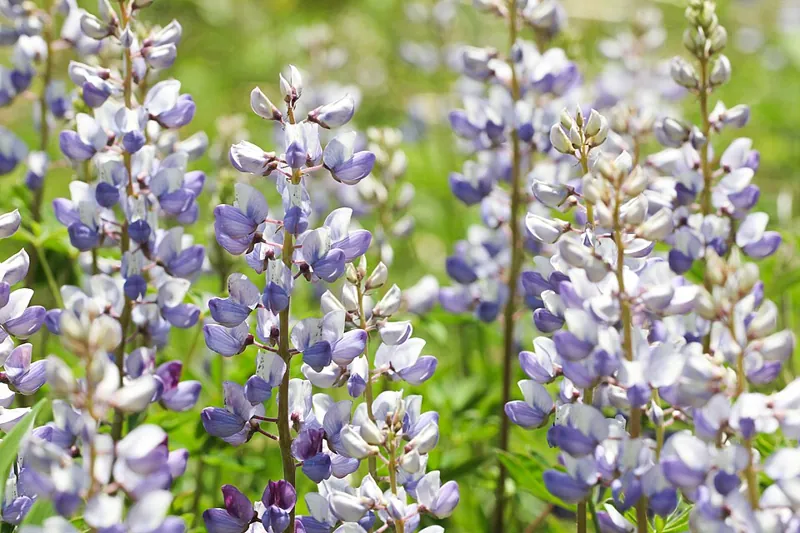
Wild lupine with blue flower spikes
Photo: cassi saari · CC BY-SA 4.0, via Wikimedia Commons.

When do I plant this? › Plan this in your garden ›

The numbers

Mature height
30–60 cm12–24 in (estimate)
Mature spread
30 cm12 in (estimate)
Hardiness zone
3–8
Light
Full sun
Feeding
Makes its own nitrogen
Root depth
Deep
Frost tolerance
Hardy (estimate)
Lifespan
Perennial
Habit
Bush
Value to pollinators
High
Fixes nitrogen
Yes

USDA PLANTS profile

Before you sow

What the seed asks for before it will come up.

Germination soil temperature
21–29 °C70–84 °F
Days to germinate
2–3 days
The 3 sources

research.fs.usda.gov

Lupinus perennis USDA Forest Service, Fire Effects Information System

USDA Forest Service FEIS

fs.usda.gov

Numbers we’re less sure of

Many of our estimates come from an extension page we’ve read that gets close without pinning the number down. Others are still our own best guess, and on some the sources disagree. Treat them all as a starting point.

Rules that apply to wild lupine

Hardiness zone is the correct variable for perennials, and only for perennials. Well established

Hardiness zone is the correct variable for perennials, and only for perennials.

Well established

If you skip this, it still grows, just less well. The planner suggests it.

How it works: Zones encode average annual minimum winter temperature, which governs whether a woody perennial survives to spring. It is the wrong quantity for an annual, which never sees winter. A zone that is too warm is a second, different mechanism. Mild winters do not kill a perennial; they fail to chill it. Deciduous fruit crops need a winter dormancy period to break bud and set fruit, so in a zone milder than a plant is adapted to it may survive and never crop. Only the cold end is enforced, because only winter survival follows from what a zone measures; the warm end gets advice and is never refused. That warm limit is a property of the cultivar, and that limits what this rule can do. Chill requirement is published per variety and varies enormously within a species, so a species-level ceiling says "the modeled range does not reach your zone", never "no plant of this kind will crop for you". So above its range the planner still offers the plant, with advice to choose a cultivar rated for your zone.

Evidence: checked against 1 source in the research-based literature.

The source

extension.oregonstate.edu

Growing blackberries in your home garden OSU Extension EC 1303
Winter cold-hardy cultivars adapted to the colder regions of Oregon (such as zones 5 to 7), may not grow normally in regions of the Willamette Valley (zone 8) where winters are warmer and plants receive less winter chill.

Plus 2 working notes on how the sources were read.

Read the full rule › · open in the planner ›

Do not plant legumes in ground that held legumes within 3 years; the root rots build where they repeat, and the worst of them outlast any garden rotation. Promising

Do not plant legumes in ground that held legumes within 3 years; the root rots build where they repeat, and the worst of them outlast any garden rotation.

Promising

If you skip this, you lose real yield. The planner warns you.

How it works: Bean and pea root rots (Fusarium solani, Rhizoctonia, Pythium, Aphanomyces) and white mold (Sclerotinia sclerotiorum) survive in soil as spores and sclerotia and build where legumes follow legumes; a three-year break holds the common ones down. Fusarium needs longer, and Aphanomyces oospores and white mold's sclerotia persist for many years, so rotation reduces but cannot clear them.

Evidence: checked against 4 sources in the research-based literature.

The 4 sources

vegetables.cornell.edu

We summarise this source in our notes rather than quote a line from it.

blog-fruit-vegetable-ipm.extension.umn.edu

Crop planning deep dive: Mind your Peas and Beans UMN Extension, Fruit and Vegetable News
Rotate away from legumes for more than 3 years

ipm.cahnr.uconn.edu

Molds and Mildews of Beans in Connecticut UConn IPM
Rotate away from susceptible crops for 7 years

ndsu.edu

Field Pea and Lentil Root Rot Risk, Diagnosis and Resources NDSU Agriculture
Fields with a long history of pulses in close rotations (every 2-3 years) are at greatest risk
Remedy

Plant legumes in different ground, or wait until 3 years have passed since this ground last held them. Where root rot has shown, make it longer, and keep the ground draining freely, because every one of these rots is worse in wet soil.

Read the full rule › · open in the planner ›

Beans, peas and other legumes only fix nitrogen with the right soil bacteria. Ground that hasn't grown their kind recently may have too few, so they fix less. Promising

Beans, peas and other legumes only fix nitrogen with the right soil bacteria. Ground that hasn't grown their kind recently may have too few, so they fix less.

Promising

If you skip this, it still grows, just less well. The planner suggests it.

How it works: Nitrogen fixation happens in root nodules formed by Rhizobium or Bradyrhizobium bacteria specific to each legume group. On ground that has not grown that legume group before (a new bed, a soil-less mix, a long gap in the rotation, a fumigated or strongly acid soil), the matching strain can be absent or sparse, so nodulation and fixation are reduced until a population builds.

Evidence: checked against 1 source in the research-based literature.

The source

extension.psu.edu

Inoculation of Forage and Grain Legumes Penn State Extension
Rhizobia bacteria are fairly specific as to which legumes they will infect, form nodules on the roots of, and for which they will fix nitrogen
Remedy

On first-time legume ground, coat the seed at sowing with the inoculant matched to the crop's group (garden peas and beans, soybean, and clover each take a different one). Ground that has grown that legume recently usually needs none. It is a cheap one-time step, advised where the history is absent and never required.

Read the full rule › · open in the planner ›

Frost can form on a night the forecast low is a few degrees above freezing. Promising

Frost can form on a night the forecast low is a few degrees above freezing.

Promising

If you skip this, the planting fails. The planner warns you.

How it works: On a clear, still night leaves lose heat to the open sky, so a leaf can fall to freezing and ice can form in it while the thermometer, a couple of meters up, still reads a few degrees above.

Evidence: checked against 7 sources in the research-based literature.

The 7 sources

www.weather.gov

Frost and Freeze Information NWS Tallahassee
Issued up to 24 hours when temperature is forecast to be between 32° and 36° on nights with calm winds

www.weather.gov

Freeze Watches and Warnings National Weather Service
… temperatures below 28°F for an extended period of time can kill most types of commercial crops and residential plants.

ipm.ucanr.edu

Freezing and Frost UC Statewide IPM Program
Frost occurs when air is warmer than 32°F but plant tissues drop to 32°F or below because plants radiate (lose) heat into the atmosphere, especially during cool, clear nights.

yardandgarden.extension.iastate.edu

Fall Planting of Vegetables Iowa State University Yard and Garden, Aaron Steil and Kim Hilgers
Tender crops will be damaged or destroyed by a light frost

extension.sdstate.edu

Fall Frost Tolerance of Common Vegetables SDSU Extension, Rhoda Burrows
Crops from more-temperate regions can withstand light freezes (28 to 32 degrees Fahrenheit):

extension.umn.edu

A Minnesota guide to garden timing UMN Extension, Robin Trott
A light frost (32°F) can damage tender plants, while a hard frost (28°F or colder) will kill most warm-season crops.

extension.colostate.edu

Frost Protection and Extending the Growing Season CSU Extension GardenNotes #722, Whiting, O'Meara and Wilson
Radiation frosts occur on calm clear nights that lack cloud cover to hold in heat.
Remedy

The evening before, cover the crops at risk with a sheet or frost cloth, never plastic, reaching the ground and loose at the bottom so the soil's warmth can rise under it, and take it off in the morning. A cover helps least in a long, hard freeze.

Read the full rule › · open in the planner ›

A cover buys cool-season crops a week or two at the ends of the season. A good hunch

A cover buys cool-season crops a week or two at the ends of the season.

A good hunch

If you skip this, it still grows, just less well. The planner suggests it.

How it works: Soil warmed by the sun by day is the heat source at night; a covering low to the ground traps that heat around the plants on calm, clear nights, keeping them a few degrees above the open air through the light frosts at each end of the season.

Evidence: checked against 6 sources in the research-based literature.

The 6 sources

yardandgarden.extension.iastate.edu

All About Cold Frames Iowa State University Extension and Outreach, Aaron Steil
The ground and frame of the cold frame are heated by the sun during the day and radiate that heat during the night, keeping the inside warmer. They are used to extend the growing season by two to four weeks in both the fall and the spring, allowing you to start plants outdoors earlier and continue growing them later in the season.

extension.colostate.edu

Frost Protection and Extending the Growing Season CSU Extension GardenNotes #722, Whiting, O'Meara and Wilson
In trials in Fort Collins, Colorado, a plastic cover on a frame typically provides 3°F to over 6°F of frost protection. It works well for cool season crops that are somewhat tolerant of frosty nights and adds two to six weeks or more on both ends of the growing season.

class.ucanr.edu

Frost Protection and Extending the Growing Season CSU Extension GardenNotes #722, Whiting, O'Meara and Wilson
Soil warmed by the sun in the daytime, is the source of heat for frost protection at night. Moist, smooth soil absorbs more heat. To trap heat from the soil around young vegetables at night, place a covering that is low to the ground and spreading. To recharge the heat source for the next night, any covering must allow sunlight to shine through to the soil or must be removed in the daytime.

extension.usu.edu

Extending the Garden Season Utah State University Extension, Beddes, Caron, Hansen and Gunnell
Low = Plant 1–2 weeks before suggested planting date; Medium = 2–4 weeks before suggested planting date; High = 4–8 weeks before average planting date

hort.extension.wisc.edu

Floating Row Cover University of Wisconsin-Madison Extension, Wisconsin Horticulture, Susan Mahr
Depending on the weight of the covering you choose, you can gain between 2 and 8 degrees of frost protection or warm the local environment sufficiently to harvest certain crops a week or two early.

uaex.uada.edu

Row covers for vegetable gardening University of Arkansas System Division of Agriculture, Cooperative Extension Service
Clear plastic is useless in providing frost protection because the radiant energy released from the soil on those frosty nights passes right through the covering and never warms the air around the plants.
Remedy

Sow or set out cool-season crops under the cover that many weeks ahead of the open-ground date, and keep autumn crops covered past the usual last call. Vent on sunny days, keep plastic off the leaves, and close the cover before sunset.

Read the full rule › · open in the planner ›

Another 138 rules depend on your own garden, like crop rotation, frost dates, sun, spacing and soil. See them all.

Plant teams that place it

When do I plant wild lupine? ›

What grows well with wild lupine? · Something wrong with your wild lupine?

More ways Milpa can help

When do I plant? · What grows well together? · Plan my garden · What can I plant now? · Something wrong in the garden? · Keep a garden diary · Heard a tip?

Cite this page

Milpa Gardens. “Wild lupine (Lupinus perennis).” https://milpa.garden/plants/lupinus-perennis/

A garden planner built on graded evidence. Every claim states its evidence grade and links its sources on the page. Cite it with the grade, and add the date you read it.

Report a problem with this page

All plants