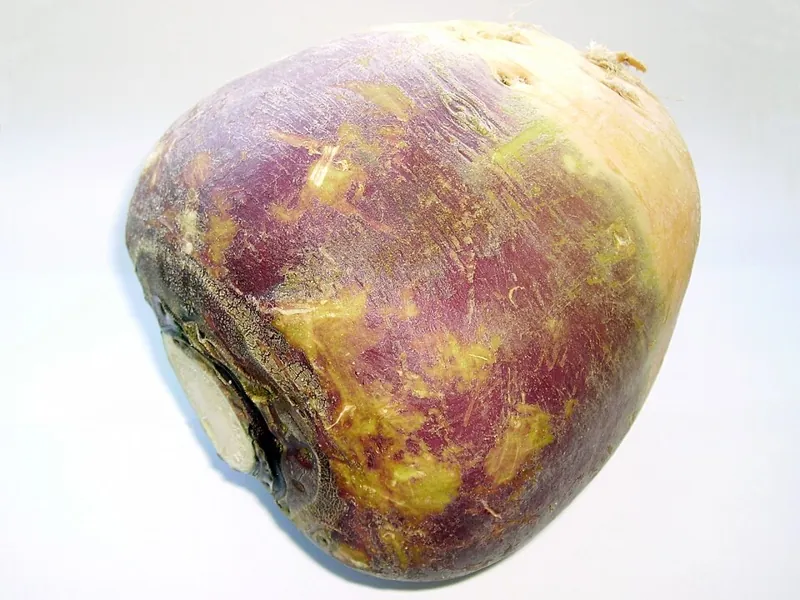
Many of our estimates come from an extension page we’ve read that gets close without pinning the number down. Others are still our own best guess, and on some the sources disagree. Treat them all as a starting point.
Mature spread — an estimate
Soil pH (in water) — an estimate
Mature height — an estimate
Spacing in row — sources disagree
Rules that apply to rutabaga
Do not plant brassicas in ground that held brassicas within 4 years (extension recommends 4-7, and even that is not a cure). Promising
Do not plant brassicas in ground that held brassicas within 4 years (extension recommends 4-7, and even that is not a cure).
If you skip this, you lose real yield. The planner warns you.
How it works: Plasmodiophora brassicae forms thick-walled resting spores that survive in soil more than 10 years. They germinate in wet, acidic soil (pH < 7); liming above ~7.2 suppresses infection. Spores outlast any garden rotation, so a host-free break reduces but does not clear inoculum.
Evidence: checked against 3 sources in the research-based literature.
Plant brassicas in different ground, or wait at least 4 years (extension recommends 4 to 7). Rotation alone is not a cure, because the resting spores outlast it. Raising soil pH above ~7.2 suppresses infection.
If you skip this, it still grows, just less well. The planner suggests it.
How it works: Excess N drives foliage at the expense of root bulking. (Forking is a separate problem, caused by rocks, compaction, or coarse/fresh organic matter in the root path. Nitrogen does not cause it.)
Evidence: checked against 2 sources in the research-based literature.
On ground that has carried brassicas within the rotation interval, a measured soil pH below about 7.2 leaves clubroot's door open; raising it is the lever every clubroot guide we read names, and the direction is all we give. Promising
On ground that has carried brassicas within the rotation interval, a measured soil pH below about 7.2 leaves clubroot's door open; raising it is the lever every clubroot guide we read names, and the direction is all we give.
If you skip this, it still grows, just less well. The planner suggests it.
How it works: Plasmodiophora brassicae's resting spores germinate in wet soil below about pH 7.0, and alkaline soil with high calcium suppresses the infection; liming to 7.1 to 7.5 slowly reduces severity but is not reliable once an infestation is established.
Evidence: checked against 4 sources in the research-based literature.
It is essential that hydrated lime be added each year unless the soil pH exceeds 7.5
Remedy
Raise this ground's pH toward 7.2 with lime well ahead of planting, using calcitic lime unless your magnesium is low (then dolomitic), and watch for boron shortage on coarse soils once the pH is up. Your lab gives the amount of lime, from a lime requirement test of your soil, and we don't. Rotation stays the first lever; this is the second.
If you skip this, it still grows, just less well. The planner suggests it.
How it works: Resource concentration. A specialist locates and holds its host more efficiently at higher host density and continuity, so an unbroken run of one family across adjacent beds is an easier target than the same family separated by a non-host (associational resistance).
Evidence: checked against 2 sources in the research-based literature.
The 2 sources
Organization of a plant-arthropod association in simple and diverse habitats: the fauna of collards (Brassica oleracea) Root 1973
… the resource concentration hypothesis, which states that herbivores are more likely to find and remain on hosts that are growing in dense or nearly pure stands; that the most specialized species frequently attain higher relative densities in simple environments.
Flea beetle movement in a broccoli monoculture and diculture Elmstrom, Andow & Barclay 1988
… strong, direct support for the hypothesis that host plants are harder to find and easier to lose in vegetationally diverse habitats than in monocultures.
Remedy
Where one family fills adjacent beds in a single season, breaking the run with a non-host family between them lengthens the distance the specialist must travel to the next host. The app discloses this and never docks a score. A continuous single-family block can be the right call anyway (a wind-pollinated crop like corn sets better massed), so the app names the trade-off and leaves the choice to the gardener.
Cold-hardy annuals can be sown or transplanted before the last spring frost (hardy crops about three weeks before, half-hardy about two weeks before). Tender crops wait for the frost itself. Promising
Cold-hardy annuals can be sown or transplanted before the last spring frost (hardy crops about three weeks before, half-hardy about two weeks before). Tender crops wait for the frost itself.
If you skip this, it still grows, just less well. The planner suggests it.
How it works: Cold hardiness. Hardy crops tolerate hard frost and half-hardy crops tolerate light frost, so they can occupy the ground weeks before frost-tender crops are allowed in. The offset is measured from the last spring frost.
Evidence: checked against 2 sources in the research-based literature.
If you skip this, the planting fails. The planner warns you.
How it works: On a clear, still night leaves lose heat to the open sky, so a leaf can fall to freezing and ice can form in it while the thermometer, a couple of meters up, still reads a few degrees above.
Evidence: checked against 7 sources in the research-based literature.
Frost occurs when air is warmer than 32°F but plant tissues drop to 32°F or below because plants radiate (lose) heat into the atmosphere, especially during cool, clear nights.
Radiation frosts occur on calm clear nights that lack cloud cover to hold in heat.
Remedy
The evening before, cover the crops at risk with a sheet or frost cloth, never plastic, reaching the ground and loose at the bottom so the soil's warmth can rise under it, and take it off in the morning. A cover helps least in a long, hard freeze.
If you skip this, it still grows, just less well. The planner suggests it.
How it works: Soil warmed by the sun by day is the heat source at night; a covering low to the ground traps that heat around the plants on calm, clear nights, keeping them a few degrees above the open air through the light frosts at each end of the season.
Evidence: checked against 6 sources in the research-based literature.
The ground and frame of the cold frame are heated by the sun during the day and radiate that heat during the night, keeping the inside warmer. They are used to extend the growing season by two to four weeks in both the fall and the spring, allowing you to start plants outdoors earlier and continue growing them later in the season.
In trials in Fort Collins, Colorado, a plastic cover on a frame typically provides 3°F to over 6°F of frost protection. It works well for cool season crops that are somewhat tolerant of frosty nights and adds two to six weeks or more on both ends of the growing season.
Soil warmed by the sun in the daytime, is the source of heat for frost protection at night. Moist, smooth soil absorbs more heat. To trap heat from the soil around young vegetables at night, place a covering that is low to the ground and spreading. To recharge the heat source for the next night, any covering must allow sunlight to shine through to the soil or must be removed in the daytime.
Low = Plant 1–2 weeks before suggested planting date; Medium = 2–4 weeks before suggested planting date; High = 4–8 weeks before average planting date
hort.extension.wisc.edu
Floating Row CoverUniversity of Wisconsin-Madison Extension, Wisconsin Horticulture, Susan Mahr
Depending on the weight of the covering you choose, you can gain between 2 and 8 degrees of frost protection or warm the local environment sufficiently to harvest certain crops a week or two early.
Clear plastic is useless in providing frost protection because the radiant energy released from the soil on those frosty nights passes right through the covering and never warms the air around the plants.
Remedy
Sow or set out cool-season crops under the cover that many weeks ahead of the open-ground date, and keep autumn crops covered past the usual last call. Vent on sunny days, keep plastic off the leaves, and close the cover before sunset.
If you skip this, you lose real yield. The planner warns you.
How it works: A hardy or half-hardy crop's tissue survives the ice of a light freeze down to about 28 °F (-2 °C), so its season ends at the first night that cold, which comes after the first 32 °F frost, and later still where winters are mild.
Evidence: not yet confirmed. It is cited to 8 sources, which a person has yet to read.
Tender crops will be damaged or destroyed by a light frost, semi-hardy crops can tolerate temperatures in the upper 20s°F, and hardy crops will survive temperatures in the mid to low 20s°F.
This temperature threshold kills some types of commercial crops and residential plants, while temperatures below 28°F for an extended period of time can kill most types of commercial crops and residential plants.
A garden planner built on graded evidence. Every claim states its evidence grade and links its sources on the page. Cite it with the grade, and add the date you read it.