Garden folklore about moon planting, midday watering and talking to plants
Old beliefs that cost nothing to hold, except the one that leaves a wilting plant unwatered in a heatwave. What's known about each.
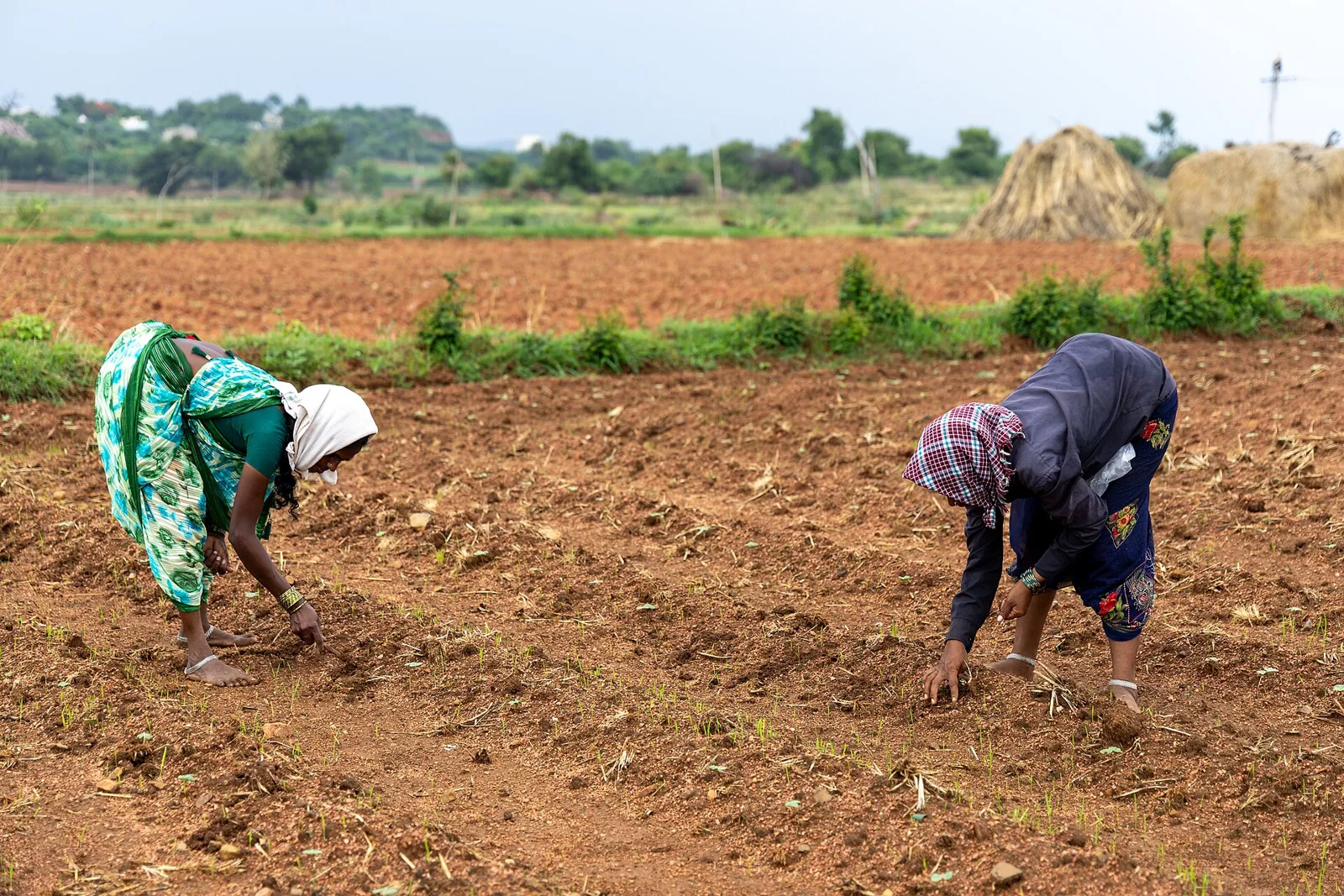
Photo: Vraj Acharya, WELL Labs · CC BY-SA 4.0, via Wikimedia Commons.
What you need
Nothing. This one is about what to stop worrying about
The remedies in the soil myths and homemade pest guides are about doing something: burying, spraying, mixing. This guide covers the beliefs about when you garden and how you behave around plants. It’s a gentler category, and mostly a harmless one.
Mostly. One of them regularly stops people watering a plant that needs water.
Each card below says how sure the evidence is. Of these three cards, two have been checked against their sources by a person and one isn’t confirmed yet because a person has yet to read its sources.
Is there a garden habit that's costing me?
Watering plants in the midday sun scorches the leaves (water droplets focus sunlight like lenses).
Watering in the midday sun won't scorch your leaves. Droplets don't focus sunlight on ordinary leaves. Water whenever the plant needs it, and aim at the soil and keep the leaves dry, because wet foliage invites fungal disease. Morning or evening watering just loses less to evaporation than the middle of the day.
What is known
Water droplets on a leaf do not focus the sun into a burn. On smooth, hairless leaves, sunlit drops of every shape caused no burn damage in a controlled optics study, and wet foliage is not prone to sunburn. The rare exception is a leaf whose water-repellent hairs hold a round drop just above the surface, as on a floating fern. There the drop can focus light and, out of contact with the leaf, no longer cools it. Hundreds of studies of leaf scorch have never pinned it on midday watering. What timing does affect is efficiency. Watering in the heat of the day loses more to evaporation than morning or evening watering, though evening watering can help fungal disease take hold. That is one more reason to put the water on the soil and keep it off the foliage.
Leaf damage can occur due to many causes: too much or too little moisture, insect damage, disease, over-fertilization, and weather conditions such as wind or frost, not sun scorching.
Hundreds of scientific publications on crop plants, turf, woody shrubs and trees have examined foliar scorch, and not one of them has implicated midday irrigation as a causal agent.
… sunlit water drops, ranging from spheroid to flat lens-shaped, on horizontal hairless leaves of Ginkgo biloba and Acer platanoides did not cause burn damage
This is the most widely believed piece of garden physics there is, and the physics is wrong.
The claim is that water droplets act as lenses, focusing sunlight and burning the leaf. They don’t. A droplet’s focal point sits below the leaf surface, so there’s nothing on the leaf to concentrate light onto, and on a flat leaf the droplet evaporates long before it could do anything anyway. Controlled trials find no scorching on smooth leaves. (Densely hairy leaves that hold a droplet up above the surface are a rare theoretical exception. They aren’t the everyday vegetable-garden case.)
Why this one matters more than the others: it changes what you do at the worst possible moment. It’s 34°C93°F, a plant is visibly wilting, and the gardener waits until evening to avoid scorching the leaves. The scorch was never possible. The drought stress was.
If a plant needs water, water it.
There are two real reasons behind the folk advice, and they’re worth keeping while you drop the lens story:
Aim at the soil. Wet foliage invites fungal disease. This is a good habit, and it has nothing to do with sunlight.
Morning or evening wastes less. Less is lost to evaporation, so more of what you pour reaches the root. That’s about efficiency. Safety doesn’t come into it.
That’s how folklore survives: the conclusion is half-reasonable, so nobody examines the reason. The watering guide covers the parts that hold up.
Does planting by the moon do anything?
Planting by lunar phase improves germination and yield.
We summarise this source in our notes rather than quote a line from it.
The corpus’s entry on this is four words long: no mechanism, no trials.
“No mechanism” is a specific and fairly damning thing to say. The moon does move the oceans, so the idea isn’t absurd on its face. But tidal force scales with the mass of the thing being pulled, and a seed in a seedbed is not an ocean. Nobody has proposed a route by which the moon’s phase reaches a germinating seed, and nobody has run the trials that would let us skip the mechanism and look at outcomes.
What governs germination is measurable: soil temperature, and whether the frost risk has passed. The planting calendar is built on those two things, and they’re why a calendar keyed to your own frost dates beats one keyed to anything else.
If you enjoy planting by the moon, it costs nothing. It’s a schedule, and any schedule gets you outside on a regular basis. Just let the soil thermometer overrule it.
Does talking to plants help? If so, why?
Talking to your plants, or playing them music, makes them grow better.
Talking to your plants won't grow them faster. You'd need to talk for hours a day for your breath to make a difference. Plants do respond to sound in the lab, but the music experiments are shaky and nothing shows a playlist helps a garden. Give them light, water and nutrients; chat to them if you enjoy it.
What is known
There is no definitive evidence that talking to plants helps them grow. The exhaled-carbon- dioxide idea fails on scale. You would have to talk to a plant for several hours a day to raise photosynthesis enough to matter. Sound itself is a live research question. Plants do respond to sound in lab studies, and one found seed germination affected at 92 decibels, far louder than speech. But the early music experiments lacked proper controls and results remain hard to reproduce, so nothing shows that music grows a garden plant better. What reliably helps is the basics of light, water and mineral nutrition.
Popular works such as The Secret Life of Plants and early experiments by Retallack suggested that plants might respond differently to various types of music, although these studies lacked rigorous experimental controls.
There’s no reliable, repeatable effect from talking to plants or playing them music. The proposed physical mechanisms, a trace of exhaled carbon dioxide or sound vibration, are far too small to matter against normal air movement and wind.
Read this entry closely, though, because the correction doesn’t end at “no”.
The occasional positive result is real, and it has an explanation: the attention. Someone who talks to their plants is regularly close to them, looking at them. They notice thirst a day earlier. They spot aphids while it’s still ten aphids. They see that the light is wrong before the plant has stretched.
So the practice does go with better outcomes, and the mechanism is how often you look. Sound has nothing to do with it. That moves the credit to where it belongs more than it debunks anything.
Do it if you enjoy it. Then act on what you noticed while you were there.
Why even mention these old sayings?
None of these three is dangerous the way sand-in-clay or dish soap is. Two are entirely harmless, and the third only costs you on a hot afternoon.
They’re kept in the record anyway, for the same reason everything else here is: a claim that was checked and failed is worth more to you than one nobody checked. Deleting the moon-planting entry wouldn’t make the belief go away. It would just mean the next gardener who meets it has no way to find out whether anyone looked.
Together, the three map the whole range this site deals in. One is wrong and it changes what you do. One is unsupported and inert. One is unsupported, but the habit wrapped around it is good for the plant. Very little garden advice is plainly true or plainly false, and sorting out which kind you’re holding is most of the skill.