Milpa Gardens
iniciar sesión

Traducción automática · Leer en inglés

Cabbage

Brassica oleracea · brasicáceas · USDA PLANTS: BROL

De un vistazo

Luz
Pleno sol
Helada
Resistente
Ciclo de vida
Bienal
En esta página

Las reglas y las notas de cosecha de esta página están traducidas automáticamente del inglés; sus fuentes, algunas notas y los títulos de las guías siguen en inglés.

Cabbage (Brassica oleracea) es una planta bienal (brasicáceas).

También se conoce como Broccoli, Kale, Cauliflower, Brussels Sprouts, Kohlrabi, Collards.

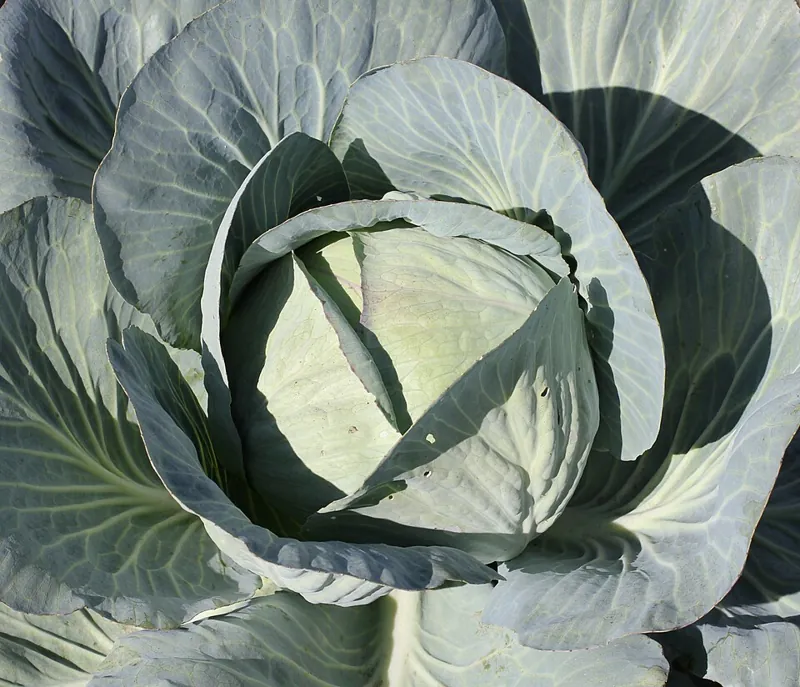
A green cabbage head with tight wrapping leaves
B. oleracea also includes broccoli, cauliflower and kale by cultivar group. Photo: George Chernilevsky · Public domain, via Wikimedia Commons.

¿Cuándo siembro esto? →

Planéala en tu huerto →

Los números

Profundidad de siembra
1.3 cm0.5 in
pH del suelo
6.2–7.5
Luz
Pleno sol
Nutrientes
Muy exigente
Profundidad de la raíz
Media
Tolerancia a la helada
Resistente
Ciclo de vida
Bienal
Forma de crecer
Roseta
Valor para los polinizadores
Ninguno

Antes de sembrar

Lo que la semilla necesita antes de brotar.

Temperatura del suelo para germinar
7–35 °C45–95 °F
Días para germinar
3–15 días
Tiempo que dura la semilla
4 años

OSU Extension, J. F. Harrington 'Soil temperature conditions for vegetable seed germination', extension.oregonstate.edu/gardening/soil-compost/soil-temperature-conditions-vegetable-seed-germination (published 2013, reviewed 2024; fetched in-container 2026-09-20, read by the maintainer 2026-09-20 via the batch-3 germination review): the Cabbage row gives minimum 40 F, optimum range 45-95 F, optimum 85 F, maximum 100 F. Stored is the OPTIMUM RANGE 45-95 F = 7-35 C; the 100 F maximum is the failure edge and is not stored. Harrington lists 'Cabbage'; the band is applied across this species' cultivar groups (broccoli, kale, cauliflower, brussels sprouts, kohlrabi, collards), which are the same species. No extension source read gives a pre-sow soak or scarification for brassicas, so no seed_treatment is recorded. [read]

OSU Extension, Harrington table (same page and fetch as germination_soil_temp_c; read by the maintainer 2026-09-20): 'days to seedling appearance' at 0.5 inch depth for Cabbage reads 50 F -> 15 days, 59 F -> 9, 68 F -> 6, 77 F -> 5, 86 F -> 4, 95 F -> 3, with little or no germination at 41 F or 104 F. Stored [3, 15] spans the range. [read]

CSU Extension, 'Storing Vegetable and Flower Seeds', extension.colostate.edu/resource/storing-vegetable-and-flower-seeds (fetched 2026-09-20, read by the maintainer 2026-09-20): the 'Relative longevity (years)' table gives Cabbage 4. [read]

Iowa State Extension, 'Germination requirements of annuals and vegetables', yardandgarden.extension.iastate.edu/how-to/germination-requirements-annuals-and-vegetables (fetched 2026-09-20, read by the maintainer 2026-09-20): the 'Cabbage' row carries the code D, with the legend 'D = Require Darkness for Germination. Cover the seed with the germination medium.' So this species germinates in darkness (light_to_germinate false). [read]

En la cosecha, y en maceta

Cabbage

Lista cuando
Harvest when the heads are compact and firm.
Se conserva
alrededor de five months, en frío y húmedo: de 0 °C32 °F a 4 °C40 °F, con humedad alta
Tamaño de maceta
al menos 19 L (5 galones de EE. UU.)al menos 5 galones (unos 19 L)

Broccoli

Lista cuando
Harvest while the flower buds are still tight and green.
Se conserva
alrededor de two weeks, en frío y húmedo: de 0 °C32 °F a 4 °C40 °F, con humedad alta

Kale

Lista cuando
Twist off the outer, older leaves when they reach a length of 8 to 10 inches and are medium-green in color.

University of Minnesota Extension, 'Harvesting and storing home garden vegetables', extension.umn.edu/planting-and-growing-guides/harvesting-and-storing-home-garden-vegetables (fetched in-container 2026-09-25, read by the maintainer 2026-09-25): the 'Cabbage' entry: 'Harvest when the heads are compact and firm.'. [read]

University of Minnesota Extension, 'Harvesting and storing home garden vegetables', extension.umn.edu/planting-and-growing-guides/harvesting-and-storing-home-garden-vegetables (fetched in-container 2026-09-25, read by the maintainer 2026-09-25): the 'Cabbage' entry: 'Store in cold and moist conditions.'; 'The expected shelf-life is five months.'. [read]

University of Minnesota Extension, 'Harvesting and storing home garden vegetables', extension.umn.edu/planting-and-growing-guides/harvesting-and-storing-home-garden-vegetables (fetched in-container 2026-09-25, read by the maintainer 2026-09-25): the 'Broccoli' entry: 'Harvest while the flower buds are still tight and green.'. [read]

University of Minnesota Extension, 'Harvesting and storing home garden vegetables', extension.umn.edu/planting-and-growing-guides/harvesting-and-storing-home-garden-vegetables (fetched in-container 2026-09-25, read by the maintainer 2026-09-25): the 'Broccoli' entry: 'Store in cold and moist conditions.'; 'The expected shelf-life is two weeks.'. [read]

NC State Extension Gardener Handbook, ch. 16 'Vegetable Gardening', content.ces.ncsu.edu/extension-gardener-handbook/16-vegetable-gardening (fetched in-container 2026-09-25, read by the maintainer 2026-09-25): under 'Kale': 'Twist off the outer, older leaves when they reach a length of 8 to 10 inches and are medium-green in color.'. NO STORAGE IS STORED: no source read gives kale's (maintainer ruling 2026-09-25). [read]

University of Maryland Extension, 'Growing Vegetables in Containers and Salad Tables', extension.umd.edu/resource/growing-vegetables-containers-and-salad-tables (fetched in-container 2026-09-25, read by the maintainer 2026-09-25): the table 'Minimum container size for common vegetables | Vegetable type | Minimum container volume', row 'Cabbage | 5 gallon'. ONE TABLE, NOT A BLEND (maintainer ruling 2026-09-25): other extension tables disagree for some crops (e.g. CSU 'Vegetable Gardening in Containers', TAMU E-545) and are not averaged in. [read]

Grupos de cultivares

No todas las plantas de cabbage crecen igual. Estos son sus tipos principales (sus grupos de cultivares), y el planeador calcula el tamaño, las fechas y el soporte de cada uno con sus propios números.

Números de los que estamos menos seguros

These are estimates from general gardening knowledge, or the sources disagree on them, so treat them as a starting point rather than a firm figure.

Reglas que se aplican a Cabbage

Prometedor No plantes brasicáceas en tierra que tuvo brasicáceas en los últimos 4 años (el servicio de extensión recomienda 4-7, y ni siquiera eso es una cura).
Prometedor

No plantes brasicáceas en tierra que tuvo brasicáceas en los últimos 4 años (el servicio de extensión recomienda 4-7, y ni siquiera eso es una cura).

si no se sigue, se pierde cosecha de verdad · el planeador te avisa

Mecanismo: Plasmodiophora brassicae forma esporas de resistencia de pared gruesa que sobreviven en el suelo más de 10 años. Germinan en suelo mojado y ácido (pH < 7); encalar por encima de ~7.2 suprime la infección. Las esporas duran más que cualquier rotación de huerto, así que un descanso sin huésped reduce el inóculo pero no lo elimina.

Evidence: confirmed against 3 sources in the research-based literature.

the 3 sources

NC State Extension, 'Clubroot of Brassicas', content.ces.ncsu.edu/clubroot-of-brassicas (read 2026-07-11): 'Plasmodiophora brassicae is capable of surviving in the soil for more than 10 years by producing thick-walled, resting spores'; 'Infested fields should be rotated away from brassica for a minimum of 4-7 years, but this is not guaranteed to prevent disease'; 'Liming to raise soil pH to 7.[2]'.

Cornell Vegetables, 'Clubroot of Crucifers', vegetables.cornell.edu/pest-management/disease-factsheets/clubroot-of-crucifers (read 2026-07-11): 'the pathogen survives for many years even in the absence of host crops'; 'rotation of at least 7 years out of susceptible crucifers may be effective.'

UMass Extension, 'Brassicas, Clubroot', ag.umass.edu/vegetable/fact-sheets/brassicas-clubroot (read 2026-07-11): 'Long (5-7 years) rotations between brassica crops'; 'Maintain a high pH by regular applications of lime.'

solución

Planta las brasicáceas en otra tierra, o espera al menos 4 años — el servicio de extensión recomienda de 4 a 7. La rotación sola no es una cura: las esporas de resistencia duran más que ella, y subir el pH del suelo por encima de ~7.2 suprime la infección.

Lee la regla completa → · abrir en el planeador ↗

Prometedor En un terreno que ha tenido brasicáceas dentro del intervalo de rotación, un pH del suelo medido por debajo de unos 7.2 le deja la puerta abierta a la hernia de la col; subirlo es la palanca que indica el servicio de extensión, y solo te damos la dirección.
Prometedor

En un terreno que ha tenido brasicáceas dentro del intervalo de rotación, un pH del suelo medido por debajo de unos 7.2 le deja la puerta abierta a la hernia de la col; subirlo es la palanca que indica el servicio de extensión, y solo te damos la dirección.

si no se sigue, igual funciona, pero peor · el planeador lo sugiere

Mecanismo: Las esporas de resistencia de Plasmodiophora brassicae germinan en suelo mojado por debajo de un pH de unos 7.0, y el suelo alcalino con mucho calcio suprime la infección; encalar hasta 7.1 a 7.5 reduce lentamente la gravedad, pero no es confiable una vez que la infestación está establecida.

Evidence: confirmed against 4 sources in the research-based literature.

the 4 sources

NC State Extension, 'Clubroot of Brassicas', content.ces.ncsu.edu/clubroot-of-brassicas (fetched in-container 2026-09-02; read by the maintainer 2026-09-02): 'The pathogen germinates in wet soils when the soil temperature is between 18 and 25 ºC (64 to 77 F), and the soil pH is acidic (pH less than 7.0)'; 'Alkaline soils and soils with high calcium content suppress the potential of the pathogen to initiate infection'; 'Liming to raise soil pH to 7.1-7.5 can slowly reduce disease severity, although this strategy is not completely reliable when there is a well-established infestation'; 'Calcitic lime is recommended over dolomitic lime unless the field has low levels of magnesium'; host list 'broccoli, Brussels sprouts, cabbage, Chinese cabbage, cauliflower, collard, kale, kohlrabi, mustard, oilseed rape (canola), radish, rutabaga, and turnip.'

UMass Extension, 'Brassicas, Clubroot', umass.edu/agriculture-food-environment/vegetable/fact-sheets/brassicas-clubroot (fetched in-container 2026-09-02; read by the maintainer 2026-09-02): 'The disease is favored by soils with a pH less than 7.0'; 'Maintain a high pH by regular applications of lime'; 'Calcitic lime is preferred over dolomitic, except where magnesium levels are low'; 'High pH can lead to boron deficiency in coarse soils'; 'occurs on broccoli, Brussels sprouts, cabbage, cauliflower, turnip, rutabaga, and radish.'

UConn IPM, 'Clubroot of Crucifers', ipm.cahnr.uconn.edu/clubroot-of-crucifers (fetched in-container 2026-09-02; read by the maintainer 2026-09-02): 'Maintain soil pH at 7.0-7.2 where clubroot is a concern. Lime well ahead of planting and incorporate thoroughly'; 'Monitor boron where pH is raised, especially on coarse soils'; 'It affects crops such as cabbage, broccoli, cauliflower, Brussels sprouts, kale, collards, turnips, rutabagas, radishes, mustard greens, and other brassicas.'

Cornell Vegetables, 'Clubroot of Crucifers', vegetables.cornell.edu/pest-management/disease-factsheets/clubroot-of-crucifers (fetched in-container 2026-09-02; read by the maintainer 2026-09-02): host range - most susceptible 'cabbage, Chinese cabbage, Brussels sprouts, some turnips, wormseed mustard, and some species of candytuft'; medium 'kohlrabi, kale, cauliflower, collards, broccoli, rutabaga, seakale, some turnips and radishes'; mildly 'rape (canola), black mustard, some turnip and radish varieties, and tumble mustard'; very resistant or occasionally immune 'wintercress; or yellow rocket, horseradish, shepherd's purse, wallflower, dames violet, peppergrass, garden cress, stock, and some radishes'. On pH: 'soil pH should be adjusted to pH 6.8 with ground limestone'; 'It is essential that hydrated lime be added each year unless the soil pH exceeds 7.5'; 'the use of nitrogen fertilizers will reduce soil pH (nullifying the beneficial effects of liming).'

solución

Sube el pH de este terreno hacia 7.2 con cal mucho antes de plantar - cal calcítica en lugar de dolomítica, a menos que tu magnesio esté bajo - y vigila la falta de boro en suelos de textura gruesa una vez que el pH haya subido. Cuánta cal usar es un número de tu laboratorio, no nuestro: una dosis necesita el pH buffer de un informe. La rotación sigue siendo la primera palanca; esta es la segunda.

Lee la regla completa → · abrir en el planeador ↗

Una buena corazonada Una plaga o enfermedad que ataca a una familia de plantas se propaga con más facilidad por un bloque compacto de esa familia que por uno interrumpido por otras plantas.
Una buena corazonada

Una plaga o enfermedad que ataca a una familia de plantas se propaga con más facilidad por un bloque compacto de esa familia que por uno interrumpido por otras plantas.

si no se sigue, igual funciona, pero peor · el planeador lo sugiere

Mecanismo: Concentración de recursos - un especialista localiza y retiene a su hospedero con más eficiencia cuando el hospedero es más denso y continuo, así que una franja ininterrumpida de una sola familia a lo largo de camas contiguas es un blanco más fácil que la misma familia separada por una planta no hospedera (resistencia por asociación).

Evidence: confirmed against 2 sources in the research-based literature.

the 2 sources

Root 1973, 'Organization of a plant-arthropod association in simple and diverse habitats: the fauna of collards (Brassica oleracea)', Ecological Monographs 43:95-124 (abstract read by the maintainer 2026-08-21): proposes 'the resource concentration hypothesis, which states that herbivores are more likely to find and remain on hosts that are growing in dense or nearly pure stands; that the most specialized species frequently attain higher relative densities in simple environments.' This is another rule here's claim and mechanism verbatim.

Elmstrom, Andow & Barclay 1988, 'Flea beetle movement in a broccoli monoculture and diculture', Environmental Entomology 17(2):299-305 (read by the maintainer 2026-08-21): the empirical test on a brassica specialist (the flea beetle Phyllotreta cruciferae) - immigration ~1.3x faster into monocultures than into dicultures, emigration ~2x faster from dicultures - reported as 'strong, direct support for the hypothesis that host plants are harder to find and easier to lose in vegetationally diverse habitats than in monocultures.'

solución

Donde una sola familia llena camas contiguas en una misma temporada, interrumpir la franja con una familia no hospedera entre ellas alarga la distancia que el especialista tiene que recorrer hasta el siguiente hospedero. Se informa, nunca se penaliza: un bloque continuo de una sola familia puede ser la decisión correcta de todos modos - un cultivo polinizado por el viento como el maíz cuaja mejor en bloque - así que la app nombra la compensación y deja la decisión al jardinero.

Lee la regla completa → · abrir en el planeador ↗

Prometedor Los cultivos anuales resistentes al frío se pueden sembrar o trasplantar antes de la última helada de primavera — los resistentes unas tres semanas antes, los semirresistentes unas dos semanas antes. Los sensibles esperan a la propia helada.
Prometedor

Los cultivos anuales resistentes al frío se pueden sembrar o trasplantar antes de la última helada de primavera — los resistentes unas tres semanas antes, los semirresistentes unas dos semanas antes. Los sensibles esperan a la propia helada.

si no se sigue, igual funciona, pero peor · el planeador lo sugiere

Mecanismo: Resistencia al frío. Los cultivos resistentes toleran heladas fuertes y los semirresistentes toleran heladas ligeras, así que pueden ocupar la tierra semanas antes de que se permita la entrada a los cultivos sensibles a las heladas. El desfase se mide desde la última helada de primavera.

Evidence: confirmed against 4 sources in the research-based literature.

the 4 sources

University of Illinois Extension, 'Time Your Vegetable Plantings by Cold Hardiness' (2018-03-26), extension.illinois.edu/blogs/ilriverhort/2018-03-26-time-your-vegetable-plantings-cold-hardiness: very hardy vegetables 'withstand freezing temperatures and hard frosts without injury' (planted earliest in spring); frost-tolerant vegetables 'can withstand light frosts, but not freezing temperatures' (planted a couple of weeks later). LLM-summarised from a read of the page; it establishes the CATEGORIES but states no week offsets.

Colorado State Univ. Extension, GardenNotes #720, 'Vegetable Planting Guide', extension.colostate.edu/resource/vegetable-planting-guide (read 2026-07-25): hardy vegetables go in 'As early as 2-4 weeks before the date of the average last spring frost'; semi-hardy 'As early as 0-2 weeks before the date of the average last spring frost'; tender from seed 'around the date of the average last spring frost'; very tender 'Typically 2+ weeks after'. This is the source that states the offsets in weeks.

Where this rule sits in that range: hardy at 3 weeks is mid-range of CSU's 2-4. Half-hardy at 2 weeks is the EARLIEST EDGE of CSU's 0-2 - the most aggressive planting CSU sanctions, not the middle of it. The rule is inside published guidance at both ends, but it leans early on the half-hardy side and a gardener following it in a cold spring is taking that boundary.

Do not import an offset from another publication's hardiness scheme without checking the category names: CSU has no 'very hardy' tier, so a '4-6 weeks before frost' figure written against a four-tier scheme does not describe CSU's 'hardy'. Categories are not comparable across sources.

Lee la regla completa → · abrir en el planeador ↗

Prometedor Una brasicácea trasplantada demasiado pronto puede espigarse o "abotonarse": una larga racha de frío sobre una planta joven la vernaliza y, en vez de una cabeza completa, echa un tallo floral prematuro o forma una cabeza pequeña y deforme.
Prometedor

Una brasicácea trasplantada demasiado pronto puede espigarse o "abotonarse": una larga racha de frío sobre una planta joven la vernaliza y, en vez de una cabeza completa, echa un tallo floral prematuro o forma una cabeza pequeña y deforme.

si no se sigue, igual funciona, pero peor · el planeador lo sugiere

Mecanismo: El repollo, el brócoli, la coliflor y sus parientes son bienales, así que el frío es su señal de que ha pasado un invierno y es hora de florecer. Una planta joven que acumula suficiente frío - una racha de clima a 40 y tantos grados F - queda vernalizada y deja de formar hojas y cabeza para echar un tallo floral y producir semilla. Trasplantado antes de que el clima se asiente, un trasplante pequeño cruza ese umbral de frío antes de haber desarrollado el volumen de hojas que necesita una cabeza, así que se abotona (una cabeza diminuta y prematura) o se espiga (se va a semilla) en vez de formar bien la cabeza.

Evidence: confirmed against 2 sources in the research-based literature.

the 2 sources

UMN Extension, 'Growing cool-season crops - non-pest issues', extension.umn.edu/planting-and-growing-guides/non-pest-issues-cool-season-crops (read 2026-08-21): 'Bolting refers to premature flowering. It occurs at any point after a plant has shifted into its reproductive stage'; 'Since bolting is partially triggered by the accumulation of cold, these strategies can reduce exposure to cold temperatures for young plants'; 'the ideal situation for cool-season vegetables is cool but moderate temperatures (50s and 60s) for the first month of growth'; 'when spring weather is quite cool, plants can experience vernalization early, and the result is buttoning up, or the formation of small, often misshapen heads.'

UMD Extension, 'Flower Stalks Form or Bolting of Vegetables', extension.umd.edu/resource/flower-stalks-form-or-bolting-vegetables (read 2026-08-21): 'Biennial vegetable crops complete their life cycle in 2 years. But many will produce flower stalks in response to cool or hot temperatures and long days'; 'Onion-biennial seed stalks form if weather is cool early in its growth cycle.'

solución

Busca un clima fresco pero moderado - más o menos de 50 y tantos a 60 y tantos grados F - durante las primeras semanas de la planta, en vez de apresurarte a trasplantar temprano; un trasplante robusto con varias hojas verdaderas aguanta sin problema una ola de frío que vernalizaría a uno diminuto, y una cubierta de hileras mantiene el frío a raya si amenaza una racha. Este es el fallo opuesto al del crecimiento demasiado tierno: aclimata la planta, pero no la trasplantes a un frío que la frene.

Lee la regla completa → · abrir en el planeador ↗

Prometedor Agujeros grandes e irregulares comidos en las hojas de repollo, brócoli o col rizada, con orugas verdes aterciopeladas encima, son el gusano importado de la col - la larva de las mariposas blancas que ponen huevos en las coles.
Prometedor

Agujeros grandes e irregulares comidos en las hojas de repollo, brócoli o col rizada, con orugas verdes aterciopeladas encima, son el gusano importado de la col - la larva de las mariposas blancas que ponen huevos en las coles.

si no se sigue, igual funciona, pero peor · el planeador lo sugiere

Mecanismo: El adulto es una mariposa blanca con manchas negras en las alas delanteras que pone sus huevos en las coles. Las orugas crecen hasta cerca de una pulgada, de color verde aterciopelado con tenues rayas amarillas, y las más grandes comen agujeros grandes e irregulares en las hojas, dejando las nervaduras gruesas.

Evidence: confirmed against 1 source in the research-based literature.

the source

UMN Extension, 'Caterpillars on cole crops', extension.umn.edu/garden-and-home/yard-and-garden/yard-and-garden-insects/caterpillars-on-cole-crops (fetched in-container 2026-09-25, read 2026-09-25): 'Adults are white butterflies with black spots on the forewings.'; 'Caterpillars can grow up to 1 inch in length and are velvety green with faint yellow stripes running lengthwise down the back and sides.'; 'Larger caterpillars chew large, ragged holes in the leaves leaving the large veins intact.'; 'Handpick and drop the caterpillars into a pail of soapy water to kill them.'; 'Floating row covers made up of lightweight all-purpose garden fabric keep the adult moths from laying eggs on plants.'; 'Fit the row covers directly over garden plants or over metal hoops/wooden frame to cover the cole crops at seeding or transplanting.'; 'When diamondback moths are the dominant caterpillar found, or when other caterpillars are found while they are still young, consider using a Bt product.'

solución

Quita las orugas a mano y échalas en una cubeta con agua jabonosa. Para impedir que pongan los huevos, cubre el cultivo con manta flotante desde la siembra o el trasplante hasta la cosecha. Donde haya muchas orugas y todavía sean jóvenes, un producto con Bt es una opción.

Lee la regla completa → · abrir en el planeador ↗

Otras 117 reglas dependen de tu huerto y no de la planta — rotación de cultivos, fechas de helada, sol, distancia entre plantas y suelo. Velas todas.

Equipos de plantas que la incluyen

Sigue leyendo

Cita esta página

Milpa Gardens. "Cabbage (Brassica oleracea)." https://milpa.garden/es/plants/brassica-oleracea/

A garden-planning corpus: every claim states its evidence grade and links its sources on the page. Cite it with the grade, and add the date you read it.

Todas las plantas