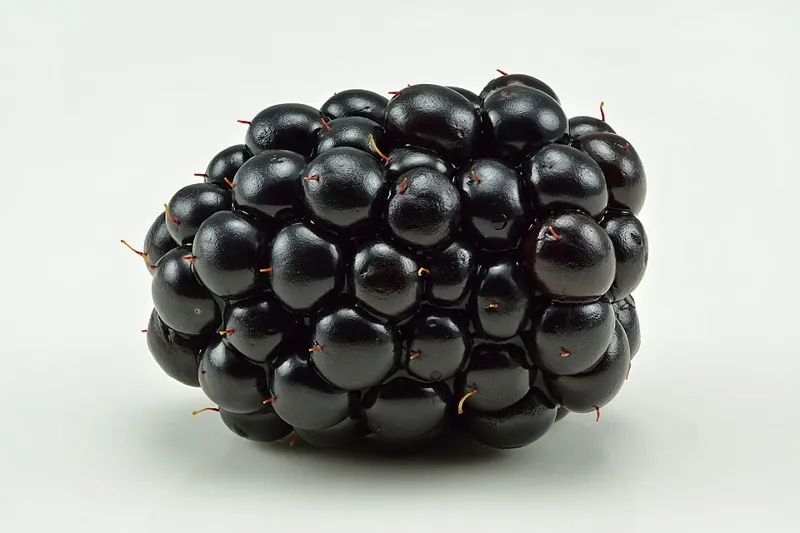
Flagged invasive in Australia, Tasmania, New Zealand. A Weed of National Significance in Australia, and a declared plant in South Australia, where landowners must deal with it on their land. In Tasmania it is a declared weed: importing, selling and growing it are prohibited, though the state's blackberry plan does not cover commercial varieties, such as thornless ones. In New Zealand it is a pest under regional plans, and Auckland bans breeding, selling or releasing the wild kinds. It spreads quickly and forms prickly thickets; rules on growing it differ from place to place. Check your local invasive or noxious weed list before planting it. In the US, that’s your state’s list.
Photo: Ivar Leidus · CC BY-SA 4.0, via Wikimedia Commons.
Many of our estimates come from an extension page we’ve read that gets close without pinning the number down. Others are still our own best guess, and on some the sources disagree. Treat them all as a starting point.
Hardiness zone — an estimate
Mature height — an estimate
Mature spread — an estimate
Soil pH (in water) — an estimate
Root depth — an estimate
Feeding — an estimate
Frost tolerance — an estimate
Value to pollinators — an estimate
+4 moreShow fewer
Ground coverage — an estimate
Bloom window — an estimate
Years to bearing — an estimate
Requires — an estimate
Rules that apply to blackberry
Don't follow a Verticillium host with raspberries, strawberries or stone fruit Promising
Don't follow a Verticillium host with raspberries, strawberries or stone fruit
If you skip this, you lose real yield. The planner warns you.
How it works: Verticillium dahliae persists in soil as microsclerotia and infects a wide host range spanning nightshades and rose family. There is no in-ground cure once a susceptible perennial is planted, so it can wilt and die from inoculum an earlier host left behind. Because the reservoir family may differ from the victim's, the same-family rotation intervals miss it.
Evidence: checked against 3 sources in the research-based literature.
Verticillium wilt is caused by two common soilborne fungi (Verticillium dahliae and Verticillium albo-atrum) that have a wide host range
www.umass.edu
Brambles - DiseasesUMass Extension, New England Small Fruit Management Guide
Verticillium attacks a wide range of plants, including potatoes, tomatoes, peppers, eggplant and strawberries. It overwinters in the soil and on plant debris. Do not plant [raspberries following these crops].
Verticillium Wilt of Tomato and Eggplant NC State Extension
Verticillium Wilt of Tomato and Eggplant
Remedy
Site the perennial on ground with no recent nightshades, or choose one that is not Verticillium-susceptible. Extension advises growing a non-host (corn or a small grain) for at least two years first, without claiming that clears the soil. Once the perennial is planted there is no in-ground cure.
If you skip this, you lose real yield. The planner warns you.
How it works: The same soil reservoir as the wilt rule for ground that grew the tomato family (Verticillium dahliae microsclerotia). This rule adds the gardener's own record: a logged strawberry, raspberry or other bramble, or stone fruit counts as an earlier host, while a rose family that is not a host, like apple, does not.
Evidence: checked against 2 sources in the research-based literature.
To minimize ... disease, choose a planting site with no known history of this problem. Avoid land recently planted with tomatoes, potatoes, eggplants, peppers, strawberries, raspberries, or stone fruits
www.umass.edu
Brambles - DiseasesUMass Extension, New England Small Fruit Management Guide
Verticillium attacks a wide range of plants, including potatoes, tomatoes, peppers, eggplant and strawberries.
Plus one working note on how the sources were read.
Remedy
Site the perennial where the log shows no previous Verticillium host, or choose one that is not susceptible. Extension advises growing a non-host (corn or a small grain) for at least two years first, without claiming that clears the soil. Once the perennial is planted there is no in-ground cure.
If you skip this, it still grows, just less well. The planner suggests it.
How it works: Zones encode average annual minimum winter temperature, which governs whether a woody perennial survives to spring. It is the wrong quantity for an annual, which never sees winter.
A zone that is too warm is a second, different mechanism. Mild winters do not kill a perennial; they fail to chill it. Deciduous fruit crops need a winter dormancy period to break bud and set fruit, so in a zone milder than a plant is adapted to it may survive and never crop. Only the cold end is enforced, because only winter survival follows from what a zone measures; the warm end gets advice and is never refused.
That warm limit is a property of the cultivar, and that limits what this rule can do. Chill requirement is published per variety and varies enormously within a species, so a species-level ceiling says "the modeled range does not reach your zone", never "no plant of this kind will crop for you". So above its range the planner still offers the plant, with advice to choose a cultivar rated for your zone.
Evidence: checked against 1 source in the research-based literature.
Winter cold-hardy cultivars adapted to the colder regions of Oregon (such as zones 5 to 7), may not grow normally in regions of the Willamette Valley (zone 8) where winters are warmer and plants receive less winter chill.
Plus 2 working notes on how the sources were read.
Brambles pick up viruses from other brambles. Aphids carry raspberry mosaic and related viruses from wild raspberries and blackberries, and from older infected plantings, into a new one. Site a new bramble planting at least 600 feet from wild brambles, and keep it away from any bramble planting that shows virus. Promising
Brambles pick up viruses from other brambles. Aphids carry raspberry mosaic and related viruses from wild raspberries and blackberries, and from older infected plantings, into a new one. Site a new bramble planting at least 600 feet from wild brambles, and keep it away from any bramble planting that shows virus.
If you skip this, it still grows, just less well. The planner suggests it.
How it works: Aphid vectoring. The raspberry aphids that feed on wild and cultivated brambles pick up the viruses in one probe and carry them to the next plant they feed on, so any bramble within their flight is a source, and there is no cure once a cane is infected.
Evidence: checked against 7 sources in the research-based literature.
Destroy all wild bramble plants within a distance of 600 feet of the site if possible, to reduce the possibility that viruses might spread to your planting.
www.umass.edu
Brambles: VirusesUMass Extension, New England Small Fruit Management Guide
A distance of at least 600 feet between cultivated raspberries and any wild brambles is recommended
Aphids can retain the virus for several hours and are very efficient at transmitting the virus from plant to plant; a single feeding probe by a single aphid suffices
Plant in elevated areas away from trees and buildings, and away from wild brambles to avoid viral diseases.
Remedy
Plant certified virus-free stock at least 600 feet from wild brambles, dig out wild brambles nearer than that where you can, and if an older raspberry or blackberry planting in your garden shows mosaic-mottled leaves or crumbly fruit, take it out before planting new canes.
Raspberry and blackberry canes are biennial. A cane grows its first year (a primocane), fruits its second year (a floricane), then dies. On summer-bearing types, after harvest cut out only the spent floricanes, at ground level, and keep the current year's primocanes, because they are next year's crop. Cutting every cane down on a summer-bearing plant removes next year's fruit. Ever-bearing (primocane-fruiting) types fruit on first-year canes and, grown for a single fall crop, can instead be cut wholesale close to the ground in winter. Promising
Raspberry and blackberry canes are biennial. A cane grows its first year (a primocane), fruits its second year (a floricane), then dies. On summer-bearing types, after harvest cut out only the spent floricanes, at ground level, and keep the current year's primocanes, because they are next year's crop. Cutting every cane down on a summer-bearing plant removes next year's fruit. Ever-bearing (primocane-fruiting) types fruit on first-year canes and, grown for a single fall crop, can instead be cut wholesale close to the ground in winter.
If you skip this, it still grows, just less well. The planner suggests it.
How it works: Each cane lives two years while the crown persists. A vegetative primocane in year one becomes the fruiting floricane in year two, and a floricane dies after fruiting, and it will not fruit again or survive another winter. Next year's fruiting wood is therefore this year's primocanes, so removing them removes the crop. The spent floricanes are cut at ground level because dead stubs left standing can harbor canker-causing fungi.
Evidence: checked against 2 sources in the research-based literature.
After harvest, or while the plants are dormant, cut the canes that fruited out at ground level and leave the current primocanes standing; thin crowded primocanes so the keepers grow stout. On an ever-bearing type grown for one fall crop, cut all canes very close to the ground in winter instead.
If you skip this, the planting fails. The planner warns you.
How it works: On a clear, still night leaves lose heat to the open sky, so a leaf can fall to freezing and ice can form in it while the thermometer, a couple of meters up, still reads a few degrees above.
Evidence: checked against 7 sources in the research-based literature.
Frost occurs when air is warmer than 32°F but plant tissues drop to 32°F or below because plants radiate (lose) heat into the atmosphere, especially during cool, clear nights.
Radiation frosts occur on calm clear nights that lack cloud cover to hold in heat.
Remedy
The evening before, cover the crops at risk with a sheet or frost cloth, never plastic, reaching the ground and loose at the bottom so the soil's warmth can rise under it, and take it off in the morning. A cover helps least in a long, hard freeze.
If you skip this, it still grows, just less well. The planner suggests it.
How it works: Soil warmed by the sun by day is the heat source at night; a covering low to the ground traps that heat around the plants on calm, clear nights, keeping them a few degrees above the open air through the light frosts at each end of the season.
Evidence: checked against 6 sources in the research-based literature.
The ground and frame of the cold frame are heated by the sun during the day and radiate that heat during the night, keeping the inside warmer. They are used to extend the growing season by two to four weeks in both the fall and the spring, allowing you to start plants outdoors earlier and continue growing them later in the season.
In trials in Fort Collins, Colorado, a plastic cover on a frame typically provides 3°F to over 6°F of frost protection. It works well for cool season crops that are somewhat tolerant of frosty nights and adds two to six weeks or more on both ends of the growing season.
Soil warmed by the sun in the daytime, is the source of heat for frost protection at night. Moist, smooth soil absorbs more heat. To trap heat from the soil around young vegetables at night, place a covering that is low to the ground and spreading. To recharge the heat source for the next night, any covering must allow sunlight to shine through to the soil or must be removed in the daytime.
Low = Plant 1–2 weeks before suggested planting date; Medium = 2–4 weeks before suggested planting date; High = 4–8 weeks before average planting date
hort.extension.wisc.edu
Floating Row CoverUniversity of Wisconsin-Madison Extension, Wisconsin Horticulture, Susan Mahr
Depending on the weight of the covering you choose, you can gain between 2 and 8 degrees of frost protection or warm the local environment sufficiently to harvest certain crops a week or two early.
Clear plastic is useless in providing frost protection because the radiant energy released from the soil on those frosty nights passes right through the covering and never warms the air around the plants.
Remedy
Sow or set out cool-season crops under the cover that many weeks ahead of the open-ground date, and keep autumn crops covered past the usual last call. Vent on sunny days, keep plastic off the leaves, and close the cover before sunset.
A garden planner built on graded evidence. Every claim states its evidence grade and links its sources on the page. Cite it with the grade, and add the date you read it.