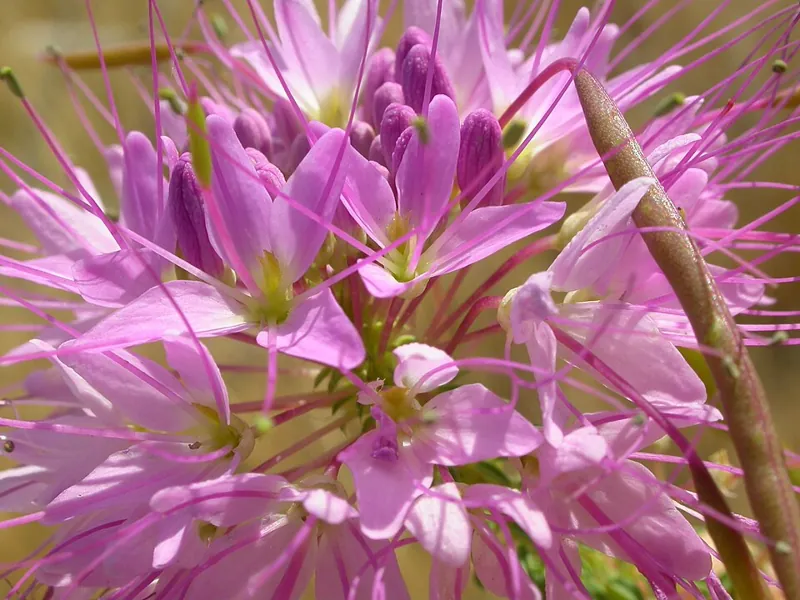
Every number above carries a confidence tier. These are the ones the corpus does not stand behind — estimated from general knowledge, or contested between sources. They are shown because hiding them would be the dishonest half of showing the rest.
days to maturity — estimated
sowing depth — estimated
Rules that apply to Rocky Mountain Bee Plant
Well established
Tender species must not be scheduled before the site's last frost date.
fatal if ignored → block
Mechanism: Ice nucleation in leaf tissue.
Evidence: settled without a trial - climatology.
remedy
Sow or set out after the last frost date, or start indoors and transplant once it has passed.
Cold-hardy annuals can be sown or transplanted before the last spring frost — hardy crops about three weeks before, half-hardy about two weeks before. Tender crops wait for the frost itself.
suboptimal if ignored → advise
Mechanism: Cold hardiness. Hardy crops tolerate hard frost and half-hardy crops tolerate light frost, so they can occupy the ground weeks before frost-tender crops are allowed in. The offset is measured from the last spring frost.
Evidence: confirmed against 4 sources in the research-based literature.
the 4 sources
University of Illinois Extension, 'Time Your Vegetable Plantings by Cold Hardiness' (2018-03-26), extension.illinois.edu/blogs/ilriverhort/2018-03-26-time-your-vegetable-plantings-cold-hardiness: very hardy vegetables 'withstand freezing temperatures and hard frosts without injury' (planted earliest in spring); frost-tolerant vegetables 'can withstand light frosts, but not freezing temperatures' (planted a couple of weeks later). LLM-summarised from a read of the page; it establishes the CATEGORIES but states no week offsets.
Colorado State Univ. Extension, GardenNotes #720, 'Vegetable Planting Guide', extension.colostate.edu/resource/vegetable-planting-guide (read 2026-07-25): hardy vegetables go in 'As early as 2-4 weeks before the date of the average last spring frost'; semi-hardy 'As early as 0-2 weeks before the date of the average last spring frost'; tender from seed 'around the date of the average last spring frost'; very tender 'Typically 2+ weeks after'. This is the source that states the offsets in weeks.
Where this rule sits in that range: hardy at 3 weeks is mid-range of CSU's 2-4. Half-hardy at 2 weeks is the EARLIEST EDGE of CSU's 0-2 - the most aggressive planting CSU sanctions, not the middle of it. The rule is inside published guidance at both ends, but it leans early on the half-hardy side and a gardener following it in a cold spring is taking that boundary.
Do not import an offset from another publication's hardiness scheme without checking the category names: CSU has no 'very hardy' tier, so a '4-6 weeks before frost' figure written against a four-tier scheme does not describe CSU's 'hardy'. Categories are not comparable across sources.
Long-season warm crops are started indoors several weeks before the last frost and set out after it — tomato and tomatillo about six weeks ahead, pepper and eggplant about eight. Basil, six.
suboptimal if ignored → advise
Mechanism: A frost-tender crop with a long days-to-maturity cannot mature if it is only direct-sown after the last frost — the frost-free window is too short. A head start under cover buys the weeks the season lacks; the seedling is set out only once frost has passed — the transplant date is still frost-gated.
Evidence: confirmed against 2 sources in the research-based literature.
the 2 sources
University of Minnesota Extension, 'Starting seeds indoors', extension.umn.edu/planting-and-growing-guides/starting-seeds-indoors: seed-starting chart gives tomato '5-6 weeks' and pepper and eggplant '9 weeks' before the outdoor planting date (warm crops set out after the last frost). Read 2026-07-19 (LLM-summarised); read by the maintainer 2026-07-25, which is the read that promoted this rule. Note what the corpus's per-crop values do with the sources: tomato 6 sits at the top of Minnesota's '5-6 weeks' and inside Illinois's '6-8'; pepper and eggplant 8 sit BELOW Minnesota's '9 weeks' and at the top of Illinois's '6-8'. They are a reconciliation of two published ranges, not a figure either source prints.
Another 110 rules in the corpus apply by situation rather than by species — rotation intervals, frost windows, sun, spacing and soil. Read the full evidence page.
A garden-planning corpus: every claim states its evidence grade and links its sources on the page. Cite it with the grade, and add the date you read it.