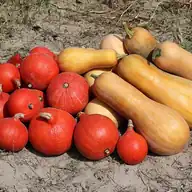
a ring of the cucurbit the beetles prefer draws them to the edge, where they are dealt with, and keeps most of them and the wilt they carry off the crop
Mechanism: Striped cucumber beetles prefer Cucurbita maxima to C. pepo and C. moschata, and they arrive in one early flush from whatever direction they overwintered. A perimeter of the preferred host intercepts that flush on every side and concentrates the beetles on plants the gardener can treat or strip, so the unsprayed centre sees far fewer beetles and far less of the wilt bacterium they transmit. The trap concentrates; it does not kill - the beetles in the border must be removed, or the ring feeds the crop instead of protecting it.
Evidence: confirmed against 3 sources in the research-based literature.
the 3 sources
Univ. of Connecticut IPM, 'Perimeter Trap Cropping Works!' (T. Jude Boucher, Robert Durgy; April 2003, reviewed 2012), ipm.cahnr.uconn.edu/perimeter-trap-cropping-works (fetched in-container 2026-09-02; read by the maintainer 2026-09-02): 'Perimeter Trap Cropping (PTC) involves planting the attractive plant species so that it completely encircles the main crop, like fortress walls'; 'For some pests, Perimeter Trap Cropping may work in very small (garden-size) plots but, for others, larger plantings may be required'; 'Blue Hubbard around yellow summer squash [...] Over 94% of the cucumber beetles in the experiment were on plants in the perimeter. Beetle populations on the unsprayed main crop in the center were reduced by up to 95%. Spraying the perimeter trap crop reduced squash vine borer infestation on the unsprayed summer squash within by 88%.'
UMass Extension Vegetable Program, 'Striped Cucumber Beetle', umass.edu/agriculture-food-environment/vegetable/fact-sheets/striped-cucumber-beetle (fetched in-container 2026-09-02; read by the maintainer 2026-09-02): 'Trap cropping exploits the fact that SCB are more attracted to Cucurbita maxima crops (e.g. buttercup and hubbard squashes and giant pumpkins) than C. pepo or C. moschata crops'; 'Plant 1 or 2 rows of a C. maxima variety in an unbroken perimeter around the field [...] and space plants no wider than the between-row spacing that is used in the main crop'; 'Do not use a crop that is highly susceptible to bacterial wilt [...] in the border. Beetles must be killed in the border.'
Univ. of Minnesota Extension, 'Cucumber beetles', extension.umn.edu/yard-and-garden-insects/cucumber-beetles (fetched in-container 2026-09-02; read by the maintainer 2026-09-02): 'Melons and cucumbers are susceptible to bacterial wilt, which makes them very vulnerable to cucumber beetle feeding all season long'; 'Plant a few highly attractive cucurbits, such as blue hubbard squash. Plant your trap crop a week or two before you plant the rest of your cucurbits, as the beetles tend to show up in one early-season flush.'