Growing currants and gooseberries, once your local rules allow them
One of the few fruits that crop in part shade, and the only one with a legal history. What that old ban protects, and how to plant around it.
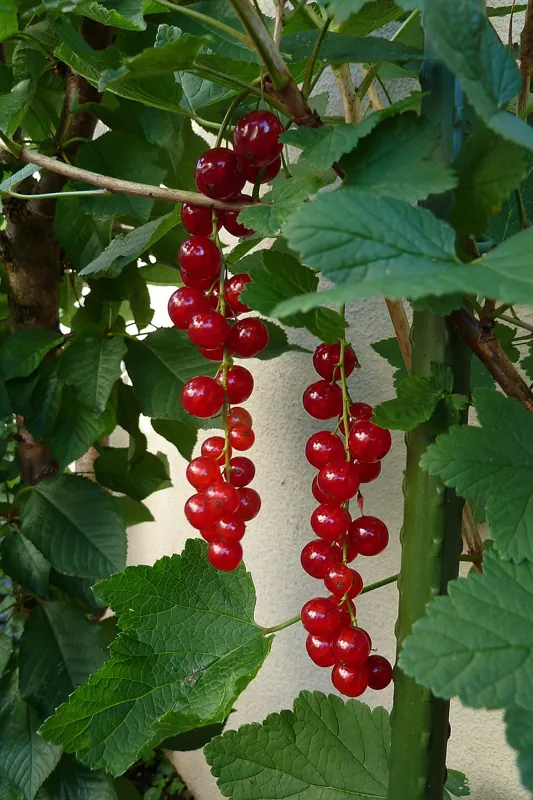
Ribes covers red currant, black currant and gooseberry. Photo: Schnobby · CC BY-SA 3.0, via Wikimedia Commons.
What you need
Your state’s current rules on Ribes (outside the US, your own country’s or region’s, if it has any). This is the one crop where that is step one.
A permanent spot, since these are perennial shrubs
A note of whether there are white pines nearby
Most of this library is about biology. This guide is about biology and law, because currants and gooseberries are the one thing you might plant in a vegetable garden where the first question is “am I allowed,” before “will it grow here.”
They’re worth the trouble. Ribes are among the very few fruits that crop properly in part sun, which makes them one of the only real answers to “what can I grow along that shady fence.” They’re shallow-rooted and self-fertile, so one bush fruits on its own, and they’re hardy well north of where most fruit gives up.
They also spent most of the twentieth century illegal.
Is there really a law about growing currants?
Currants and gooseberries (Ribes) are an alternate host of white pine blister rust, and some states regulate or ban planting them, especially black currant. Check your state's rules before planting, and where white pines are nearby choose a rust-resistant cultivar.
If you skip this, it still grows, just less well. The planner suggests it.
How it works: White pine blister rust (Cronartium ribicola) needs BOTH a Ribes and a five-needle (white) pine to complete its life cycle. The rust is a minor nuisance on Ribes but can be lethal to white pines, which is why some states restrict Ribes planting. Restrictions are strictest for black currant (Ribes nigrum), the most susceptible type. A rust-immune cultivar breaks the cycle. It cannot host the rust, so it cannot pass it to a pine.
Evidence: checked against 5 sources in the research-based literature.
Some New England states regulate aspects of Ribes spp. production within their boundaries due to their role as alternate hosts of White Pine Blister Rust (Cronartium ribicola)
In the early 1900s, currants were banned in the northern United States to prevent the spread of white pine blister rust. However for most states, including Utah, the ban was lifted in 1966
Black currant (Ribes nigrum) is the most susceptible, though resistant varieties are available
Remedy
Check your state's Ribes regulations before planting. A 1900s federal ban was lifted in 1966, but some states still restrict planting, especially of black currant. Where white pines grow nearby, plant a rust-immune cultivar ('Consort', 'Crusader' or 'Titania' black currant, or a resistant gooseberry), which cannot carry the rust to the pine.
Read the mechanism carefully, because it explains everything else. White pine blister rust needs two hosts to complete its life cycle: a Ribes and a five-needle white pine. Take either one away and the fungus can’t finish.
This part surprises people. The rust is barely a problem for your currants. UMN calls it little more than a nuisance to the grower. It’s the white pines it kills. So the restriction protects a timber tree from a disease your shrub can carry to it, and it was never about the fruit crop or about you. That makes this one of the few pieces of gardening advice that’s really about your neighbors.
The federal ban went in during the early 1900s and was lifted in 1966. Some states still restrict planting, most often black currant specifically.
A note about this particular card
A person has checked this card against its sources. The extension services quoted on it agree with each other.
It doesn’t change what you should do. The advice this rule gives is go and check your own state’s current rules, and that’s the right move however well-sourced the rule is, because regulations change and a citation from last year can’t tell you what your state says today.
So what do I need to do?
Check your state first, and check it yourself. This site deliberately does not publish a list of which states restrict Ribes, because a state list goes stale. Regulations get amended, some states have partial rules by county, and several New England states that once restricted now say they have no regulations at present. A list published here would be wrong eventually, and confidently wrong in the meantime. Your state’s department of agriculture is the source that’s current. Outside the US, the same goes for your own country’s or region’s plant health rules: check what they say today, if they say anything about Ribes.
Know which one you’re buying. Susceptibility varies across the genus:
Black currant (Ribes nigrum) is the most susceptible, and the one restrictions target most often.
Red currants are far less so. USU notes most red currant varieties are immune.
Gooseberries sit in between, with resistant varieties available.
If white pines grow nearby, plant a resistant cultivar. This resolves the whole problem, because it breaks the cycle at your end. A rust-immune plant can’t host the rust, so it can’t pass it to a pine. The cultivars named across those extension sources are ‘Consort’, ‘Crusader’ and ‘Titania’ for black currant, with resistant gooseberries available too.
Where should I plant them?
Perennial members must not be sited in ground that is annually turned or rotated.
A currant bush is a permanent shrub. It goes in ground you’ve decided not to turn, and the annuals rotate around it. The fruit tree guild guide opens with the same decision, for the same reason.
The part-shade tolerance is the practical gift here. Most fruit demands full sun and sulks without it. Ribes will crop along a wall, under the edge of a canopy, or on the shady side of something (the north side, north of the equator), usually ground a vegetable garden has already written off.
The short version
Check your state (or, outside the US, your own local rules), then buy accordingly. Red currants and gooseberries are the low-risk end, black currant is the one restrictions name, and a rust-immune cultivar solves it where white pines are close. Then treat it as a permanent shrub in permanent ground, producing fruit in the shady corner where nothing else would.
Further reading
Good places to read more about the technique on this page. The grade on each card comes from that card’s own sources.