Las reglas y las notas de cosecha de esta página están traducidas automáticamente del inglés; sus fuentes, algunas notas y los títulos de las guías siguen en inglés.
Calabaza de invierno (Cucurbita maxima) es una planta anual (cucurbitáceas).
También se conoce como Hubbard, Kabocha, Buttercup, Buttercup / Kabocha, Giant / Show Pumpkin.
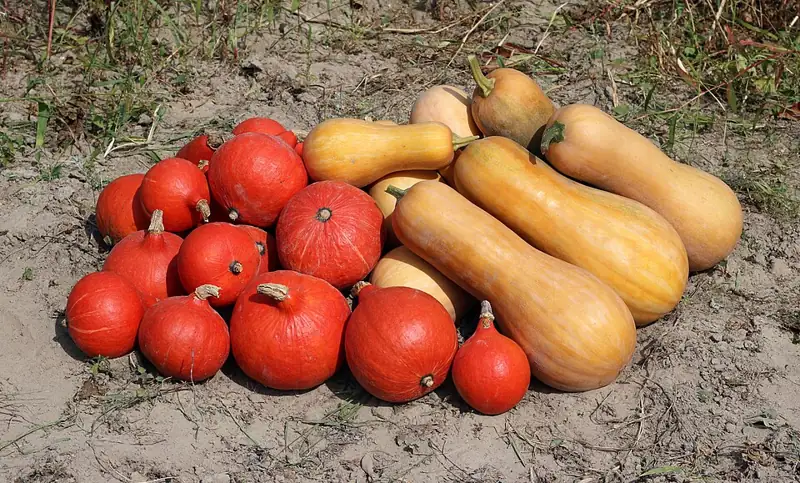
C. maxima spans many winter squashes and pumpkins. Photo: George Chernilevsky · Public domain, via Wikimedia Commons.
OSU Extension, J. F. Harrington 'Soil temperature conditions for vegetable seed germination', extension.oregonstate.edu/gardening/soil-compost/soil-temperature-conditions-vegetable-seed-germination (published 2013, reviewed 2024; fetched in-container 2026-09-20, read by the maintainer 2026-09-20 via the batch-3 germination review): the Squash row gives minimum 60 F, optimum range 70-95 F, optimum 95 F, maximum 100 F. Stored is the OPTIMUM RANGE 70-95 F = 21-35 C; the 100 F maximum is the failure edge and is not stored. Harrington's table names 'Squash' generically, so the same band applies to this species. No extension source read gives a pre-sow soak or scarification for squash, so no seed_treatment is recorded. [read]
Iowa State Extension, 'Germination requirements of annuals and vegetables', yardandgarden.extension.iastate.edu/how-to/germination-requirements-annuals-and-vegetables (fetched 2026-09-20, read by the maintainer 2026-09-20): the table row 'Squash and Pumpkin | 70-95 | D | 5-10' gives 5-10 days. Harrington's days-to-seedling table carries NO squash or pumpkin row, so the day count is taken from Iowa State. Stored [5, 10]. [read]
Iowa State Extension, 'Germination requirements of annuals and vegetables' (same page and fetch as days_to_germinate; read by the maintainer 2026-09-20): the row 'Squash and Pumpkin | 70-95 | D | 5-10' with the legend 'D = Require Darkness for Germination. Cover the seed with the germination medium.' So this species germinates in darkness (light_to_germinate false). [read]
En la cosecha, y en maceta
Lista cuando
Cosecha cuando la cáscara esté dura y antes de una helada.
Se conserva
alrededor de de dos a seis meses, según la variedad, en fresco y seco: de 10 °C50 °F a 16 °C60 °F
University of Minnesota Extension, 'Harvesting and storing home garden vegetables', extension.umn.edu/planting-and-growing-guides/harvesting-and-storing-home-garden-vegetables (fetched in-container 2026-09-25, read by the maintainer 2026-09-25): the 'Squash, winter' entry: 'Store in cool and dry conditions.'; 'The expected shelf-life is two to six months, depending on variety.'. Virginia's yield per 10-ft row for winter squash (10-80 lbs) is too wide to be useful and is not stored (maintainer ruling 2026-09-25). [read]
Grupos de cultivares
No todas las plantas de calabaza de invierno crecen igual. Estos son sus tipos principales (sus grupos de cultivares), y el planeador calcula el tamaño, las fechas y el soporte de cada uno con sus propios números.
Buttercup / Kabocha — enredadera, distancia en el surco 100 cm39 in, altura adulta 30–40 cm12–16 in, ancho adulto 200–350 cm79–138 in, días a la cosecha 85–100
Hubbard — enredadera, distancia en el surco 120 cm47 in, altura adulta 30–40 cm12–16 in, ancho adulto 300–450 cm118–177 in, días a la cosecha 95–110
Giant / Show Pumpkin — enredadera, distancia en el surco 300 cm118 in, altura adulta 40–50 cm16–20 in, ancho adulto 500–800 cm197–315 in, días a la cosecha 110–130
Números de los que estamos menos seguros
These are estimates from general gardening knowledge, or the sources disagree on them, so treat them as a starting point rather than a firm figure.
Época de floración — un estimado
Ancho adulto — un estimado
pH del suelo — un estimado
Buttercup kabocha: altura adulta — un estimado
Buttercup kabocha: ancho adulto — un estimado
Buttercup kabocha: días a la cosecha — un estimado
Buttercup kabocha: distancia en el surco — un estimado
Hubbard: altura adulta — un estimado
Hubbard: ancho adulto — un estimado
Hubbard: días a la cosecha — un estimado
Giant: altura adulta — un estimado
Giant: ancho adulto — un estimado
Giant: días a la cosecha — un estimado
Giant: distancia en el surco — un estimado
Reglas que se aplican a Calabaza de invierno
Prometedor No plantes cucurbitáceas en tierra que tuvo cucurbitáceas en los últimos 2-3 años.Prometedor
No plantes cucurbitáceas en tierra que tuvo cucurbitáceas en los últimos 2-3 años.
si no se sigue, se pierde cosecha de verdad · el planeador te avisa
Mecanismo: Melittia cucurbitae pasa el invierno como pupa en el suelo donde creció su huésped y emerge el verano siguiente; Anasa tristis pasa el invierno como adulto en sitios resguardados (restos de plantas, bajo tablas o piedras) y vuela a las cucurbitáceas en primavera. Un descanso sin huésped corta el arrastre local, pero ambos son buenos voladores que vuelven a invadir desde lejos, así que la rotación es solo parcial y funciona mejor junto con la limpieza de otoño (destruir las guías agotadas).
Evidence: confirmed against 3 sources in the research-based literature.
the 3 sources
UMN Extension, 'Squash vine borers', extension.umn.edu/yard-and-garden-insects/squash-vine-borers (read 2026-07-11): 'squash vine borers spend the winter in the soil near their host plants ... Practice rotation ... planting cucurbits in different areas of your garden if possible, or alternate seasons'; 'rotate away from the area and destroy crop residue.'
Ohioline (Ohio State Univ.), 'Squash Vine Borer', ohioline.osu.edu/factsheet/ent-0106 (read 2026-07-11): 'Crop rotation away from previously infested fields helps reduce local populations, as overwintering pupae remain in the soil. However ... fields often need to be rotated more than 5 miles away as SVB can fly into fields from long distances.'
UMN Extension, 'Squash bugs', extension.umn.edu/yard-and-garden-insects/squash-bugs (read 2026-07-11): 'Squash bugs can live through the winter as adults in sheltered places, such as under plant debris, around buildings, or under rocks. When adults come out in the spring, they fly to growing cucurbit plants.'
solución
Planta las cucurbitáceas en otra tierra, o espera 3 años. Destruye las guías agotadas en otoño y retira los restos y las tablas cercanas — las pupas pasan el invierno en el suelo donde creció el cultivo, y los adultos en los refugios a su alrededor. La rotación es solo parcial; ambas plagas llegan volando desde lejos.
Una buena corazonada Una plaga o enfermedad que ataca a una familia de plantas se propaga con más facilidad por un bloque compacto de esa familia que por uno interrumpido por otras plantas.Una buena corazonada
Una plaga o enfermedad que ataca a una familia de plantas se propaga con más facilidad por un bloque compacto de esa familia que por uno interrumpido por otras plantas.
si no se sigue, igual funciona, pero peor · el planeador lo sugiere
Mecanismo: Concentración de recursos - un especialista localiza y retiene a su hospedero con más eficiencia cuando el hospedero es más denso y continuo, así que una franja ininterrumpida de una sola familia a lo largo de camas contiguas es un blanco más fácil que la misma familia separada por una planta no hospedera (resistencia por asociación).
Evidence: confirmed against 2 sources in the research-based literature.
the 2 sources
Root 1973, 'Organization of a plant-arthropod association in simple and diverse habitats: the fauna of collards (Brassica oleracea)', Ecological Monographs 43:95-124 (abstract read by the maintainer 2026-08-21): proposes 'the resource concentration hypothesis, which states that herbivores are more likely to find and remain on hosts that are growing in dense or nearly pure stands; that the most specialized species frequently attain higher relative densities in simple environments.' This is another rule here's claim and mechanism verbatim.
Elmstrom, Andow & Barclay 1988, 'Flea beetle movement in a broccoli monoculture and diculture', Environmental Entomology 17(2):299-305 (read by the maintainer 2026-08-21): the empirical test on a brassica specialist (the flea beetle Phyllotreta cruciferae) - immigration ~1.3x faster into monocultures than into dicultures, emigration ~2x faster from dicultures - reported as 'strong, direct support for the hypothesis that host plants are harder to find and easier to lose in vegetationally diverse habitats than in monocultures.'
solución
Donde una sola familia llena camas contiguas en una misma temporada, interrumpir la franja con una familia no hospedera entre ellas alarga la distancia que el especialista tiene que recorrer hasta el siguiente hospedero. Se informa, nunca se penaliza: un bloque continuo de una sola familia puede ser la decisión correcta de todos modos - un cultivo polinizado por el viento como el maíz cuaja mejor en bloque - así que la app nombra la compensación y deja la decisión al jardinero.
Prometedor Los cultivos anuales resistentes al frío se pueden sembrar o trasplantar antes de la última helada de primavera — los resistentes unas tres semanas antes, los semirresistentes unas dos semanas antes. Los sensibles esperan a la propia helada.Prometedor
Los cultivos anuales resistentes al frío se pueden sembrar o trasplantar antes de la última helada de primavera — los resistentes unas tres semanas antes, los semirresistentes unas dos semanas antes. Los sensibles esperan a la propia helada.
si no se sigue, igual funciona, pero peor · el planeador lo sugiere
Mecanismo: Resistencia al frío. Los cultivos resistentes toleran heladas fuertes y los semirresistentes toleran heladas ligeras, así que pueden ocupar la tierra semanas antes de que se permita la entrada a los cultivos sensibles a las heladas. El desfase se mide desde la última helada de primavera.
Evidence: confirmed against 4 sources in the research-based literature.
the 4 sources
University of Illinois Extension, 'Time Your Vegetable Plantings by Cold Hardiness' (2018-03-26), extension.illinois.edu/blogs/ilriverhort/2018-03-26-time-your-vegetable-plantings-cold-hardiness: very hardy vegetables 'withstand freezing temperatures and hard frosts without injury' (planted earliest in spring); frost-tolerant vegetables 'can withstand light frosts, but not freezing temperatures' (planted a couple of weeks later). LLM-summarised from a read of the page; it establishes the CATEGORIES but states no week offsets.
Colorado State Univ. Extension, GardenNotes #720, 'Vegetable Planting Guide', extension.colostate.edu/resource/vegetable-planting-guide (read 2026-07-25): hardy vegetables go in 'As early as 2-4 weeks before the date of the average last spring frost'; semi-hardy 'As early as 0-2 weeks before the date of the average last spring frost'; tender from seed 'around the date of the average last spring frost'; very tender 'Typically 2+ weeks after'. This is the source that states the offsets in weeks.
Where this rule sits in that range: hardy at 3 weeks is mid-range of CSU's 2-4. Half-hardy at 2 weeks is the EARLIEST EDGE of CSU's 0-2 - the most aggressive planting CSU sanctions, not the middle of it. The rule is inside published guidance at both ends, but it leans early on the half-hardy side and a gardener following it in a cold spring is taking that boundary.
Do not import an offset from another publication's hardiness scheme without checking the category names: CSU has no 'very hardy' tier, so a '4-6 weeks before frost' figure written against a four-tier scheme does not describe CSU's 'hardy'. Categories are not comparable across sources.
Prometedor Los cultivos de clima cálido de temporada larga se empiezan bajo techo varias semanas antes de la última helada y se trasplantan después de ella — el tomate y el tomatillo unas seis semanas antes, el chile y la berenjena unas ocho. La albahaca, seis.Prometedor
Los cultivos de clima cálido de temporada larga se empiezan bajo techo varias semanas antes de la última helada y se trasplantan después de ella — el tomate y el tomatillo unas seis semanas antes, el chile y la berenjena unas ocho. La albahaca, seis.
si no se sigue, igual funciona, pero peor · el planeador lo sugiere
Mecanismo: Un cultivo sensible a las heladas con muchos días a la cosecha no puede madurar si solo se siembra directamente después de la última helada — la ventana sin heladas es demasiado corta. Una ventaja inicial bajo cubierta compra las semanas que le faltan a la temporada; la plántula solo se trasplanta una vez que ha pasado la helada — la fecha de trasplante sigue dependiendo de la helada.
Evidence: confirmed against 2 sources in the research-based literature.
the 2 sources
University of Minnesota Extension, 'Starting seeds indoors', extension.umn.edu/planting-and-growing-guides/starting-seeds-indoors: seed-starting chart gives tomato '5-6 weeks' and pepper and eggplant '9 weeks' before the outdoor planting date (warm crops set out after the last frost). Read 2026-07-19 (LLM-summarised); read by the maintainer 2026-07-25, which is the read that promoted this rule. Note what the corpus's per-crop values do with the sources: tomato 6 sits at the top of Minnesota's '5-6 weeks' and inside Illinois's '6-8'; pepper and eggplant 8 sit BELOW Minnesota's '9 weeks' and at the top of Illinois's '6-8'. They are a reconciliation of two published ranges, not a figure either source prints.
Prometedor Las manchas blancas y polvosas en las hojas de calabaza, pepino, melón o calabaza de Castilla son oídio, un hongo que se propaga con el viento y ataca primero las hojas más viejas. Debilita la planta y la fruta madura antes de tiempo.Prometedor
Las manchas blancas y polvosas en las hojas de calabaza, pepino, melón o calabaza de Castilla son oídio, un hongo que se propaga con el viento y ataca primero las hojas más viejas. Debilita la planta y la fruta madura antes de tiempo.
si no se sigue, igual funciona, pero peor · el planeador lo sugiere
Mecanismo: El hongo (principalmente Podosphaera xanthii) crece sobre la superficie de la hoja; las esporas que se forman en cada mancha las lleva el viento a otras hojas, y en condiciones favorables se extiende hasta cubrir la mayor parte del follaje. Una planta que pierde por él la mayor parte de su superficie foliar queda debilitada, y su fruta madura prematuramente. Se establece con más facilidad en guías plantadas muy juntas, plantas apretadas por la maleza, plantas a la sombra y plantas con exceso de fertilizante.
Evidence: confirmed against 1 source in the research-based literature.
the source
UMN Extension, 'Powdery mildew of cucurbits', extension.umn.edu/agriculture/specialty-crops/vegetable-farming/disease-management/powdery-mildew-of-cucurbits (fetched in-container 2026-09-25, read 2026-09-25): 'White powdery spots can form on both upper and lower leaf surfaces, and quickly expand into large blotches.'; 'When powdery mildew infects the majority of the foliage, the plant becomes weak and the fruit ripens prematurely.'; 'The older leaves are more susceptible and powdery mildew will infect them first.'; 'Wind blows spores produced in leaf spots to infect other leaves.'; 'Powdery mildew is more likely to infect densely planted vines, plants crowded by weeds, plants in shaded sites and over-fertilized plants.'; 'Plant varieties with complete or partial resistance to powdery mildew.'; 'Provide good air movement around plants through proper spacing, staking of plants, and weed control.'; 'Powdery mildew, mainly caused by the fungus Podosphaera xanthii , infects all cucurbits, including muskmelons, squash, cucumbers, gourds, watermelons and pumpkins.'; 'If susceptible varieties are growing in an area where powdery mildew has resulted in yield loss in the past, fungicide applications may be necessary.'; 'Monitor for the presence of powdery mildew, and start fungicide treatments when disease is first found.'
solución
Cultiva variedades con resistencia completa o parcial, y dales aire a las guías: espácialas bien al plantar, ponles tutores donde puedas y mantén a raya la maleza. Donde el oídio ya te ha costado una cosecha y la variedad es susceptible, puede hacer falta un fungicida - empieza con las primeras manchas.
Prometedor Una guía de calabaza o de calabaza de Castilla que se marchita de repente, con excremento parecido al aserrín saliendo de agujeros en el tallo cerca de la parte marchita, tiene dentro un barrenador de la calabaza: la larva se alimenta dentro de la guía y le corta el agua.Prometedor
Una guía de calabaza o de calabaza de Castilla que se marchita de repente, con excremento parecido al aserrín saliendo de agujeros en el tallo cerca de la parte marchita, tiene dentro un barrenador de la calabaza: la larva se alimenta dentro de la guía y le corta el agua.
si no se sigue, igual funciona, pero peor · el planeador lo sugiere
Mecanismo: El adulto es una polilla que vuela de día y pone sus huevos uno por uno en la base de la planta, en los pecíolos y en las guías. Las larvas hacen túneles en el tallo para alimentarse, y al alimentarse destruyen el tejido vascular de la guía, lo que detiene el movimiento del agua y de los nutrientes - de ahí el marchitamiento repentino. Mientras se alimentan, empujan el excremento hacia afuera por agujeros en el costado del tallo.
Evidence: confirmed against 1 source in the research-based literature.
the source
UW-Madison Extension (Wisconsin Horticulture), 'Squash Vine Borer, Melittia cucurbitae', hort.extension.wisc.edu/articles/squash-vine-borer-melittia-curcurbitae/ (fetched in-container 2026-09-25, read 2026-09-25): 'If you've ever had a squash or pumpkin plant with one or more runners that suddenly wilt and then die, it was mostly likely infested by squash vine borer.'; 'Their feeding within the vines destroys the vascular tissues of the plant, preventing water movement and nutrient transfer, which leads to the characteristic wilting.'; 'As they feed, they push their sawdust-like fecal matter (frass) out of holes in the side of the stem near the wilting point.'; 'At the first sight of frass, homeowners can carefully slit the vine lengthwise near the damaged area and remove the larvae.'; 'Plants can be covered with floating row cover but only where squash didn't grow the previous year.'; 'The adult squash vine borer is a day-flying moth, with a distinctive superficial appearance more like a wasp than a moth.'; 'Females lay up to 250 small flattened, oval, and dull-red to brown eggs individually, rather than in groups, on the base of plants, leaf stalks, and vines which are almost impossible to spot.'; 'For vining (not bush) varieties, try burying a few nodes along each vine so the plant will root at these nodes and less the impact of the pest if it does infest the base of the vine.'
solución
A la primera señal de excremento, abre con cuidado la guía a lo largo cerca del daño y saca la larva. En los tipos de guía, entierra unos cuantos nudos a lo largo de cada guía para que eche raíces ahí y sobreviva a un ataque en la base. La cubierta flotante impide que las polillas pongan huevos - pero solo donde no se cultivó calabaza el año anterior.
Milpa Gardens. "Calabaza de invierno (Cucurbita maxima)." https://milpa.garden/es/plants/cucurbita-maxima/
A garden-planning corpus: every claim states its evidence grade and links its sources on the page. Cite it with the grade, and add the date you read it.