Soak — a seed must take up water (imbibition) before it can germinate; a pre-sow soak begins that uptake so the seed starts already swollen a few hours or overnight
Many of our estimates come from an extension page we’ve read that gets close without pinning the number down. Others are still our own best guess, and on some the sources disagree. Treat them all as a starting point.
Spacing in row — an estimate
Days to maturity — an estimate
Root depth — an estimate
Feeding — an estimate
Ground coverage — an estimate
Frost tolerance — an estimate
Rules that apply to nasturtium
Don't sow or set out tender crops before your last frost date Well established
Don't sow or set out tender crops before your last frost date
Cold-hardy annuals can be sown or transplanted before the last spring frost (hardy crops about three weeks before, half-hardy about two weeks before). Tender crops wait for the frost itself. Promising
Cold-hardy annuals can be sown or transplanted before the last spring frost (hardy crops about three weeks before, half-hardy about two weeks before). Tender crops wait for the frost itself.
If you skip this, it still grows, just less well. The planner suggests it.
How it works: Cold hardiness. Hardy crops tolerate hard frost and half-hardy crops tolerate light frost, so they can occupy the ground weeks before frost-tender crops are allowed in. The offset is measured from the last spring frost.
Evidence: checked against 2 sources in the research-based literature.
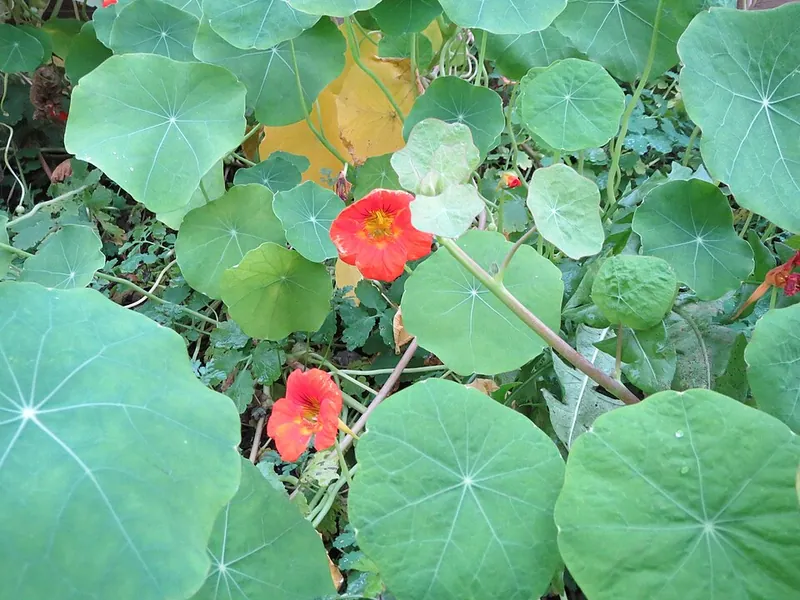
Nasturtiums bloom best in lean, poor-to-average, well-drained soil in full sun. Rich soil or heavy nitrogen feeding pushes the plant into lush leaf growth at the expense of flowers, the familiar 'all leaves, few blooms'. Go easy on feeding, and do not fertilize except on very poor ground. Promising
Nasturtiums bloom best in lean, poor-to-average, well-drained soil in full sun. Rich soil or heavy nitrogen feeding pushes the plant into lush leaf growth at the expense of flowers, the familiar 'all leaves, few blooms'. Go easy on feeding, and do not fertilize except on very poor ground.
If you skip this, it still grows, just less well. The planner suggests it.
How it works: Rich soil and abundant nitrogen bias the plant toward vegetative leaf growth over flowering; lean, low-fertility soil shifts the same balance back toward bloom. It is the foliage-over-flower tradeoff that heavy feeding produces in many plants, here spending the plant on leaves at the cost of the flowers it was grown for.
Evidence: checked against 2 sources in the research-based literature.
It grows best in poor to average, well-drained soil in full sun, but with some afternoon shade in hot summers
Remedy
Plant in average-to-poor, well-drained soil in full sun. Do not fertilize, and avoid nitrogen-rich feeding; reserve any feeding for very poor ground. The planner doesn't guess at fertilizer numbers.
If you skip this, the planting fails. The planner warns you.
How it works: On a clear, still night leaves lose heat to the open sky, so a leaf can fall to freezing and ice can form in it while the thermometer, a couple of meters up, still reads a few degrees above.
Evidence: checked against 7 sources in the research-based literature.
Frost occurs when air is warmer than 32°F but plant tissues drop to 32°F or below because plants radiate (lose) heat into the atmosphere, especially during cool, clear nights.
Radiation frosts occur on calm clear nights that lack cloud cover to hold in heat.
Remedy
The evening before, cover the crops at risk with a sheet or frost cloth, never plastic, reaching the ground and loose at the bottom so the soil's warmth can rise under it, and take it off in the morning. A cover helps least in a long, hard freeze.
A garden planner built on graded evidence. Every claim states its evidence grade and links its sources on the page. Cite it with the grade, and add the date you read it.