Milpa Gardens
Sign in

Leer en español

Spinach

Spinacia oleracea · amaranth family

At a glance

Light
Part sun
Frost
Hardy
Spacing
8 cm3 in
Days to maturity
37–55
On this page
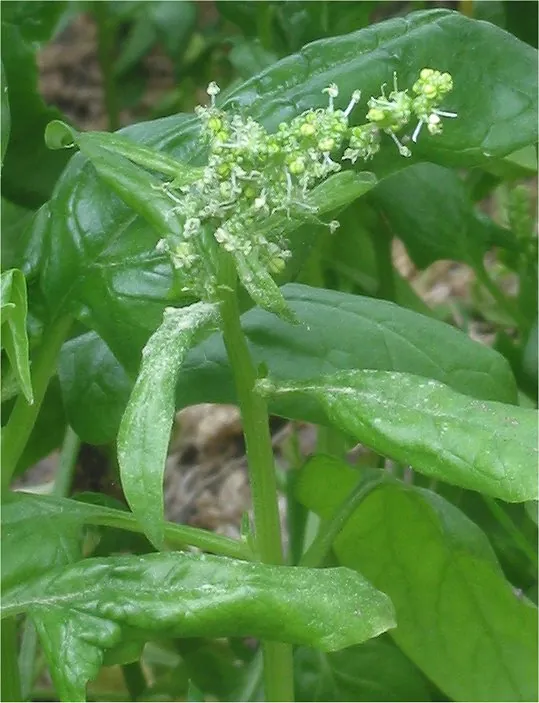
A spinach plant with broad green leaves
Photo: Rasbak · CC BY-SA 3.0, via Wikimedia Commons.

When do I plant this? › Plan this in your garden ›

The numbers

Sowing depth
1.3 cm0.5 in
Spacing in row
8 cm3 in
Mature height
15–30 cm6–12 in
Mature spread
15–20 cm6–8 in (estimate)
Soil pH (in water)
6–7.5 (estimate)
Days to maturity
37–55
Days between succession sowings
10–14 (estimate)
Light
Part sun
Feeding
Moderate feeder
Root depth
Shallow
Frost tolerance
Hardy
Lifespan
Annual
Habit
Rosette
Value to pollinators
None

USDA PLANTS profile

Numbers we’re less sure of

Many of our estimates come from an extension page we’ve read that gets close without pinning the number down. Others are still our own best guess, and on some the sources disagree. Treat them all as a starting point.

Rules that apply to spinach

Do not plant beets, chard, spinach or amaranth in ground that held them within 3 years. Promising

Do not plant beets, chard, spinach or amaranth in ground that held them within 3 years.

Promising

If you skip this, you lose real yield. The planner warns you.

How it works: Cercospora beticola, the leaf spot of beet, chard and spinach, survives on infested residue and in soil for up to three years and carries over on lambsquarters and pigweed; spinach downy mildew (Peronospora effusa) leaves oospores in the soil for a few years and rides on seed. A three-year break outlasts both.

Evidence: checked against 7 sources in the research-based literature.

The 7 sources

vegetables.cornell.edu

Cercospora Leaf Spot of Table beet Cornell Vegetables
Rotate with non-host crops for at least 3 years

extension.psu.edu

Cercospora Leaf Spot on Table Beets Penn State Extension
Beet growers wishing to prevent Cercospora leaf spot on their farm should implement a 3-year crop rotation featuring non-host crops

umass.edu

Cercospora Leaf Spot of Swiss Chard, Beets, and Spinach UMass Extension
Rotate to non-host crops (outside of the Chenopodium family) for 2-3 years

extension.umd.edu

Cercospora Leaf Spot of Vegetables Univ. of Maryland Extension
Don't plant susceptible crops in the same spot more than once every three years.

umass.edu

Spinach Downy Mildew UMass Extension
Rotate out of spinach for at least 3 years

vegetables.cornell.edu

Spinach Downy Mildew Cornell Vegetables
Rotate out of land where spinach was grown for at least 2-3 years

Do Rotations Matter within Disease Management Programs? Cornell Vegetables

We summarise this source in our notes rather than quote a line from it.

Remedy

Plant them in different ground, or wait until 3 years have passed since this ground last held them. Bury or remove the old leaves, keep lambsquarters and pigweed out of the bed in between, and buy clean seed.

Read the full rule › · open in the planner ›

Cold-hardy annuals can be sown or transplanted before the last spring frost (hardy crops about three weeks before, half-hardy about two weeks before). Tender crops wait for the frost itself. Promising

Cold-hardy annuals can be sown or transplanted before the last spring frost (hardy crops about three weeks before, half-hardy about two weeks before). Tender crops wait for the frost itself.

Promising

If you skip this, it still grows, just less well. The planner suggests it.

How it works: Cold hardiness. Hardy crops tolerate hard frost and half-hardy crops tolerate light frost, so they can occupy the ground weeks before frost-tender crops are allowed in. The offset is measured from the last spring frost.

Evidence: checked against 2 sources in the research-based literature.

The 2 sources

extension.illinois.edu

Time Your Vegetable Plantings by Cold Hardiness University of Illinois Extension
… withstand freezing temperatures and hard frosts without injury

extension.colostate.edu

Vegetable Planting Guide Colorado State Univ. Extension, GardenNotes #720
As early as 2-4 weeks before the date of the average last spring frost

Plus 2 working notes on how the sources were read.

Read the full rule › · open in the planner ›

Lettuce and spinach that ripen in hot, long days run to seed. Promising

Lettuce and spinach that ripen in hot, long days run to seed.

Promising

If you skip this, you lose real yield. The planner warns you.

How it works: Long days and several days in a row above about 24 °C (75 °F) switch lettuce and spinach from making leaves to making a flower stalk, which turns the leaves bitter and ends the harvest.

Evidence: checked against 2 sources in the research-based literature.

The 2 sources

extension.umn.edu

Growing lettuce, endive and radicchio in home gardens UMN Extension
Multiple days of high temperatures (greater than 75° F) can cause lettuce plants to flower.

extension.umn.edu

Growing spinach and Swiss chard in home gardens UMN Extension
Spinach plants can start to flower after multiple days of high temperatures (greater than 75° F).
Remedy

Sow so the crop is picked before the hot months begin, or wait and sow for fall: lettuce about three months before your average first fall frost, spinach about two. Spinach sown for fall grows under shortening days and does not bolt.

Read the full rule › · open in the planner ›

Frost can form on a night the forecast low is a few degrees above freezing. Promising

Frost can form on a night the forecast low is a few degrees above freezing.

Promising

If you skip this, the planting fails. The planner warns you.

How it works: On a clear, still night leaves lose heat to the open sky, so a leaf can fall to freezing and ice can form in it while the thermometer, a couple of meters up, still reads a few degrees above.

Evidence: checked against 7 sources in the research-based literature.

The 7 sources

www.weather.gov

Frost and Freeze Information NWS Tallahassee
Issued up to 24 hours when temperature is forecast to be between 32° and 36° on nights with calm winds

www.weather.gov

Freeze Watches and Warnings National Weather Service
… temperatures below 28°F for an extended period of time can kill most types of commercial crops and residential plants.

ipm.ucanr.edu

Freezing and Frost UC Statewide IPM Program
Frost occurs when air is warmer than 32°F but plant tissues drop to 32°F or below because plants radiate (lose) heat into the atmosphere, especially during cool, clear nights.

yardandgarden.extension.iastate.edu

Fall Planting of Vegetables Iowa State University Yard and Garden, Aaron Steil and Kim Hilgers
Tender crops will be damaged or destroyed by a light frost

extension.sdstate.edu

Fall Frost Tolerance of Common Vegetables SDSU Extension, Rhoda Burrows
Crops from more-temperate regions can withstand light freezes (28 to 32 degrees Fahrenheit):

extension.umn.edu

A Minnesota guide to garden timing UMN Extension, Robin Trott
A light frost (32°F) can damage tender plants, while a hard frost (28°F or colder) will kill most warm-season crops.

extension.colostate.edu

Frost Protection and Extending the Growing Season CSU Extension GardenNotes #722, Whiting, O'Meara and Wilson
Radiation frosts occur on calm clear nights that lack cloud cover to hold in heat.
Remedy

The evening before, cover the crops at risk with a sheet or frost cloth, never plastic, reaching the ground and loose at the bottom so the soil's warmth can rise under it, and take it off in the morning. A cover helps least in a long, hard freeze.

Read the full rule › · open in the planner ›

A cover buys cool-season crops a week or two at the ends of the season. A good hunch

A cover buys cool-season crops a week or two at the ends of the season.

A good hunch

If you skip this, it still grows, just less well. The planner suggests it.

How it works: Soil warmed by the sun by day is the heat source at night; a covering low to the ground traps that heat around the plants on calm, clear nights, keeping them a few degrees above the open air through the light frosts at each end of the season.

Evidence: checked against 6 sources in the research-based literature.

The 6 sources

yardandgarden.extension.iastate.edu

All About Cold Frames Iowa State University Extension and Outreach, Aaron Steil
The ground and frame of the cold frame are heated by the sun during the day and radiate that heat during the night, keeping the inside warmer. They are used to extend the growing season by two to four weeks in both the fall and the spring, allowing you to start plants outdoors earlier and continue growing them later in the season.

extension.colostate.edu

Frost Protection and Extending the Growing Season CSU Extension GardenNotes #722, Whiting, O'Meara and Wilson
In trials in Fort Collins, Colorado, a plastic cover on a frame typically provides 3°F to over 6°F of frost protection. It works well for cool season crops that are somewhat tolerant of frosty nights and adds two to six weeks or more on both ends of the growing season.

class.ucanr.edu

Frost Protection and Extending the Growing Season CSU Extension GardenNotes #722, Whiting, O'Meara and Wilson
Soil warmed by the sun in the daytime, is the source of heat for frost protection at night. Moist, smooth soil absorbs more heat. To trap heat from the soil around young vegetables at night, place a covering that is low to the ground and spreading. To recharge the heat source for the next night, any covering must allow sunlight to shine through to the soil or must be removed in the daytime.

extension.usu.edu

Extending the Garden Season Utah State University Extension, Beddes, Caron, Hansen and Gunnell
Low = Plant 1–2 weeks before suggested planting date; Medium = 2–4 weeks before suggested planting date; High = 4–8 weeks before average planting date

hort.extension.wisc.edu

Floating Row Cover University of Wisconsin-Madison Extension, Wisconsin Horticulture, Susan Mahr
Depending on the weight of the covering you choose, you can gain between 2 and 8 degrees of frost protection or warm the local environment sufficiently to harvest certain crops a week or two early.

uaex.uada.edu

Row covers for vegetable gardening University of Arkansas System Division of Agriculture, Cooperative Extension Service
Clear plastic is useless in providing frost protection because the radiant energy released from the soil on those frosty nights passes right through the covering and never warms the air around the plants.
Remedy

Sow or set out cool-season crops under the cover that many weeks ahead of the open-ground date, and keep autumn crops covered past the usual last call. Vent on sunny days, keep plastic off the leaves, and close the cover before sunset.

Read the full rule › · open in the planner ›

Where frost is rare, sow so the crop grows through months that suit it. A good hunch

Where frost is rare, sow so the crop grows through months that suit it.

A good hunch

If you skip this, you lose real yield. The planner suggests it.

How it works: A crop grows and makes its harvest within a band of warmth: in months colder than its band it grows too slowly to finish, and in months hotter than it a cool-season crop bolts and turns bitter while a warm-season crop drops its flowers.

Evidence: checked against 9 sources in the research-based literature.

The 9 sources

oc4h.ucanr.edu

Vegetable Characteristics UC Cooperative Extension Placer/Nevada Counties, publication 31-043C
Optimum Temperatures for Different Vegetables

www.ucanr.edu

Hold the Tomatoes! UC Master Gardeners of Monterey, San Benito and Santa Cruz Counties, Jazmin Lopez
Average monthly temperatures for cool-season crops during their growing period: 60-65F. This includes, carrots, parsnips, spinach, lettuce, broccoli, and garlic to name a few.

www.fao.org

Technical manual on small-scale processing of fruits and vegetables FAO
Group D: These vegetables thrive in areas where the mean monthly temperatures range between 15 and 18°C. They are intolerant to temperatures between 21 and 24°C, and tolerate weak frosts. This group includes spinach, lettuce, broccoli, beetroot, Brussels sprout, cabbage, radish, rhubarb and watercress.

content.ces.ncsu.edu

16. Vegetable Gardening NC State Extension, Extension Gardener Handbook
Summer. As temperatures rise, cool-season crops bolt and become bitter.

extension.umd.edu

Poor Blossom and Fruit Set of Vegetables University of Maryland Extension
Night temperatures below 60° F. and above 75° F. or day temperatures above 95° F. can cause pepper flowers and small fruits to drop.

daf.nt.gov

Lettuce Northern Territory Government, Agnote B1
In the Top End climate lettuce plantings are restricted to the cooler months from April till July. Hot weather makes the plants to bolt, as they do not form a head but flower instead.

daf.nt.gov

Cabbages Northern Territory Government, Agnote B3
Cabbages are a cool climate crop and their planting in the Top End is restricted from the end of March through to July.

daf.nt.gov

Onions Northern Territory Government, Agnote B9
Onions can be grown only in the cooler months in the Top End, which limits planting from the end of March to the end of May.

edis.ifas.ufl.edu

Florida Vegetable Gardening Guide UF/IFAS EDIS SP103/VH021, Park-Brown, Saracino, Williams and Treadwell
Leaf types grow well in Florida; grow crisphead type only in coolest months.
Remedy

Sow in the months the app names. Outside them, grow a crop whose months they are, or a variety bred for the heat or the cool.

Read the full rule › · open in the planner ›

Hardy crops can go in later, counted back from the freeze they can't stand Promising

Hardy crops can go in later, counted back from the freeze they can't stand

Promising

If you skip this, you lose real yield. The planner warns you.

How it works: A hardy or half-hardy crop's tissue survives the ice of a light freeze down to about 28 °F (-2 °C), so its season ends at the first night that cold, which comes after the first 32 °F frost, and later still where winters are mild.

Evidence: not yet confirmed. It is cited to 8 sources, which a person has yet to read.

What this rests on - 8 pointers

agrilifeextension.tamu.edu

Fall Vegetable Gardening Guide for Texas Texas A&M AgriLife Extension, EHT-056

We summarise this source in our notes rather than quote a line from it.

yardandgarden.extension.iastate.edu

Fall Planting of Vegetables Iowa State University Extension and Outreach
Tender crops will be damaged or destroyed by a light frost, semi-hardy crops can tolerate temperatures in the upper 20s°F, and hardy crops will survive temperatures in the mid to low 20s°F.

extension.sdstate.edu

Fall Frost Tolerance of Common Vegetables SDSU Extension
Crops from more-temperate regions can withstand light freezes (28 to 32 degrees Fahrenheit):

vegetables.ces.ncsu.edu

Frost and Freeze Protection for Vegetable Crops NC State Extension
If water within the plant cell or between the plant cells freeze, this can result in damage to plant tissue.

extension.oregonstate.edu

Plant cold-hardy vegetables now for a spring harvest Oregon State University Extension
Semi-hardy crops tolerate light frost (28–32°F), including beets, carrots, parsnip, lettuce, chard, garden pea (before flowering), Chinese cabbage, endive, radicchio, cauliflower, parsley and celery.

extension.umn.edu

A Minnesota guide to garden timing University of Minnesota Extension
A light frost (32°F) can damage tender plants, while a hard frost (28°F or colder) will kill most warm-season crops.

www.weather.gov

Understanding Cold Weather Alerts National Weather Service
This temperature threshold kills some types of commercial crops and residential plants, while temperatures below 28°F for an extended period of time can kill most types of commercial crops and residential plants.

www.ncei.noaa.gov

Normals Calculation Methodology 2020 NOAA NCEI
Frost-freeze probabilities are the likelihood that a given minimum temperature will be experienced at least once during a month or year.

Plus one working note on how the sources were read.

Remedy

Sow or set out hardy crops up to the date the app gives. After it, choose a faster variety or wait for the spring sowing.

Read the full rule › · open in the planner ›

Where frost sets the season, a crop still needs enough warm months to reach harvest. A good hunch

Where frost sets the season, a crop still needs enough warm months to reach harvest.

A good hunch

If you skip this, you lose real yield. The planner suggests it.

How it works: A crop grows at the pace its days to maturity assume only in months at least as warm as the low end of its band, and in cooler months it grows too slowly to finish, so a frost-free season of cool months can end before the crop is ready.

Evidence: not yet confirmed. It is cited to 8 sources, which a person has yet to read.

What this rests on - 8 pointers

oc4h.ucanr.edu

Vegetable Characteristics UC Cooperative Extension Placer/Nevada Counties, publication 31-043C
Optimum Temperatures for Different Vegetables

www.ucanr.edu

Hold the Tomatoes! UC Master Gardeners of Monterey, San Benito and Santa Cruz Counties, Jazmin Lopez
Average monthly temperatures for warm season crops during their growing period: 65-80F. This includes melons, corn, eggplant, peppers, squash, and tomatoes.

extension.colostate.edu Not yet read by a person

Vegetable Gardening in the Mountains Colorado State University Extension
Of the warm season vegetables, bush beans and summer squash are the most likely to succeed.

extension.umn.edu Not yet read by a person

Growing eggplant in home gardens University of Minnesota Extension
Eggplant needs warm conditions, and will not thrive during a cool season. There are varieties available that thrive in Minnesota’s short summer season.

extension.umn.edu Not yet read by a person

Growing peppers University of Minnesota Extension
In general, smaller-fruited peppers are more tolerant of both cool and hot temperatures

extension.oregonstate.edu Not yet read by a person

Growing vegetables in the Pacific Northwest coastal region Oregon State University Extension, EM 9695
Cold rain, wind, and cool nights can keep coastal soils cold well into summer.

extension.oregonstate.edu Not yet read by a person

Coastal gardening: How to succeed in wind and microclimates Oregon State University Extension
There are some things you can’t do very well on the coast, like tomatoes,

solutions.tennessee.edu

Fall Vegetable Gardens University of Tennessee Agricultural Extension Service, SP291G
Most seed packets and variety descriptions in catalogs estimate the days from planting to maturity. Add about 10 days to this estimate because of the cooler, shorter days in the fall.

Plus one working note on how the sources were read.

Remedy

Grow it under cover, in a greenhouse, tunnel or cloche; start it early indoors and choose its quickest variety; or grow a crop whose months these are.

Read the full rule › · open in the planner ›

Another 135 rules depend on your own garden, like crop rotation, frost dates, sun, spacing and soil. See them all.

Plant teams that place it

When do I plant spinach? ›

What grows well with spinach? · Something wrong with your spinach?

More ways Milpa can help

When do I plant? · What grows well together? · Plan my garden · What can I plant now? · Something wrong in the garden? · Keep a garden diary · Heard a tip?

Cite this page

Milpa Gardens. “Spinach (Spinacia oleracea).” https://milpa.garden/plants/spinacia-oleracea/

A garden planner built on graded evidence. Every claim states its evidence grade and links its sources on the page. Cite it with the grade, and add the date you read it.

Report a problem with this page

All plants