A perennial guild - a standing planting, not lifted between seasons.
The Mediterranean culinary herbs the extension herb guides group together on one regime (Clemson HGIC 'Herbs'; Univ. of Maryland Extension 'Care of Herbs'; both read for the watering rule) - grown as a bed of their own, which is how those guides describe siting them.
What binds this planting
The corpus partly backs this planting with 1 graded mechanism its members share:
At least 1.5 m²16.1 ft². A bed smaller than that does not get this guild quietly substituted for something else — the planner greys it out, says why, and offers the nearest adaptation that does fit.
What it looks like planted
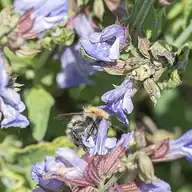
4 × sage
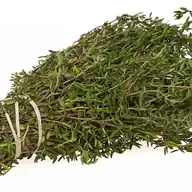
11 × thyme
The real placement, on an example 5 ft bed - the same layout the planner draws.
Between seasons
The guild is the standing planting; it is not lifted at all.
What it claims
one regime - sharp drainage, full sun and low summer water - which vegetable irrigation breaks
Promising
Mechanism: These species are adapted to dry-climate Mediterranean conditions - gritty, fast-draining soils and low summer water. In wet or heavy, poorly drained soil the root zone stays waterlogged, starving the roots of oxygen and rotting them; excess water and rich fertility compound the rot risk and, in these aromatic herbs, thin the essential oils that carry the flavour.
Evidence: confirmed against 3 sources in the research-based literature.
the 3 sources
Clemson HGIC, 'Herbs', hgic.clemson.edu/factsheet/herbs (read 2026-08-22): 'Many common herbs are from the Mediterranean region. They grow well in full sun, well-drained soil, and dry summers'; rosemary - 'All grow best in dry, sunny areas in well-drained soil'; sage - 'The plants require excellent drainage and dry soil in full sun'; thyme - 'Plant thyme in full sun in very well drained soil that stays dry'; oregano - 'Plant oregano in full sun and well-drained soil'; 'Most herbs do not need a highly fertile soil. Very fertile soils tend to produce lush leaves that lack flavor.'
Univ. of Maryland Extension, 'Care of Herbs and Starting Herbs from Seed', extension.umd.edu/resource/care-herbs-and-starting-herbs-seed (read 2026-08-22): 'Drainage is probably the most important single factor in successful herb growing'; 'Herbs will not grow in wet soils'; 'The "Mediterranean" herbs, such as basil, thyme, rosemary, oregano, and lavender, grow best on sunny, dry sites in light (sandy) soil'; 'Over-fertilizing herb plants can lower the plant's essential oil content and encourage root and stem rot diseases.'
NC State Extension Gardener Plant Toolbox, 'Salvia officinalis', plants.ces.ncsu.edu/plants/salvia-officinalis (read 2026-08-22): 'Common sage prefers full sun and well-drained, medium to dry soils that mimic those of its Mediterranean homeland'; 'It is intolerant of wet or poorly drained soils'; 'It will tolerate drought and poor soils.'
The honest version
Nothing here feeds or guards another plant. These five are together because they want the same thing - gritty, fast-draining soil, full sun and water only when dry - and because the vegetables they usually get planted among want the opposite. The pizza garden keeps its herbs for the kitchen; this bed keeps them alive. Marjoram, savory and tarragon stay out until they are sourced on their own terms, as the rule itself says.
Roles
A role is filled by whatever satisfies its predicate, not by a fixed species list. The canonical filler is the default; the alternatives are priced.
Hardiness zone is the correct variable for perennials, and only for perennials.
suboptimal if ignored → advise
Mechanism: Zones encode average annual minimum winter temperature, which governs whether a woody perennial survives to spring. It is the wrong quantity for an annual, which never sees winter.
THE CEILING IS A SECOND AND DIFFERENT MECHANISM, and until 2026-07-26 this rule enforced it without naming it. A zone too WARM does not kill a perennial; it fails to chill it. Deciduous fruit crops need a winter dormancy period to break bud and set fruit, so in a zone milder than a plant is adapted to it may survive and never crop. Until ISSUES #13 was decided the band was enforced at both ends; now (option E) only the cold end gates — it alone follows from the definition of the zone system — and the warm end is carried as an ADVISORY, not a refusal.
AND THE WARM END IS A CULTIVAR'S ANSWER, NOT A SPECIES', which is the honest limit of what this rule can do. Chill requirement is published per variety and varies enormously within a species, so a species-level ceiling says "the modelled range does not reach your zone", never "no plant of this kind will crop for you". So the engine offers the plant above its band and advises choosing a cultivar rated for the zone rather than refusing it — the same move invariant 3 makes for soil, applied to chill.
Evidence: confirmed against 3 sources in the research-based literature.
the 3 sources
THE FLOOR IS TRUE BY DEFINITION and needs no citation: the USDA system defines a zone AS a band of average annual minimum winter temperature, so 'a plant colder-hardy than your zone survives your winter' is the definition restated. This rule was `verified_trivially` on that basis alone until 2026-07-26. THE CEILING WAS NEVER COVERED BY IT - a minimum-temperature definition says nothing about a plant failing for want of chill - and that gap is why ISSUES #13 exists. The pointer below closes it.
OSU Extension EC 1303, 'Growing blackberries in your home garden' (Bernadine Strik), catalog.extension.oregonstate.edu/sites/catalog/files/project/pdf/ec1303.pdf (read 2026-07-26). THE CEILING'S MECHANISM, STATED: 'Winter cold-hardy cultivars adapted to the colder regions of Oregon (such as zones 5 to 7), may not grow normally in regions of the Willamette Valley (zone 8) where winters are warmer and plants receive less winter chill.' A plant failing in a WARMER zone for want of chill - which is what this rule's upper bound enforces and what no source said until now. THE SAME PAGE MAKES IT A CULTIVAR PROPERTY: 'Even cultivars within the same type (trailing, erect or semierect) differ in fruit quality and flavor, appearance, tolerance to pests, cold hardiness, and plant longevity', and the remedy it gives is the one this rule's rejection text now repeats: 'Minimize risk by choosing types and cultivars that are adapted to your hardiness zone.' The page then publishes a table of sixteen cultivars EACH WITH ITS OWN ZONE RANGE, which is the strongest available evidence that a species-level band is an approximation. [read]
WHAT THIS DOES NOT SETTLE. The mechanism is now named, but the corpus still carries ONE band per species where the source carries one per cultivar, and 12 of 25 perennial zones have no citation at all. So the ceiling is explained without being precise. ISSUES #13 stays open on that, and the rejection text is deliberately phrased as 'the modelled range does not reach your zone' rather than as a prediction that nothing will crop.