Milpa Gardens
iniciar sesión

Traducción automática · Leer en inglés

Chirivía

Parsnip · Pastinaca sativa · familia de las apiáceas · USDA PLANTS: PASA2

De un vistazo

Luz
Pleno sol
Helada
Resistente
Distancia
8 cm3 in
Días a la cosecha
120–180
En esta página

Las reglas y las notas de cosecha de esta página están traducidas automáticamente del inglés; sus fuentes, algunas notas y los títulos de las guías siguen en inglés.

Chirivía (Pastinaca sativa) es una planta bienal (familia de las apiáceas).

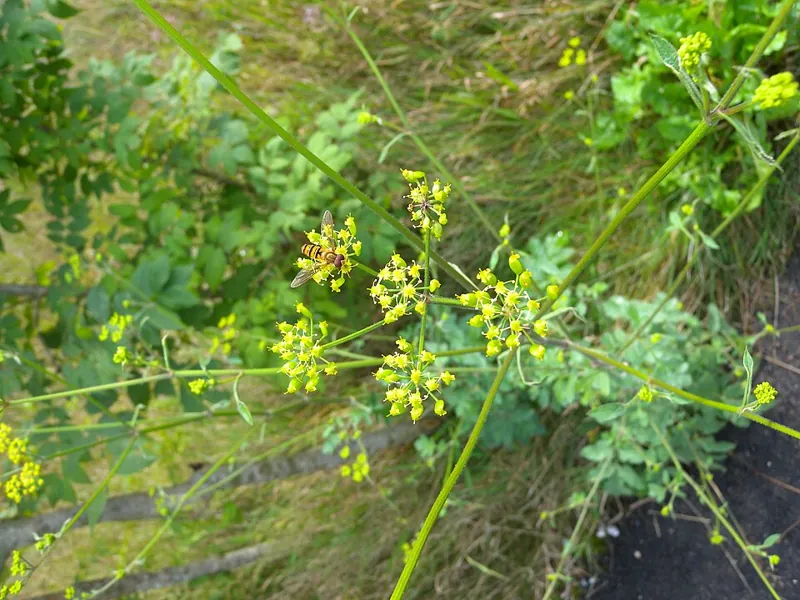
A parsnip plant in flower
Grown for its root; shown here in flower. Photo: MurielBendel · CC BY-SA 4.0, via Wikimedia Commons.

¿Cuándo siembro esto? →

Planéala en tu huerto →

Los números

Profundidad de siembra
1.3 cm0.5 in
Distancia en el surco
8 cm3 in
Altura adulta
30–40 cm12–16 in
Ancho adulto
10–15 cm4–6 in
pH del suelo
6–7
Días a la cosecha
120–180
Luz
Pleno sol
Nutrientes
Poco exigente
Profundidad de la raíz
Profunda
Tolerancia a la helada
Resistente
Ciclo de vida
Bienal
Forma de crecer
Raíz
Valor para los polinizadores
Ninguno

Antes de sembrar

Lo que la semilla necesita antes de brotar.

Temperatura del suelo para germinar
13–18 °C55–64 °F
Días para germinar
14–21 días

Utah State University Extension, 'How to Grow Parsnips in Your Garden' (Dan Drost), extension.usu.edu/yardandgarden/research/parsnips-in-the-garden (fetched in-container 2026-09-25, read by the maintainer 2026-09-25): 'Parsnips can be planted after soils reach 40ºF. Seeds germinate best at 55-65ºF and require 14-21 days to emerge. Temperatures above 80ºF reduce seed germination.' Stored [13, 18] C is the 55-65 F 'germinate best' band. OSU's Harrington table gives 'Parsnip 35 50–70 65 85' (minimum, optimum range, optimum, maximum F) - a wider band; USU's is stored (maintainer ruling 2026-09-25, D-221). [read]

Utah State University Extension, 'How to Grow Parsnips in Your Garden', extension.usu.edu/yardandgarden/research/parsnips-in-the-garden (fetched in-container 2026-09-25, read by the maintainer 2026-09-25): 'Seeds germinate best at 55-65ºF and require 14-21 days to emerge.' [read]

University of Minnesota Extension, 'Growing carrots and parsnips in home gardens', extension.umn.edu/vegetables/growing-carrots-and-parsnips (fetched in-container 2026-09-25, read by the maintainer 2026-09-25): 'The seeds may take as long as three weeks to germinate.' [read]

Penn State Extension, York County Master Gardeners, 'Vegetable Seed Planting Guide' (fetched in-container 2026-09-25, read by the maintainer 2026-09-25): the 'Days to germinate' column, row 'Parsnip': 21. [read]

COLD SOIL TAKES LONGER, recorded and not stored (maintainer ruling 2026-09-25, D-221): Clemson HGIC 'Carrot, Beet, Radish & Parsnip', hgic.clemson.edu/factsheet/carrot-beet-radish-parsnip/ (fetched in-container 2026-09-25, read by the maintainer 2026-09-25): 'Seeds are slow to germinate and may take 18 to as much as 60 days.'; OSU Extension, J. F. Harrington, 'Soil temperature conditions for vegetable seed germination', extension.oregonstate.edu/catalog/soil-temperature-conditions-vegetable-seed-germination (fetched in-container 2026-09-25, read by the maintainer 2026-09-25): days to seedlings for parsnip 'Parsnip 171 57 27 19 14 15 32' at 32, 41, 50, 59, 68, 77, 86 F - so 21 days holds at about 59 F or warmer. The thinning job dates from the upper end, 21 days; it is the app's inference, since no source gives a day count for thinning. [read]
Números de los que estamos menos seguros

These are estimates from general gardening knowledge, or the sources disagree on them, so treat them as a starting point rather than a firm figure.

Reglas que se aplican a Chirivía

Una buena corazonada Las aliáceas y la familia de la zanahoria no tienen parentesco con las solanáceas/cucurbitáceas/brasicáceas y pueden romper los ciclos de rotación de esas familias — pero no son de "baja presión" y necesitan su propia rotación.
Una buena corazonada

Las aliáceas y la familia de la zanahoria no tienen parentesco con las solanáceas/cucurbitáceas/brasicáceas y pueden romper los ciclos de rotación de esas familias — pero no son de "baja presión" y necesitan su propia rotación.

si no se sigue, igual funciona, pero peor · el planeador lo sugiere

Mecanismo: No hospedan ninguno de los patógenos del suelo de las tres grandes familias, así que poner una aliácea o una apiácea después de esos cultivos rompe el ciclo de hospederos. Pero no son de baja presión por naturaleza: la pudrición blanca de las aliáceas (Sclerotium cepivorum) es específica de las aliáceas, sus esclerocios persisten 15+ años y no se puede erradicar una vez establecida; las apiáceas tienen sus propias enfermedades del suelo.

Evidence: confirmed against 1 source in the research-based literature.

the source

UMass Extension, 'Alliums, White Rot', ag.umass.edu/vegetable/fact-sheets/alliums-white-rot (read 2026-07-11): 'Sclerotium cepivorum is specific to allium species'; sclerotia 'may remain viable in soil for 15 years or more without allium hosts'; 'Currently, there is no way to eradicate white rot from a field where it has become established.'

Lee la regla completa → · abrir en el planeador ↗

Prometedor No apliques fertilizante fresco alto en N a los cultivos de raíz.
Prometedor

No apliques fertilizante fresco alto en N a los cultivos de raíz.

si no se sigue, igual funciona, pero peor · el planeador lo sugiere

Mecanismo: El exceso de N impulsa el follaje a costa del engrosamiento de la raíz. (La bifurcación es un problema aparte — la causan piedras, compactación o materia orgánica gruesa o fresca en el camino de la raíz, no el nitrógeno.)

Evidence: confirmed against 2 sources in the research-based literature.

the 2 sources

UMN Extension, 'Growing carrots and parsnips in home gardens', extension.umn.edu/vegetables/growing-carrots-and-parsnips (read 2026-07-11): 'Excessive nitrogen fertilization can also contribute to lots of leaf growth at the expense of root growth'; 'Forked, or split, roots may result from rocky, heavy, or compacted soil.'

Univ. of Illinois Extension, 'Carrots', extension.illinois.edu/gardening/carrots (read 2026-07-11): 'excess organic debris such as woodchips worked into the soil just before planting also may affect root penetration, causing forked and twisted roots'; hairy roots 'are caused by a viral disease known as "aster yellows."'

Lee la regla completa → · abrir en el planeador ↗

Prometedor No plantes la familia de la zanahoria en tierra que la tuvo en los últimos 3 años.
Prometedor

No plantes la familia de la zanahoria en tierra que la tuvo en los últimos 3 años.

si no se sigue, se pierde cosecha de verdad · el planeador te avisa

Mecanismo: Los tizones de la hoja de la zanahoria (Alternaria dauci, Cercospora carotae y el tizón bacteriano) y el tizón tardío por Septoria del apio sobreviven en los restos del cultivo y mueren a medida que estos se descomponen; un descanso de dos a tres años los mata de hambre. Alternaria radicina, la especie de la pudrición negra, infecta también el apio, el apio nabo, el eneldo, el hinojo, el perejil y la chirivía, y puede persistir en el suelo hasta ocho años, por eso la familia se rota como una sola.

Evidence: confirmed against 5 sources in the research-based literature.

the 5 sources

UMass Extension, 'Carrot, Alternaria Leaf Blight', umass.edu/agriculture-food-environment/vegetable/fact-sheets/carrot-alternaria-leaf-blight (fetched in-container 2026-09-02; read by the maintainer 2026-09-02): 'Practice relatively long rotations of 3-4 years'; 'A. radicina infects celery, celeriac, caraway, dill, fennel, parsley, and parsnips'; 'The fungus survives in the soil on crop debris but dies when the residue decomposes'; A. radicina 'can persist in soil for up to 8 years.'

Cornell Vegetables, 'Carrot Leaf Blight Diseases and their Management', vegetables.cornell.edu/pest-management/disease-factsheets/carrot-leaf-blight-diseases-and-their-management (fetched in-container 2026-09-02; read by the maintainer 2026-09-02): 'it is important to practice a minimum of a 2-year rotation out of carrots to allow time for decomposition of crop residue'; 'All three pathogens can be transmitted through infected or contaminated seeds and can survive on crop residue, which can act as a source of inoculum in subsequent cropping years.'

Cornell Vegetables, 'Do Rotations Matter within Disease Management Programs?', vegetables.cornell.edu/pest-management/disease-factsheets/do-rotations-matter-within-disease-management-programs (fetched in-container 2026-09-02; read by the maintainer 2026-09-02): its rotation table gives carrot leaf blights (fungal and bacterial) 2-3 years and celery leaf blights 2 years.

UMass Vegetable Notes 2025 vol. 37:13, Septoria late blight of celery, umass.edu/agriculture-food-environment/vegetable/newsletters/vegetable-notes/vegetable-notes-2025-vol-3713 (fetched in-container 2026-09-02; read by the maintainer 2026-09-02): 'The pathogen survives in crop debris in soil for up to 18 months, or outbreaks may originate from seed-borne inoculum.'

Clemson HGIC, 'Crop Rotation', hgic.clemson.edu/factsheet/crop-rotation (fetched in-container 2026-09-02; read by the maintainer 2026-09-02): 'a crop should only be grown in the same spot a maximum of once every three years'; its family table puts carrot, parsley, celery, cilantro, fennel and dill in the parsley family (Apiaceae).

solución

Planta los cultivos de la familia de la zanahoria en otra tierra, o espera a que pasen 3 años desde la última vez que esta tierra los tuvo. En cualquier caso, retira e incorpora pronto al suelo las hojas viejas, y compra semilla limpia: los tres tizones de la zanahoria viajan en la semilla.

Lee la regla completa → · abrir en el planeador ↗

Prometedor Los cultivos anuales resistentes al frío se pueden sembrar o trasplantar antes de la última helada de primavera — los resistentes unas tres semanas antes, los semirresistentes unas dos semanas antes. Los sensibles esperan a la propia helada.
Prometedor

Los cultivos anuales resistentes al frío se pueden sembrar o trasplantar antes de la última helada de primavera — los resistentes unas tres semanas antes, los semirresistentes unas dos semanas antes. Los sensibles esperan a la propia helada.

si no se sigue, igual funciona, pero peor · el planeador lo sugiere

Mecanismo: Resistencia al frío. Los cultivos resistentes toleran heladas fuertes y los semirresistentes toleran heladas ligeras, así que pueden ocupar la tierra semanas antes de que se permita la entrada a los cultivos sensibles a las heladas. El desfase se mide desde la última helada de primavera.

Evidence: confirmed against 4 sources in the research-based literature.

the 4 sources

University of Illinois Extension, 'Time Your Vegetable Plantings by Cold Hardiness' (2018-03-26), extension.illinois.edu/blogs/ilriverhort/2018-03-26-time-your-vegetable-plantings-cold-hardiness: very hardy vegetables 'withstand freezing temperatures and hard frosts without injury' (planted earliest in spring); frost-tolerant vegetables 'can withstand light frosts, but not freezing temperatures' (planted a couple of weeks later). LLM-summarised from a read of the page; it establishes the CATEGORIES but states no week offsets.

Colorado State Univ. Extension, GardenNotes #720, 'Vegetable Planting Guide', extension.colostate.edu/resource/vegetable-planting-guide (read 2026-07-25): hardy vegetables go in 'As early as 2-4 weeks before the date of the average last spring frost'; semi-hardy 'As early as 0-2 weeks before the date of the average last spring frost'; tender from seed 'around the date of the average last spring frost'; very tender 'Typically 2+ weeks after'. This is the source that states the offsets in weeks.

Where this rule sits in that range: hardy at 3 weeks is mid-range of CSU's 2-4. Half-hardy at 2 weeks is the EARLIEST EDGE of CSU's 0-2 - the most aggressive planting CSU sanctions, not the middle of it. The rule is inside published guidance at both ends, but it leans early on the half-hardy side and a gardener following it in a cold spring is taking that boundary.

Do not import an offset from another publication's hardiness scheme without checking the category names: CSU has no 'very hardy' tier, so a '4-6 weeks before frost' figure written against a four-tier scheme does not describe CSU's 'hardy'. Categories are not comparable across sources.

Lee la regla completa → · abrir en el planeador ↗

Prometedor Un cultivo de raíz sembrado directamente que no se ralea produce raíces amontonadas que se quedan pequeñas - las plántulas crecen mucho más densas de lo que pueden madurar, compiten por el mismo suelo, y las raíces se tuercen y se enredan en vez de engordar.
Prometedor

Un cultivo de raíz sembrado directamente que no se ralea produce raíces amontonadas que se quedan pequeñas - las plántulas crecen mucho más densas de lo que pueden madurar, compiten por el mismo suelo, y las raíces se tuercen y se enredan en vez de engordar.

si no se sigue, igual funciona, pero peor · el planeador lo sugiere

Mecanismo: Los cultivos de raíz se siembran como semilla en su sitio y germinan mucho más densos de lo que pueden madurar. Donde las plántulas quedan demasiado juntas, sus raíces al engrosar se quedan sin espacio y compiten por espacio, agua y nutrientes, así que se quedan pequeñas y se deforman - torciéndose y enredándose con las vecinas. Ralear mientras las plántulas son jóvenes deja a cada raíz que queda el espacio para desarrollarse. (Distinto de la BIFURCACIÓN, que las fuentes atribuyen a suelo pedregoso o compactado y a nematodos agalladores, no al amontonamiento - así que esta regla afirma pequeñas y enredadas, no bifurcadas.)

Evidence: confirmed against 2 sources in the research-based literature.

the 2 sources

UMN Extension, 'Growing carrots and parsnips in home gardens', extension.umn.edu/vegetables/growing-carrots-and-parsnips (read 2026-08-21): 'You must thin out both carrots and parsnips to allow room for the roots to develop properly'; 'When the largest seedlings are three to four inches tall, thin by pulling up extra seedlings so that the remaining plants are about two to four inches apart'; 'If the plants develop healthy green tops, but limited root growth, it is usually because the plants are crowded.'

Univ. of Illinois Extension, Home Vegetable Gardening - 'Carrots', extension.illinois.edu/gardening/carrots (read 2026-08-21): 'Twisting and intertwining result from seeding too thickly and inadequate thinning of seedlings'; 'Thin the seedlings when they are about one inch tall to no more than three seedlings per inch for finger carrots ... and one seedling per 1 to 2 inches for larger varieties.'

solución

Ralea mientras las plántulas son jóvenes - de unos 2.5 cm (una pulgada) de alto - hasta el espaciado del cultivo, arrancando o cortando las sobrantes en vez de dejar la hilera llena: más o menos una plántula cada 2.5-5 cm para una zanahoria de tamaño completo, más separadas para la chirivía y las variedades más grandes. Las zanahorias que arrancas al ralear se pueden comer, con todo y hojas.

Lee la regla completa → · abrir en el planeador ↗

Otras 118 reglas dependen de tu huerto y no de la planta — rotación de cultivos, fechas de helada, sol, distancia entre plantas y suelo. Velas todas.

Cita esta página

Milpa Gardens. "Chirivía (Pastinaca sativa)." https://milpa.garden/es/plants/pastinaca-sativa/

A garden-planning corpus: every claim states its evidence grade and links its sources on the page. Cite it with the grade, and add the date you read it.

Todas las plantas