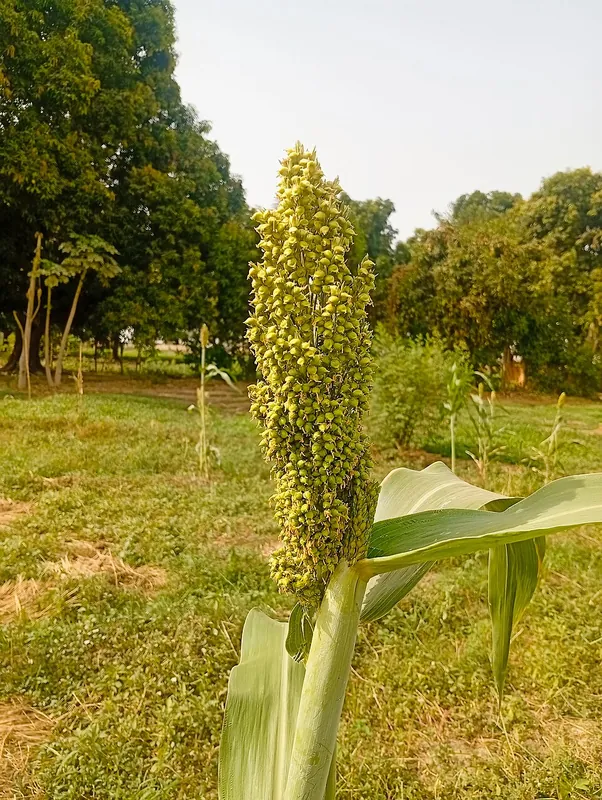
Not every sorghum grows the same. These are its main types (its cultivar groups), and the planner sizes, times and supports each one by its own numbers.
Grain sorghum — one upright stem, spacing in row 15 cm6 in, mature height 0.6–1.2 m2–4 ft, mature spread 60–90 cm24–35 in, days to maturity 90–120
Broomcorn — one upright stem, spacing in row 15 cm6 in, mature height 2.4–4.5 m8–15 ft, mature spread 60–90 cm24–35 in, days to maturity 90–120
Numbers we’re less sure of
Many of our estimates come from an extension page we’ve read that gets close without pinning the number down. Others are still our own best guess, and on some the sources disagree. Treat them all as a starting point.
Spacing in row — an estimate
Root depth — an estimate
Feeding — an estimate
Broomcorn: mature spread — an estimate
Rules that apply to sorghum
Don't sow or set out tender crops before your last frost date Well established
Don't sow or set out tender crops before your last frost date
Ground that just carried cereal rye or a sorghum cover crop is a poor seedbed for small seeds for a few weeks. As the residue breaks down it releases chemicals that stop small seeds germinating, and the smaller the seed the worse it fares; transplants and big seeds largely shrug it off. Promising
Ground that just carried cereal rye or a sorghum cover crop is a poor seedbed for small seeds for a few weeks. As the residue breaks down it releases chemicals that stop small seeds germinating, and the smaller the seed the worse it fares; transplants and big seeds largely shrug it off.
If you skip this, it still grows, just less well. The planner suggests it.
How it works: Rye and sorghum roots and residue release allelochemicals (benzoxazinoids from rye, sorgoleone from sorghum) that persist in the surface soil for weeks after the cover is killed. A small seed sown into that layer has little reserve to push through the inhibition; a large seed or a transplant is already past the germination window.
Evidence: checked against 4 sources in the research-based literature.
Small-seeded and slow germinating crops are more likely to be adversely effected by allelopathic cover crops than are large-seeded, rapidly germinating crops (Weston, 1996)
It needs to be terminated in mid to late spring before it goes to seed, about 2 weeks before the desired transplant date.
Remedy
Wait about two weeks after killing rye and about four after sorghum before sowing small seeds, water an inch to leach the surface, or plant transplants. Big seeds and transplants can go in sooner.
Cold-hardy annuals can be sown or transplanted before the last spring frost (hardy crops about three weeks before, half-hardy about two weeks before). Tender crops wait for the frost itself. Promising
Cold-hardy annuals can be sown or transplanted before the last spring frost (hardy crops about three weeks before, half-hardy about two weeks before). Tender crops wait for the frost itself.
If you skip this, it still grows, just less well. The planner suggests it.
How it works: Cold hardiness. Hardy crops tolerate hard frost and half-hardy crops tolerate light frost, so they can occupy the ground weeks before frost-tender crops are allowed in. The offset is measured from the last spring frost.
Evidence: checked against 2 sources in the research-based literature.
If you skip this, the planting fails. The planner warns you.
How it works: On a clear, still night leaves lose heat to the open sky, so a leaf can fall to freezing and ice can form in it while the thermometer, a couple of meters up, still reads a few degrees above.
Evidence: checked against 7 sources in the research-based literature.
Frost occurs when air is warmer than 32°F but plant tissues drop to 32°F or below because plants radiate (lose) heat into the atmosphere, especially during cool, clear nights.
Radiation frosts occur on calm clear nights that lack cloud cover to hold in heat.
Remedy
The evening before, cover the crops at risk with a sheet or frost cloth, never plastic, reaching the ground and loose at the bottom so the soil's warmth can rise under it, and take it off in the morning. A cover helps least in a long, hard freeze.
A garden planner built on graded evidence. Every claim states its evidence grade and links its sources on the page. Cite it with the grade, and add the date you read it.