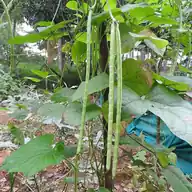
A summer of cowpeas in a bed, ahead of the cool-season crops, so the bed rests from its usual crops through the hot months and banks nitrogen for the ones that follow.
Why these are grouped
A rest for the soil. It benefits next season’s crop as a rotation break and green manure. The plants are not claimed to help each other while they grow.
At least 0.3 m²3 ft². If your bed is smaller, the planner grays this plant team out, says why, and offers the nearest adaptation that fits. It never swaps in something else without telling you.
What it looks like planted
3 × Cowpea
The real placement on an example 4 ft bed, the same layout the planner draws.
Between seasons
Nothing is left living in the bed over winter; the whole planting is re-established.
What it claims
Residue mineralizes N for the cool-season crop that follows
How it works: A legume fixes atmospheric nitrogen into its tissue as it grows. When the crop is killed and its residue decomposes, soil microbes mineralize that organic nitrogen, converting a form plants can't use into one they can, and release it for the next crop. How much depends on how well the legume grew, and it is lower on sandy soils.
Evidence: checked against 2 sources in the research-based literature.
The nitrogen credit depends on the amount of crop growth and when the legume was planted. Nitrogen credits are 50 lb N/a lower on sandy, coarse-textured soils.
Who does what, and the swaps
Each job in this planting can be done by more than one plant. The usual choice comes first, and each swap says what it costs.
Rotation history belongs to the ground itself, so this is what the planner records about this patch after the plant team comes out.
Legumes: counts as a full season of this family
Where this plant team comes from
A new combination: UF/IFAS's advice that beans and peas 'make good summer cover crops, enriching the soil for your cool-weather plantings' (Gardening Solutions, 'Heat-Tolerant Vegetables'), with cowpea, the summer cover crop UF/IFAS's Florida Vegetable Gardening Guide names first ('Summer: cowpea, velvet bean, soybean, sunflower, and sunn hemp'). Not a documented traditional planting.