Milpa Gardens
iniciar sesión

Traducción automática · Leer en inglés

Zinia

Zinnia · Zinnia elegans · familia de las asteráceas · USDA PLANTS: ZIVI2 (listed there as Zinnia violacea Cav.)

De un vistazo

Luz
Pleno sol
Helada
Sensible
Distancia
30 cm12 in
Días a la cosecha
56–84
En esta página

Las reglas y las notas de cosecha de esta página están traducidas automáticamente del inglés; sus fuentes, algunas notas y los títulos de las guías siguen en inglés.

Zinia (Zinnia elegans) es una planta anual (familia de las asteráceas).

También se conoce como Common Zinnia.

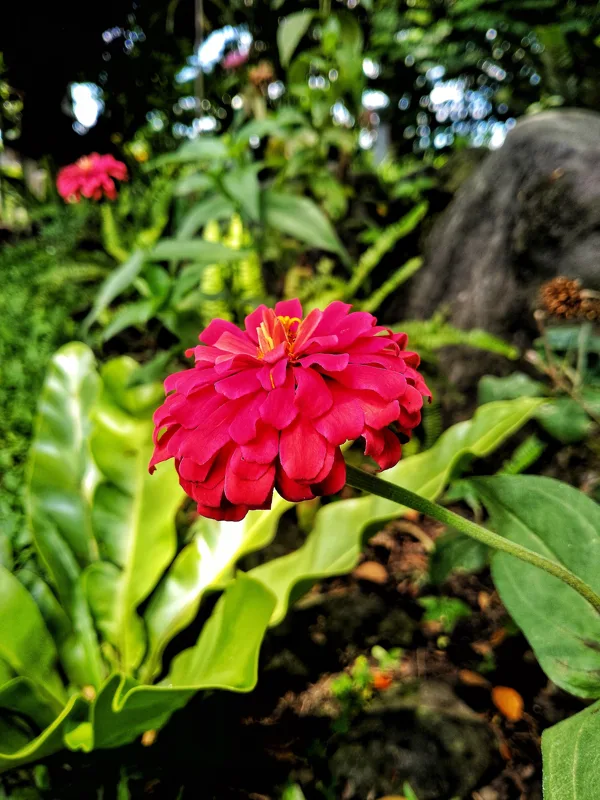
A common zinnia flower in bloom
Photo: Derk29 · CC BY-SA 4.0, via Wikimedia Commons.

¿Cuándo siembro esto? →

Planéala en tu huerto →

Los números

Profundidad de siembra
0.6 cm0.2 in
Distancia en el surco
30 cm12 in
Altura adulta
15–120 cm6–47 in
Ancho adulto
20–30 cm8–12 in
Días a la cosecha
56–84
Luz
Pleno sol
Nutrientes
Poco exigente
Profundidad de la raíz
Poco profunda
Tolerancia a la helada
Sensible
Ciclo de vida
Anual
Forma de crecer
Tallo
Valor para los polinizadores
Alto

Antes de sembrar

Lo que la semilla necesita antes de brotar.

Temperatura del suelo para germinar
21 °C70 °F
Días para germinar
5–7 días

Iowa State Extension, 'Germination Requirements of Annuals and Vegetables' (Jauron & Steil, last reviewed Dec 2023), yardandgarden.extension.iastate.edu/how-to/germination-requirements-annuals-and-vegetables (fetched in-container 2026-09-20, read by the maintainer 2026-09-20 via the batch-3 germination review): the row 'Zinnia (Zinnia elegans)' gives Germination Temperature 70 F = 21 C, stored as the single-value band [21, 21]. FLAGGED ESTIMATED: Iowa State labels this column 'Germination Temperature (°F)' and defines it as 'The ideal air temperature for germination' - an AIR temperature, not a soil temperature, and this field is germination_soil_temp_c. No source read gives zinnia a soil-germination temperature; this is the nearest published germination figure, stored with that caveat. No extension source read gives a pre-sow soak or scarification for zinnia, so no seed_treatment is recorded. [read]

Iowa State Extension, same page and fetch as germination_soil_temp_c (read by the maintainer 2026-09-20): the row 'Zinnia (Zinnia elegans)' gives Days to Germination 5-7. Stored [5, 7]. [read]

Iowa State Extension, same page and fetch (read by the maintainer 2026-09-20): the Zinnia row carries the light code D, defined verbatim as 'D = Require Darkness for Germination. Cover the seed with the germination medium.' So this species germinates in darkness (light_to_germinate false). [read]

Números de los que estamos menos seguros

These are estimates from general gardening knowledge, or the sources disagree on them, so treat them as a starting point rather than a firm figure.

Reglas que se aplican a Zinia

Bien establecido Las especies sensibles a la helada no deben programarse antes de la fecha de la última helada del sitio.
Bien establecido

Las especies sensibles a la helada no deben programarse antes de la fecha de la última helada del sitio.

si no se sigue, la siembra fracasa · el planeador lo rechaza

Mecanismo: Nucleación de hielo en el tejido de la hoja.

Evidence: settled without a trial - climatology.

solución

Siembra o trasplanta después de la fecha de la última helada, o empieza en interiores y trasplanta cuando haya pasado.

Lee la regla completa → · abrir en el planeador ↗

Una buena corazonada No plantes lechuga ni su familia en tierra que la tuvo en los últimos 3 años, y ten en cuenta que los hongos del moho blanco de la lechuga también viven en la mayoría de las otras hortalizas.
Una buena corazonada

No plantes lechuga ni su familia en tierra que la tuvo en los últimos 3 años, y ten en cuenta que los hongos del moho blanco de la lechuga también viven en la mayoría de las otras hortalizas.

si no se sigue, se pierde cosecha de verdad · el planeador lo sugiere

Mecanismo: La pudrición basal (Rhizoctonia solani) y el moho blanco de la lechuga (Sclerotinia sclerotiorum y S. minor) sobreviven en el suelo como micelio y esclerocios durante años y se acumulan donde la lechuga se repite; un descanso de tres años mantiene a raya la pudrición basal. Los hongos del moho blanco infectan también aliáceas, brasicáceas, solanáceas, cucurbitáceas y leguminosas, así que una rotación de la lechuga los frena sin matarlos de hambre, y solo los cereales son tierra segura.

Evidence: confirmed against 4 sources in the research-based literature.

the 4 sources

Cornell Vegetables, 'Do Rotations Matter within Disease Management Programs?', vegetables.cornell.edu/pest-management/disease-factsheets/do-rotations-matter-within-disease-management-programs (fetched in-container 2026-09-02; read by the maintainer 2026-09-02): its rotation table gives lettuce bottom rot (Rhizoctonia) 3 years and drop (Sclerotinia) 3 years.

NC State Extension, 'Lettuce Drop', content.ces.ncsu.edu/lettuce-drop (fetched in-container 2026-09-02; read by the maintainer 2026-09-02): 'Sclerotinia sclerotiorum and S. minor have a wide host range infecting allium (onion, garlic), brassica (cabbage, broccoli), solanaceae (pepper, potato), cucurbits (cucumber, squash), lettuce, and sweetpotato crops'; 'Cereals (maize, wheat, sorghum) are less susceptible to these pathogens'; 'the broad host range of both pathogens significantly limits the efficacy of crop rotation.'

Utah State University Extension, 'Drop (Sclerotinia Rot)', extension.usu.edu/planthealth/ipm/notes_ag/veg-drop-sclerotinia (fetched in-container 2026-09-02; read by the maintainer 2026-09-02): 'The sclerotia can survive dormant in the soil for extended periods'; 'S. sclerotiorum affects a wide range of hosts, including root crops, legumes, and solanaceous crops however, drop is specific to lettuce'; rotate 'with nonsusceptible crops such as grains or corn to reduce disease build-up.'

UMass Vegetable Notes 2024 vol. 36:2, umass.edu/agriculture-food-environment/vegetable/newsletters/vegetable-notes/vegetable-notes-2024-vol-362 (fetched in-container 2026-09-02; read by the maintainer 2026-09-02): bottom rot - 'Rhizoctonia survives in the soil, as mycelium or sclerotia'; lettuce drop - 'It produces sclerotia that can survive in the soil for many years'; 'Its host range includes many vegetables such as tomato and beans.'

solución

Planta la lechuga y su familia en otra tierra, o espera a que pasen 3 años desde la última vez que esta tierra las tuvo. Donde ha aparecido el moho blanco, el descanso que cuenta es uno de granos o maíz, ya que la mayoría de las hortalizas lo portan, y las plantas muertas van a la basura, no a la composta: los esclerocios sobreviven a ella.

Lee la regla completa → · abrir en el planeador ↗
Prometedor Los cultivos anuales resistentes al frío se pueden sembrar o trasplantar antes de la última helada de primavera — los resistentes unas tres semanas antes, los semirresistentes unas dos semanas antes. Los sensibles esperan a la propia helada.
Prometedor

Los cultivos anuales resistentes al frío se pueden sembrar o trasplantar antes de la última helada de primavera — los resistentes unas tres semanas antes, los semirresistentes unas dos semanas antes. Los sensibles esperan a la propia helada.

si no se sigue, igual funciona, pero peor · el planeador lo sugiere

Mecanismo: Resistencia al frío. Los cultivos resistentes toleran heladas fuertes y los semirresistentes toleran heladas ligeras, así que pueden ocupar la tierra semanas antes de que se permita la entrada a los cultivos sensibles a las heladas. El desfase se mide desde la última helada de primavera.

Evidence: confirmed against 4 sources in the research-based literature.

the 4 sources

University of Illinois Extension, 'Time Your Vegetable Plantings by Cold Hardiness' (2018-03-26), extension.illinois.edu/blogs/ilriverhort/2018-03-26-time-your-vegetable-plantings-cold-hardiness: very hardy vegetables 'withstand freezing temperatures and hard frosts without injury' (planted earliest in spring); frost-tolerant vegetables 'can withstand light frosts, but not freezing temperatures' (planted a couple of weeks later). LLM-summarised from a read of the page; it establishes the CATEGORIES but states no week offsets.

Colorado State Univ. Extension, GardenNotes #720, 'Vegetable Planting Guide', extension.colostate.edu/resource/vegetable-planting-guide (read 2026-07-25): hardy vegetables go in 'As early as 2-4 weeks before the date of the average last spring frost'; semi-hardy 'As early as 0-2 weeks before the date of the average last spring frost'; tender from seed 'around the date of the average last spring frost'; very tender 'Typically 2+ weeks after'. This is the source that states the offsets in weeks.

Where this rule sits in that range: hardy at 3 weeks is mid-range of CSU's 2-4. Half-hardy at 2 weeks is the EARLIEST EDGE of CSU's 0-2 - the most aggressive planting CSU sanctions, not the middle of it. The rule is inside published guidance at both ends, but it leans early on the half-hardy side and a gardener following it in a cold spring is taking that boundary.

Do not import an offset from another publication's hardiness scheme without checking the category names: CSU has no 'very hardy' tier, so a '4-6 weeks before frost' figure written against a four-tier scheme does not describe CSU's 'hardy'. Categories are not comparable across sources.

Lee la regla completa → · abrir en el planeador ↗

Prometedor Los cultivos de clima cálido de temporada larga se empiezan bajo techo varias semanas antes de la última helada y se trasplantan después de ella — el tomate y el tomatillo unas seis semanas antes, el chile y la berenjena unas ocho. La albahaca, seis.
Prometedor

Los cultivos de clima cálido de temporada larga se empiezan bajo techo varias semanas antes de la última helada y se trasplantan después de ella — el tomate y el tomatillo unas seis semanas antes, el chile y la berenjena unas ocho. La albahaca, seis.

si no se sigue, igual funciona, pero peor · el planeador lo sugiere

Mecanismo: Un cultivo sensible a las heladas con muchos días a la cosecha no puede madurar si solo se siembra directamente después de la última helada — la ventana sin heladas es demasiado corta. Una ventaja inicial bajo cubierta compra las semanas que le faltan a la temporada; la plántula solo se trasplanta una vez que ha pasado la helada — la fecha de trasplante sigue dependiendo de la helada.

Evidence: confirmed against 2 sources in the research-based literature.

the 2 sources

University of Minnesota Extension, 'Starting seeds indoors', extension.umn.edu/planting-and-growing-guides/starting-seeds-indoors: seed-starting chart gives tomato '5-6 weeks' and pepper and eggplant '9 weeks' before the outdoor planting date (warm crops set out after the last frost). Read 2026-07-19 (LLM-summarised); read by the maintainer 2026-07-25, which is the read that promoted this rule. Note what the corpus's per-crop values do with the sources: tomato 6 sits at the top of Minnesota's '5-6 weeks' and inside Illinois's '6-8'; pepper and eggplant 8 sit BELOW Minnesota's '9 weeks' and at the top of Illinois's '6-8'. They are a reconciliation of two published ranges, not a figure either source prints.

University of Illinois Extension, 'When should I start my seeds?' (2023-02-10), extension.illinois.edu/blogs/good-growing/2023-02-10-when-should-i-start-my-seeds: peppers, tomatoes, and eggplant started '6-8 weeks before the last frost'. Read 2026-07-19.

Lee la regla completa → · abrir en el planeador ↗

Otras 119 reglas dependen de tu huerto y no de la planta — rotación de cultivos, fechas de helada, sol, distancia entre plantas y suelo. Velas todas.

Equipos de plantas que la incluyen

Cita esta página

Milpa Gardens. "Zinia (Zinnia elegans)." https://milpa.garden/es/plants/zinnia-elegans/

A garden-planning corpus: every claim states its evidence grade and links its sources on the page. Cite it with the grade, and add the date you read it.

Todas las plantas