Milpa Gardens
iniciar sesión

Traducción automática · Leer en inglés

Perejil

Parsley · Petroselinum crispum · familia de las apiáceas · USDA PLANTS: PECR2

De un vistazo

Luz
Sol parcial
Helada
Resistente
Distancia
15 cm6 in
Días a la cosecha
70–90
En esta página

Las reglas y las notas de cosecha de esta página están traducidas automáticamente del inglés; sus fuentes, algunas notas y los títulos de las guías siguen en inglés.

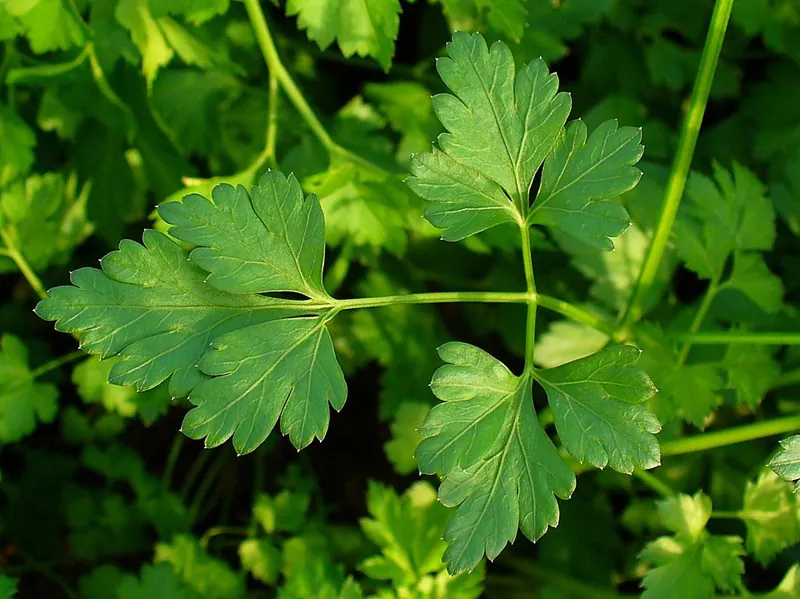
Perejil (Petroselinum crispum) es una planta bienal (familia de las apiáceas).

Flat-leaf parsley foliage
Photo: H. Zell · CC BY-SA 3.0, via Wikimedia Commons.

¿Cuándo siembro esto? →

Planéala en tu huerto →

Los números

Profundidad de siembra
0.3–0.6 cm0.1–0.2 in
Distancia en el surco
15 cm6 in
Altura adulta
20–35 cm8–14 in
Ancho adulto
20–25 cm8–10 in
pH del suelo
6–7
Días a la cosecha
70–90
Luz
Sol parcial
Nutrientes
Moderadamente exigente
Profundidad de la raíz
Media
Tolerancia a la helada
Resistente
Ciclo de vida
Bienal
Forma de crecer
Roseta
Valor para los polinizadores
Moderado

Antes de sembrar

Lo que la semilla necesita antes de brotar.

Temperatura del suelo para germinar
10–29 °C50–84 °F
Días para germinar
14–25 días
Tiempo que dura la semilla
1 años

OSU Extension, J. F. Harrington 'Soil temperature conditions for vegetable seed germination', extension.oregonstate.edu/gardening/soil-compost/soil-temperature-conditions-vegetable-seed-germination (published 2013, reviewed 2024; fetched in-container 2026-09-19, read by the maintainer 2026-09-19 via the batch-1 germination review): the Parsley row gives minimum 40 F, optimum range 50-85 F, optimum 75 F, maximum 90 F. Stored is the OPTIMUM RANGE 50-85 F = 10-29 C; the 90 F maximum is the failure edge and is not stored. SOAK NOT RECORDED, deliberately: UMN Extension ('Growing parsley in home gardens') and Wisconsin Horticulture both advise soaking the seed but only as 'speed up the process' / 'helps to enhance germination' - neither states a physical mechanism, and E-SEED-SHAPE (invariant 1) requires one, so no seed_treatment is recorded until a mechanism source is read. [read]

TWO EXTENSION SOURCES CONFLICT and the stored range spans them, leaning slow. OSU Extension's Harrington table (same page and fetch as germination_soil_temp_c) gives fast lab figures - Parsley 50 F -> 13 days, 59 F -> 7, 68 F -> 5, 77 F -> 4 - while Iowa State Extension's germination table ('Germination requirements of annuals and vegetables', yardandgarden.extension.iastate.edu/how-to/germination-requirements-annuals-and-vegetables) gives 'Parsley | 70-75 | D | 20-25', matching parsley's slow-to-germinate reputation. Stored [14, 25] follows the slower, real-garden figure (the maintainer's call on the conflict, 2026-09-19). [read]

CSU Extension, 'Storing Vegetable and Flower Seeds', extension.colostate.edu/resource/storing-vegetable-and-flower-seeds (fetched 2026-09-19, read by the maintainer 2026-09-19): the 'Relative longevity (years)' table gives Parsley 1 - among the shortest-lived vegetable seeds, matching its reputation. [read]

Iowa State Extension, 'Germination requirements of annuals and vegetables', yardandgarden.extension.iastate.edu/how-to/germination-requirements-annuals-and-vegetables (fetched 2026-09-19, read by the maintainer 2026-09-19): the table row 'Parsley | 70-75 | D | 20-25' with the legend 'D = Require Darkness for Germination. Cover the seed with the germination medium.' So this species germinates in darkness (light_to_germinate false). [read]

En la cosecha, y en maceta

Tamaño de maceta
al menos 19 L (5 galones de EE. UU.)al menos 5 galones (unos 19 L)

University of Maryland Extension, 'Growing Vegetables in Containers and Salad Tables', extension.umd.edu/resource/growing-vegetables-containers-and-salad-tables (fetched in-container 2026-09-25, read by the maintainer 2026-09-25): 'Large-statured herbs (rosemary, bay leaf, sage, parsley, lavender, dill, and fennel) require 5-gallon or larger pots.' Stored is the minimum the sentence gives. [read]

Números de los que estamos menos seguros

These are estimates from general gardening knowledge, or the sources disagree on them, so treat them as a starting point rather than a firm figure.

Reglas que se aplican a Perejil

Una buena corazonada Las aliáceas y la familia de la zanahoria no tienen parentesco con las solanáceas/cucurbitáceas/brasicáceas y pueden romper los ciclos de rotación de esas familias — pero no son de "baja presión" y necesitan su propia rotación.
Una buena corazonada

Las aliáceas y la familia de la zanahoria no tienen parentesco con las solanáceas/cucurbitáceas/brasicáceas y pueden romper los ciclos de rotación de esas familias — pero no son de "baja presión" y necesitan su propia rotación.

si no se sigue, igual funciona, pero peor · el planeador lo sugiere

Mecanismo: No hospedan ninguno de los patógenos del suelo de las tres grandes familias, así que poner una aliácea o una apiácea después de esos cultivos rompe el ciclo de hospederos. Pero no son de baja presión por naturaleza: la pudrición blanca de las aliáceas (Sclerotium cepivorum) es específica de las aliáceas, sus esclerocios persisten 15+ años y no se puede erradicar una vez establecida; las apiáceas tienen sus propias enfermedades del suelo.

Evidence: confirmed against 1 source in the research-based literature.

the source

UMass Extension, 'Alliums, White Rot', ag.umass.edu/vegetable/fact-sheets/alliums-white-rot (read 2026-07-11): 'Sclerotium cepivorum is specific to allium species'; sclerotia 'may remain viable in soil for 15 years or more without allium hosts'; 'Currently, there is no way to eradicate white rot from a field where it has become established.'

Lee la regla completa → · abrir en el planeador ↗

Prometedor No plantes la familia de la zanahoria en tierra que la tuvo en los últimos 3 años.
Prometedor

No plantes la familia de la zanahoria en tierra que la tuvo en los últimos 3 años.

si no se sigue, se pierde cosecha de verdad · el planeador te avisa

Mecanismo: Los tizones de la hoja de la zanahoria (Alternaria dauci, Cercospora carotae y el tizón bacteriano) y el tizón tardío por Septoria del apio sobreviven en los restos del cultivo y mueren a medida que estos se descomponen; un descanso de dos a tres años los mata de hambre. Alternaria radicina, la especie de la pudrición negra, infecta también el apio, el apio nabo, el eneldo, el hinojo, el perejil y la chirivía, y puede persistir en el suelo hasta ocho años, por eso la familia se rota como una sola.

Evidence: confirmed against 5 sources in the research-based literature.

the 5 sources

UMass Extension, 'Carrot, Alternaria Leaf Blight', umass.edu/agriculture-food-environment/vegetable/fact-sheets/carrot-alternaria-leaf-blight (fetched in-container 2026-09-02; read by the maintainer 2026-09-02): 'Practice relatively long rotations of 3-4 years'; 'A. radicina infects celery, celeriac, caraway, dill, fennel, parsley, and parsnips'; 'The fungus survives in the soil on crop debris but dies when the residue decomposes'; A. radicina 'can persist in soil for up to 8 years.'

Cornell Vegetables, 'Carrot Leaf Blight Diseases and their Management', vegetables.cornell.edu/pest-management/disease-factsheets/carrot-leaf-blight-diseases-and-their-management (fetched in-container 2026-09-02; read by the maintainer 2026-09-02): 'it is important to practice a minimum of a 2-year rotation out of carrots to allow time for decomposition of crop residue'; 'All three pathogens can be transmitted through infected or contaminated seeds and can survive on crop residue, which can act as a source of inoculum in subsequent cropping years.'

Cornell Vegetables, 'Do Rotations Matter within Disease Management Programs?', vegetables.cornell.edu/pest-management/disease-factsheets/do-rotations-matter-within-disease-management-programs (fetched in-container 2026-09-02; read by the maintainer 2026-09-02): its rotation table gives carrot leaf blights (fungal and bacterial) 2-3 years and celery leaf blights 2 years.

UMass Vegetable Notes 2025 vol. 37:13, Septoria late blight of celery, umass.edu/agriculture-food-environment/vegetable/newsletters/vegetable-notes/vegetable-notes-2025-vol-3713 (fetched in-container 2026-09-02; read by the maintainer 2026-09-02): 'The pathogen survives in crop debris in soil for up to 18 months, or outbreaks may originate from seed-borne inoculum.'

Clemson HGIC, 'Crop Rotation', hgic.clemson.edu/factsheet/crop-rotation (fetched in-container 2026-09-02; read by the maintainer 2026-09-02): 'a crop should only be grown in the same spot a maximum of once every three years'; its family table puts carrot, parsley, celery, cilantro, fennel and dill in the parsley family (Apiaceae).

solución

Planta los cultivos de la familia de la zanahoria en otra tierra, o espera a que pasen 3 años desde la última vez que esta tierra los tuvo. En cualquier caso, retira e incorpora pronto al suelo las hojas viejas, y compra semilla limpia: los tres tizones de la zanahoria viajan en la semilla.

Lee la regla completa → · abrir en el planeador ↗
Prometedor Los cultivos anuales resistentes al frío se pueden sembrar o trasplantar antes de la última helada de primavera — los resistentes unas tres semanas antes, los semirresistentes unas dos semanas antes. Los sensibles esperan a la propia helada.
Prometedor

Los cultivos anuales resistentes al frío se pueden sembrar o trasplantar antes de la última helada de primavera — los resistentes unas tres semanas antes, los semirresistentes unas dos semanas antes. Los sensibles esperan a la propia helada.

si no se sigue, igual funciona, pero peor · el planeador lo sugiere

Mecanismo: Resistencia al frío. Los cultivos resistentes toleran heladas fuertes y los semirresistentes toleran heladas ligeras, así que pueden ocupar la tierra semanas antes de que se permita la entrada a los cultivos sensibles a las heladas. El desfase se mide desde la última helada de primavera.

Evidence: confirmed against 4 sources in the research-based literature.

the 4 sources

University of Illinois Extension, 'Time Your Vegetable Plantings by Cold Hardiness' (2018-03-26), extension.illinois.edu/blogs/ilriverhort/2018-03-26-time-your-vegetable-plantings-cold-hardiness: very hardy vegetables 'withstand freezing temperatures and hard frosts without injury' (planted earliest in spring); frost-tolerant vegetables 'can withstand light frosts, but not freezing temperatures' (planted a couple of weeks later). LLM-summarised from a read of the page; it establishes the CATEGORIES but states no week offsets.

Colorado State Univ. Extension, GardenNotes #720, 'Vegetable Planting Guide', extension.colostate.edu/resource/vegetable-planting-guide (read 2026-07-25): hardy vegetables go in 'As early as 2-4 weeks before the date of the average last spring frost'; semi-hardy 'As early as 0-2 weeks before the date of the average last spring frost'; tender from seed 'around the date of the average last spring frost'; very tender 'Typically 2+ weeks after'. This is the source that states the offsets in weeks.

Where this rule sits in that range: hardy at 3 weeks is mid-range of CSU's 2-4. Half-hardy at 2 weeks is the EARLIEST EDGE of CSU's 0-2 - the most aggressive planting CSU sanctions, not the middle of it. The rule is inside published guidance at both ends, but it leans early on the half-hardy side and a gardener following it in a cold spring is taking that boundary.

Do not import an offset from another publication's hardiness scheme without checking the category names: CSU has no 'very hardy' tier, so a '4-6 weeks before frost' figure written against a four-tier scheme does not describe CSU's 'hardy'. Categories are not comparable across sources.

Lee la regla completa → · abrir en el planeador ↗

Otras 120 reglas dependen de tu huerto y no de la planta — rotación de cultivos, fechas de helada, sol, distancia entre plantas y suelo. Velas todas.

Cita esta página

Milpa Gardens. "Perejil (Petroselinum crispum)." https://milpa.garden/es/plants/petroselinum-crispum/

A garden-planning corpus: every claim states its evidence grade and links its sources on the page. Cite it with the grade, and add the date you read it.

Todas las plantas