Milpa Gardens
iniciar sesión

Traducción automática · Leer en inglés

Hinojo

Fennel · Foeniculum vulgare · familia de las apiáceas · USDA PLANTS: FOVU

De un vistazo

Luz
Pleno sol
Helada
Aguanta algo de frío
Distancia
45 cm18 in
Zona de rusticidad
4–10
En esta página

Las reglas y las notas de cosecha de esta página están traducidas automáticamente del inglés; sus fuentes, algunas notas y los títulos de las guías siguen en inglés.

Hinojo (Foeniculum vulgare) es una planta perenne (familia de las apiáceas).

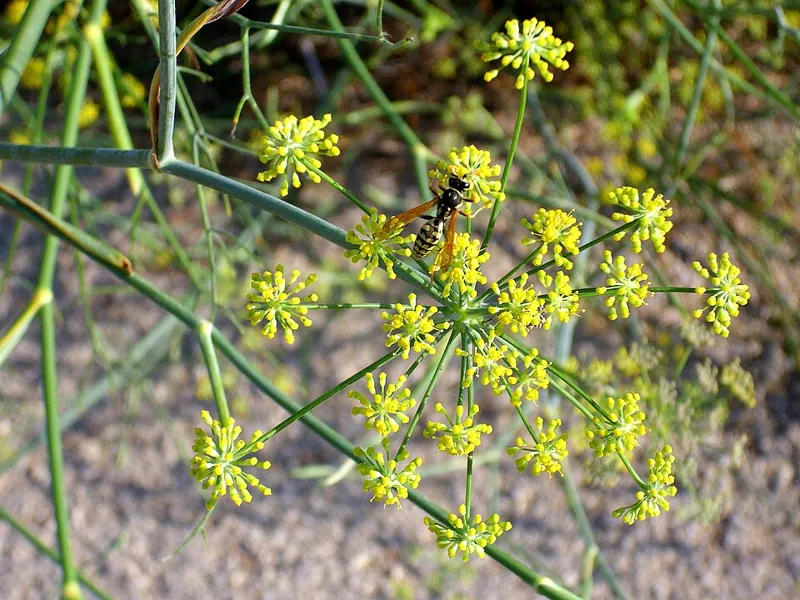
A fennel plant with yellow flower umbels
Photo: Javier martin · Public domain, via Wikimedia Commons.

¿Cuándo siembro esto? →

Planéala en tu huerto →

Los números

Distancia en el surco
45 cm18 in
Altura adulta
120–200 cm47–79 in
Ancho adulto
45 cm18 in
Zona de rusticidad
4–10
Luz
Pleno sol
Nutrientes
Moderadamente exigente
Profundidad de la raíz
Profunda
Tolerancia a la helada
Aguanta algo de frío
Ciclo de vida
Perenne
Forma de crecer
Tallo
Valor para los polinizadores
Alto
Da sombra a las plantas vecinas
Sí

Antes de sembrar

Lo que la semilla necesita antes de brotar.

Temperatura del suelo para germinar
10–24 °C50–75 °F
Días para germinar
7–10 días

Utah State University Extension, 'How to Grow Fennel in Your Garden', extension.usu.edu/yardandgarden/research/fennel-in-the-garden (fetched in-container 2026-09-20, read by the maintainer 2026-09-20 via the batch-3 germination review): 'Plant seeds 1/4 inch deep when soil temperatures are between 50-75 °F.' This is an explicit SOIL temperature, so the field is unflagged: 50-75 F = 10-24 C (stored). No extension source read gives a pre-sow soak or scarification for fennel, so no seed_treatment is recorded. [read]

Utah State University Extension, same page and fetch as germination_soil_temp_c (read by the maintainer 2026-09-20): 'Seeds usually germinate in 7-10 days.' Stored [7, 10]. [read]

En la cosecha, y en maceta

Tamaño de maceta
al menos 19 L (5 galones de EE. UU.)al menos 5 galones (unos 19 L)

University of Maryland Extension, 'Growing Vegetables in Containers and Salad Tables', extension.umd.edu/resource/growing-vegetables-containers-and-salad-tables (fetched in-container 2026-09-25, read by the maintainer 2026-09-25): 'Large-statured herbs (rosemary, bay leaf, sage, parsley, lavender, dill, and fennel) require 5-gallon or larger pots.' Stored is the minimum the sentence gives. [read]

Números de los que estamos menos seguros

These are estimates from general gardening knowledge, or the sources disagree on them, so treat them as a starting point rather than a firm figure.

Reglas que se aplican a Hinojo

Una buena corazonada Las aliáceas y la familia de la zanahoria no tienen parentesco con las solanáceas/cucurbitáceas/brasicáceas y pueden romper los ciclos de rotación de esas familias — pero no son de "baja presión" y necesitan su propia rotación.
Una buena corazonada

Las aliáceas y la familia de la zanahoria no tienen parentesco con las solanáceas/cucurbitáceas/brasicáceas y pueden romper los ciclos de rotación de esas familias — pero no son de "baja presión" y necesitan su propia rotación.

si no se sigue, igual funciona, pero peor · el planeador lo sugiere

Mecanismo: No hospedan ninguno de los patógenos del suelo de las tres grandes familias, así que poner una aliácea o una apiácea después de esos cultivos rompe el ciclo de hospederos. Pero no son de baja presión por naturaleza: la pudrición blanca de las aliáceas (Sclerotium cepivorum) es específica de las aliáceas, sus esclerocios persisten 15+ años y no se puede erradicar una vez establecida; las apiáceas tienen sus propias enfermedades del suelo.

Evidence: confirmed against 1 source in the research-based literature.

the source

UMass Extension, 'Alliums, White Rot', ag.umass.edu/vegetable/fact-sheets/alliums-white-rot (read 2026-07-11): 'Sclerotium cepivorum is specific to allium species'; sclerotia 'may remain viable in soil for 15 years or more without allium hosts'; 'Currently, there is no way to eradicate white rot from a field where it has become established.'

Lee la regla completa → · abrir en el planeador ↗

Una buena corazonada El hinojo podría frenar a las hortalizas vecinas con sustancias químicas que libera, pero la evidencia es escasa: pruebas de laboratorio, sobre todo en malezas.
Una buena corazonada

El hinojo podría frenar a las hortalizas vecinas con sustancias químicas que libera, pero la evidencia es escasa: pruebas de laboratorio, sobre todo en malezas.

si no se sigue, igual funciona, pero peor · el planeador lo sugiere

Mecanismo: Exudados alelopáticos reportados. Tamaño del efecto mal caracterizado.

Evidence: confirmed against 3 sources in the research-based literature.

the 3 sources

Nourimand, Mohsenzadeh, Teixeira da Silva & Saharkhiz (2011), 'Allelopathic Potential of Fennel (Foeniculum vulgare Mill.)', Medicinal and Aromatic Plant Science and Biotechnology 5(1):54-57 (read 2026-07-13): fennel-seed ethanolic extract inhibited germination and seedling growth of FOUR WEEDS (perennial ryegrass, wild barley, oat, dandelion) in vitro at 2.5-10%; no crop or vegetable was tested.

Tanase, Istrate & Stoleru (2026), 'Allelopathic Interactions in Vegetable Production Systems', Horticulturae 12(4):438, doi:10.3390/horticulturae12040438 (read 2026-07-13): lists fennel among aromatic vegetables (with dill, parsley, carrot, onion) whose extracts can have 'both inhibitory and stimulatory effects on plant germination and growth, depending on the species, concentration, and application conditions'; no fennel-specific suppression of a neighbouring vegetable is reported.

Gap: no study tests fennel suppressing a neighbouring VEGETABLE in situ; documented activity is weed-directed and in vitro. The claim was reworded 2026-07-13 to say exactly that, and the maintainer read both papers 2026-07-25 and promoted it. What is verified here is the HEDGE - that the effect is plausible and poorly characterized - not a suppression effect. A field trial of fennel against a neighbouring vegetable would change this rule whichever way it came out.

Lee la regla completa → · abrir en el planeador ↗

Bien establecido La zona de rusticidad es la variable correcta para las perennes, y solo para las perennes.
Bien establecido

La zona de rusticidad es la variable correcta para las perennes, y solo para las perennes.

si no se sigue, igual funciona, pero peor · el planeador lo sugiere

Mecanismo: Las zonas codifican la temperatura mínima invernal media anual, que determina si una perenne leñosa sobrevive hasta la primavera. Es la magnitud equivocada para una anual, que nunca llega a ver el invierno. Una zona demasiado cálida es un segundo mecanismo, distinto. Los inviernos suaves no matan a una perenne; no le dan el frío que necesita. Los frutales caducifolios necesitan un periodo de latencia invernal para brotar y dar fruto, así que en una zona más suave que aquella a la que está adaptada una planta, esta puede sobrevivir y nunca producir. Solo se aplica el extremo frío, porque solo la supervivencia invernal se deduce de lo que mide una zona; el extremo cálido es un consejo, no un rechazo. Ese límite cálido pertenece a la variedad, no a la especie, y ese es el límite honesto de lo que esta regla puede hacer. El requisito de frío se publica por variedad y varía muchísimo dentro de una especie, así que un techo a nivel de especie dice "el rango modelado no llega a tu zona", nunca "ninguna planta de este tipo te dará cosecha". Por eso, por encima de su rango, el planificador sigue ofreciendo la planta, con el consejo de elegir una variedad clasificada para tu zona, en lugar de rechazarla.

Evidence: confirmed against 3 sources in the research-based literature.

the 3 sources

THE FLOOR IS TRUE BY DEFINITION and needs no citation: the USDA system defines a zone AS a band of average annual minimum winter temperature, so 'a plant colder-hardy than your zone survives your winter' is the definition restated. This rule was `verified_trivially` on that basis alone until 2026-07-26. THE CEILING WAS NEVER COVERED BY IT - a minimum-temperature definition says nothing about a plant failing for want of chill - and that gap is why ISSUES #13 exists. The pointer below closes it.

OSU Extension EC 1303, 'Growing blackberries in your home garden' (Bernadine Strik), catalog.extension.oregonstate.edu/sites/catalog/files/project/pdf/ec1303.pdf (read 2026-07-26). THE CEILING'S MECHANISM, STATED: 'Winter cold-hardy cultivars adapted to the colder regions of Oregon (such as zones 5 to 7), may not grow normally in regions of the Willamette Valley (zone 8) where winters are warmer and plants receive less winter chill.' A plant failing in a WARMER zone for want of chill - which is what this rule's upper bound enforces and what no source said until now. THE SAME PAGE MAKES IT A CULTIVAR PROPERTY: 'Even cultivars within the same type (trailing, erect or semierect) differ in fruit quality and flavor, appearance, tolerance to pests, cold hardiness, and plant longevity', and the remedy it gives is the one this rule's rejection text now repeats: 'Minimize risk by choosing types and cultivars that are adapted to your hardiness zone.' The page then publishes a table of sixteen cultivars EACH WITH ITS OWN ZONE RANGE, which is the strongest available evidence that a species-level band is an approximation. [read]

WHAT THIS DOES NOT SETTLE (amended 2026-09-24). The mechanism is named, but the corpus carries ONE band per species where the source carries one per cultivar, so the warm limit is explained without being precise. That is why, since 2026-07-26, the planner treats the warm end as advice rather than a refusal: above a species' band it still offers the plant and says to look for a cultivar rated for your zone, never that nothing will crop. Every species band now records what its sources say, though most are still marked estimated.

Lee la regla completa → · abrir en el planeador ↗
Prometedor No plantes la familia de la zanahoria en tierra que la tuvo en los últimos 3 años.
Prometedor

No plantes la familia de la zanahoria en tierra que la tuvo en los últimos 3 años.

si no se sigue, se pierde cosecha de verdad · el planeador te avisa

Mecanismo: Los tizones de la hoja de la zanahoria (Alternaria dauci, Cercospora carotae y el tizón bacteriano) y el tizón tardío por Septoria del apio sobreviven en los restos del cultivo y mueren a medida que estos se descomponen; un descanso de dos a tres años los mata de hambre. Alternaria radicina, la especie de la pudrición negra, infecta también el apio, el apio nabo, el eneldo, el hinojo, el perejil y la chirivía, y puede persistir en el suelo hasta ocho años, por eso la familia se rota como una sola.

Evidence: confirmed against 5 sources in the research-based literature.

the 5 sources

UMass Extension, 'Carrot, Alternaria Leaf Blight', umass.edu/agriculture-food-environment/vegetable/fact-sheets/carrot-alternaria-leaf-blight (fetched in-container 2026-09-02; read by the maintainer 2026-09-02): 'Practice relatively long rotations of 3-4 years'; 'A. radicina infects celery, celeriac, caraway, dill, fennel, parsley, and parsnips'; 'The fungus survives in the soil on crop debris but dies when the residue decomposes'; A. radicina 'can persist in soil for up to 8 years.'

Cornell Vegetables, 'Carrot Leaf Blight Diseases and their Management', vegetables.cornell.edu/pest-management/disease-factsheets/carrot-leaf-blight-diseases-and-their-management (fetched in-container 2026-09-02; read by the maintainer 2026-09-02): 'it is important to practice a minimum of a 2-year rotation out of carrots to allow time for decomposition of crop residue'; 'All three pathogens can be transmitted through infected or contaminated seeds and can survive on crop residue, which can act as a source of inoculum in subsequent cropping years.'

Cornell Vegetables, 'Do Rotations Matter within Disease Management Programs?', vegetables.cornell.edu/pest-management/disease-factsheets/do-rotations-matter-within-disease-management-programs (fetched in-container 2026-09-02; read by the maintainer 2026-09-02): its rotation table gives carrot leaf blights (fungal and bacterial) 2-3 years and celery leaf blights 2 years.

UMass Vegetable Notes 2025 vol. 37:13, Septoria late blight of celery, umass.edu/agriculture-food-environment/vegetable/newsletters/vegetable-notes/vegetable-notes-2025-vol-3713 (fetched in-container 2026-09-02; read by the maintainer 2026-09-02): 'The pathogen survives in crop debris in soil for up to 18 months, or outbreaks may originate from seed-borne inoculum.'

Clemson HGIC, 'Crop Rotation', hgic.clemson.edu/factsheet/crop-rotation (fetched in-container 2026-09-02; read by the maintainer 2026-09-02): 'a crop should only be grown in the same spot a maximum of once every three years'; its family table puts carrot, parsley, celery, cilantro, fennel and dill in the parsley family (Apiaceae).

solución

Planta los cultivos de la familia de la zanahoria en otra tierra, o espera a que pasen 3 años desde la última vez que esta tierra los tuvo. En cualquier caso, retira e incorpora pronto al suelo las hojas viejas, y compra semilla limpia: los tres tizones de la zanahoria viajan en la semilla.

Lee la regla completa → · abrir en el planeador ↗

Otras 119 reglas dependen de tu huerto y no de la planta — rotación de cultivos, fechas de helada, sol, distancia entre plantas y suelo. Velas todas.

Cita esta página

Milpa Gardens. "Hinojo (Foeniculum vulgare)." https://milpa.garden/es/plants/foeniculum-vulgare/

A garden-planning corpus: every claim states its evidence grade and links its sources on the page. Cite it with the grade, and add the date you read it.

Todas las plantas