Milpa Gardens
iniciar sesión

Traducción automática · Leer en inglés

Eleagno

Autumn Olive · Elaeagnus umbellata · familia de las eleagnáceas · USDA PLANTS: ELUM

De un vistazo

Luz
Pleno sol
Helada
Resistente
Zona de rusticidad
4–9
Ciclo de vida
Perenne
En esta página

Las reglas y las notas de cosecha de esta página están traducidas automáticamente del inglés; sus fuentes, algunas notas y los títulos de las guías siguen en inglés.

Eleagno (Elaeagnus umbellata) es una planta perenne (familia de las eleagnáceas).

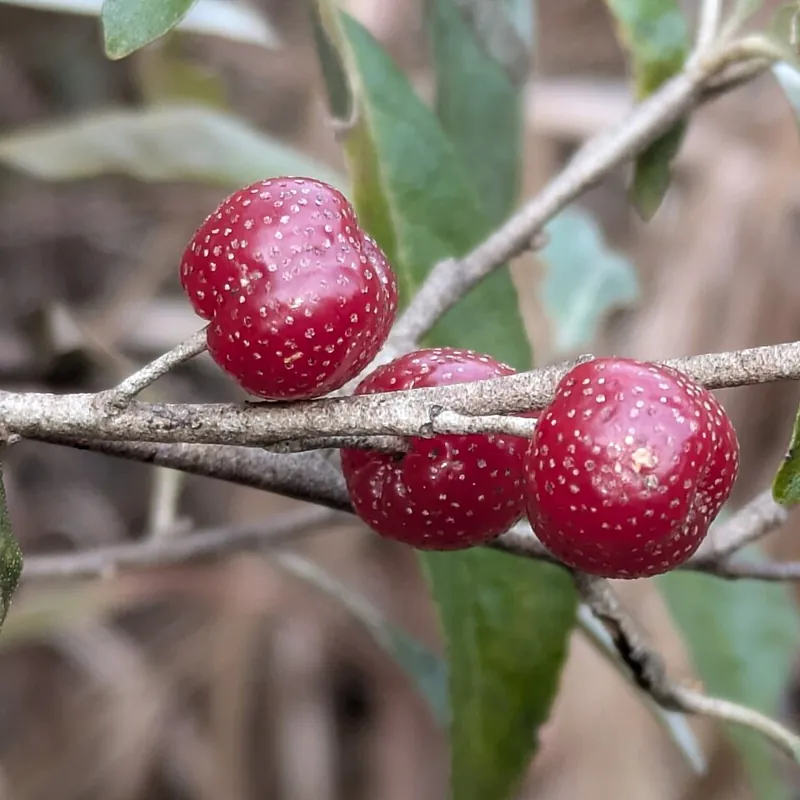
Red speckled autumn olive berries on the branch
A regulated invasive in much of the US — check your state before planting. Photo: Alpsdake · CC BY-SA 4.0, via Wikimedia Commons.

¿Cuándo siembro esto? →

Planéala en tu huerto →

Los números

Altura adulta
300–600 cm118–236 in
Ancho adulto
300–600 cm118–236 in
Zona de rusticidad
4–9
Luz
Pleno sol
Nutrientes
Produce su propio nitrógeno
Profundidad de la raíz
Profunda
Tolerancia a la helada
Resistente
Ciclo de vida
Perenne
Forma de crecer
Arbusto
Valor para los polinizadores
Moderado
Fija nitrógeno
Sí
Da sombra a las plantas vecinas
Sí
Puede sostener una trepadora
Puede sostener una trepadora ligera

Números de los que estamos menos seguros

These are estimates from general gardening knowledge, or the sources disagree on them, so treat them as a starting point rather than a firm figure.

Reglas que se aplican a Eleagno

Bien establecido La zona de rusticidad es la variable correcta para las perennes, y solo para las perennes.
Bien establecido

La zona de rusticidad es la variable correcta para las perennes, y solo para las perennes.

si no se sigue, igual funciona, pero peor · el planeador lo sugiere

Mecanismo: Las zonas codifican la temperatura mínima invernal media anual, que determina si una perenne leñosa sobrevive hasta la primavera. Es la magnitud equivocada para una anual, que nunca llega a ver el invierno. Una zona demasiado cálida es un segundo mecanismo, distinto. Los inviernos suaves no matan a una perenne; no le dan el frío que necesita. Los frutales caducifolios necesitan un periodo de latencia invernal para brotar y dar fruto, así que en una zona más suave que aquella a la que está adaptada una planta, esta puede sobrevivir y nunca producir. Solo se aplica el extremo frío, porque solo la supervivencia invernal se deduce de lo que mide una zona; el extremo cálido es un consejo, no un rechazo. Ese límite cálido pertenece a la variedad, no a la especie, y ese es el límite honesto de lo que esta regla puede hacer. El requisito de frío se publica por variedad y varía muchísimo dentro de una especie, así que un techo a nivel de especie dice "el rango modelado no llega a tu zona", nunca "ninguna planta de este tipo te dará cosecha". Por eso, por encima de su rango, el planificador sigue ofreciendo la planta, con el consejo de elegir una variedad clasificada para tu zona, en lugar de rechazarla.

Evidence: confirmed against 3 sources in the research-based literature.

the 3 sources

THE FLOOR IS TRUE BY DEFINITION and needs no citation: the USDA system defines a zone AS a band of average annual minimum winter temperature, so 'a plant colder-hardy than your zone survives your winter' is the definition restated. This rule was `verified_trivially` on that basis alone until 2026-07-26. THE CEILING WAS NEVER COVERED BY IT - a minimum-temperature definition says nothing about a plant failing for want of chill - and that gap is why ISSUES #13 exists. The pointer below closes it.

OSU Extension EC 1303, 'Growing blackberries in your home garden' (Bernadine Strik), catalog.extension.oregonstate.edu/sites/catalog/files/project/pdf/ec1303.pdf (read 2026-07-26). THE CEILING'S MECHANISM, STATED: 'Winter cold-hardy cultivars adapted to the colder regions of Oregon (such as zones 5 to 7), may not grow normally in regions of the Willamette Valley (zone 8) where winters are warmer and plants receive less winter chill.' A plant failing in a WARMER zone for want of chill - which is what this rule's upper bound enforces and what no source said until now. THE SAME PAGE MAKES IT A CULTIVAR PROPERTY: 'Even cultivars within the same type (trailing, erect or semierect) differ in fruit quality and flavor, appearance, tolerance to pests, cold hardiness, and plant longevity', and the remedy it gives is the one this rule's rejection text now repeats: 'Minimize risk by choosing types and cultivars that are adapted to your hardiness zone.' The page then publishes a table of sixteen cultivars EACH WITH ITS OWN ZONE RANGE, which is the strongest available evidence that a species-level band is an approximation. [read]

WHAT THIS DOES NOT SETTLE (amended 2026-09-24). The mechanism is named, but the corpus carries ONE band per species where the source carries one per cultivar, so the warm limit is explained without being precise. That is why, since 2026-07-26, the planner treats the warm end as advice rather than a refusal: above a species' band it still offers the plant and says to look for a cultivar rated for your zone, never that nothing will crop. Every species band now records what its sources say, though most are still marked estimated.

Lee la regla completa → · abrir en el planeador ↗

Bien establecido

El olivo de otoño (Elaeagnus umbellata) es un buen fijador de nitrógeno para un gremio de árbol frutal.

Esta es una afirmación que el planeador se niega a aplicar — la dejamos aquí junto con lo que de verdad se sabe, en lugar de borrarla.

Lo que de verdad se sabe: It fixes nitrogen. It is also bird-dispersed, forms dense thickets, and is listed as invasive or noxious across much of the eastern and midwestern US.

Evidence: confirmed against 2 sources in the research-based literature.

the 2 sources

NC State Extension Gardener Plant Toolbox, 'Elaeagnus umbellata', plants.ces.ncsu.edu/plants/elaeagnus-umbellata (read 2026-07-11): 'This plant is an invasive species in North Carolina'; 'It becomes quite competitive even in poor soils by fixing nitrogen in its roots'; 'The fruits are taken by birds and small mammals, which disperse the seeds ... a large plant may produce hundreds or thousands of fruits. Autumn olive threatens native species by out-competing them'; 'Many states have banned its sale.'

USDA Forest Service, Fire Effects Information System (Munger 2003), 'Elaeagnus umbellata', fs.usda.gov/database/feis/plants/shrub/elaumb/all.html (read 2026-07-11): symbiosis with soil actinomycetes 'permits the fixation and subsequent utilization of atmospheric nitrogen'; 'Seeds are dispersed by frugivorous birds'; listed 'as a noxious weed in several West Virginia counties'; USFS Region 8 lists it a 'category 1 weed' whose introduction 'is prohibited on National Forest System Lands.'

solución

El olivo de otoño se escapará de tu patio. Usa trébol blanco, lupino silvestre o un fijador nativo, y revisa la lista de malezas nocivas de tu estado antes de plantar cualquier fijador de nitrógeno leñoso.

Lee la regla completa → · abrir en el planeador ↗

Otras 121 reglas dependen de tu huerto y no de la planta — rotación de cultivos, fechas de helada, sol, distancia entre plantas y suelo. Velas todas.

Cita esta página

Milpa Gardens. "Eleagno (Elaeagnus umbellata)." https://milpa.garden/es/plants/elaeagnus-umbellata/

A garden-planning corpus: every claim states its evidence grade and links its sources on the page. Cite it with the grade, and add the date you read it.

Todas las plantas