Milpa Gardens
iniciar sesión

Traducción automática · Leer en inglés

Beet

Beta vulgaris · familia de las amarantáceas · USDA PLANTS: BEVU2

De un vistazo

Luz
Pleno sol
Helada
Aguanta algo de frío
Ciclo de vida
Bienal
En esta página

Las reglas y las notas de cosecha de esta página están traducidas automáticamente del inglés; sus fuentes, algunas notas y los títulos de las guías siguen en inglés.

Beet (Beta vulgaris) es una planta bienal (familia de las amarantáceas).

También se conoce como Beetroot, Swiss Chard, Chard.

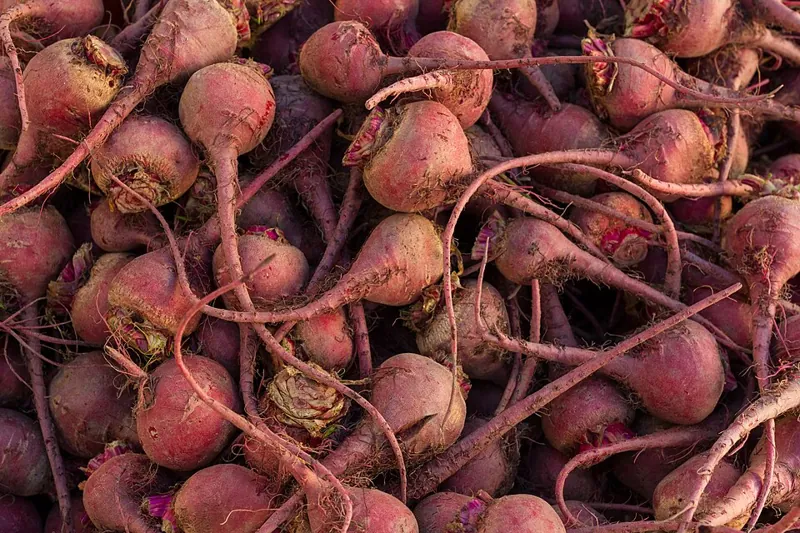
Freshly harvested red beets with their roots and tops
Photo: Frank Schulenburg · CC0, via Wikimedia Commons.

¿Cuándo siembro esto? →

Planéala en tu huerto →

Los números

Profundidad de siembra
2.5 cm1 in
pH del suelo
6.2–7
Días entre siembras escalonadas
14–21
Luz
Pleno sol
Nutrientes
Moderadamente exigente
Profundidad de la raíz
Media
Tolerancia a la helada
Aguanta algo de frío
Ciclo de vida
Bienal
Valor para los polinizadores
Ninguno

En la cosecha, y en maceta

Beetroot

Tamaño de maceta
al menos 1.9 L (medio galón de EE. UU.)al menos medio galón (unos 1.9 L)

Swiss Chard

Tamaño de maceta
al menos 7.6 L (2 galones de EE. UU.)al menos 2 galones (unos 7.6 L)

University of Maryland Extension, 'Growing Vegetables in Containers and Salad Tables', extension.umd.edu/resource/growing-vegetables-containers-and-salad-tables (fetched in-container 2026-09-25, read by the maintainer 2026-09-25): the table 'Minimum container size for common vegetables | Vegetable type | Minimum container volume', row 'Beets | ½ gallon'. ONE TABLE, NOT A BLEND (maintainer ruling 2026-09-25): other extension tables disagree for some crops (e.g. CSU 'Vegetable Gardening in Containers', TAMU E-545) and are not averaged in. [read]

University of Maryland Extension, 'Growing Vegetables in Containers and Salad Tables', extension.umd.edu/resource/growing-vegetables-containers-and-salad-tables (fetched in-container 2026-09-25, read by the maintainer 2026-09-25): the table 'Minimum container size for common vegetables | Vegetable type | Minimum container volume', row 'Swiss chard | 2 gallon'. ONE TABLE, NOT A BLEND (maintainer ruling 2026-09-25): other extension tables disagree for some crops (e.g. CSU 'Vegetable Gardening in Containers', TAMU E-545) and are not averaged in. [read]

Grupos de cultivares

No todas las plantas de beet crecen igual. Estos son sus tipos principales (sus grupos de cultivares), y el planeador calcula el tamaño, las fechas y el soporte de cada uno con sus propios números.

Números de los que estamos menos seguros

These are estimates from general gardening knowledge, or the sources disagree on them, so treat them as a starting point rather than a firm figure.

Reglas que se aplican a Beet

Prometedor No plantes betabel, acelga, espinaca ni amaranto en tierra que los tuvo en los últimos 3 años.
Prometedor

No plantes betabel, acelga, espinaca ni amaranto en tierra que los tuvo en los últimos 3 años.

si no se sigue, se pierde cosecha de verdad · el planeador te avisa

Mecanismo: Cercospora beticola, la mancha foliar del betabel, la acelga y la espinaca, sobrevive en residuos infestados y en el suelo hasta tres años y se mantiene de una temporada a otra en el quelite cenizo y el bledo; el mildiú velloso de la espinaca (Peronospora effusa) deja oosporas en el suelo durante unos años y viaja en la semilla. Un descanso de tres años dura más que ambos.

Evidence: confirmed against 7 sources in the research-based literature.

the 7 sources

Cornell Vegetables, 'Cercospora Leaf Spot of Table beet', vegetables.cornell.edu/pest-management/disease-factsheets/cercospora-leaf-spot-of-table-beet (fetched in-container 2026-09-02; read by the maintainer 2026-09-02): 'Rotate with non-host crops for at least 3 years'; 'Cercospora beticola can survive in the soil on infested plant residues for up to 3 years'; hosts 'Table beet, sugar beet, spinach, Swiss chard, lambsquarters, and pigweed.'

Penn State Extension, 'Cercospora Leaf Spot on Table Beets', extension.psu.edu/cercospora-leaf-spot-on-table-beets (fetched in-container 2026-09-02; read by the maintainer 2026-09-02): 'Beet growers wishing to prevent Cercospora leaf spot on their farm should implement a 3-year crop rotation featuring non-host crops'; 'Cercospora beticola can overwinter on host debris and in the soil for up to 3 years or survive on alternative weed hosts like lambsquarters and pigweed'; 'Cercospora leaf spot will infect spinach, Swiss chard, and sugar beets.'

UMass Extension, 'Cercospora Leaf Spot of Swiss Chard, Beets, and Spinach', umass.edu/agriculture-food-environment/vegetable/fact-sheets/cercospora-leaf-spot-of-swiss-chard-beets-spinach (fetched in-container 2026-09-02; read by the maintainer 2026-09-02): 'Rotate to non-host crops (outside of the Chenopodium family) for 2-3 years'; 'It can survive in the soil for up to two years.'

Univ. of Maryland Extension, 'Cercospora Leaf Spot of Vegetables', extension.umd.edu/resource/cercospora-leaf-spot-vegetables (fetched in-container 2026-09-02; read by the maintainer 2026-09-02): 'Don't plant susceptible crops in the same spot more than once every three years.'

UMass Extension, 'Spinach Downy Mildew', umass.edu/agriculture-food-environment/vegetable/fact-sheets/spinach-downy-mildew (fetched in-container 2026-09-02; read by the maintainer 2026-09-02): 'Rotate out of spinach for at least 3 years'; 'P. farinosa is capable of producing oospores, thick-walled structures which are capable of survival in soil.'

Cornell Vegetables, 'Spinach Downy Mildew', vegetables.cornell.edu/pest-management/disease-factsheets/spinach-downy-mildew (fetched in-container 2026-09-02; read by the maintainer 2026-09-02): 'Rotate out of land where spinach was grown for at least 2-3 years'; 'The pathogen can survive a few years in soil as oospores'; 'Oospores also could be left behind in soil after planting contaminated seed.'

Cornell Vegetables, 'Do Rotations Matter within Disease Management Programs?' (fetched in-container 2026-09-02; read by the maintainer 2026-09-02): its rotation table gives beet Cercospora leaf spot 3 years, beet root rots 3 years, spinach downy mildew and white rust 2 years.

solución

Plántalos en otra tierra, o espera a que pasen 3 años desde la última vez que esta tierra los tuvo. Entierra o retira las hojas viejas, mantén el quelite cenizo y el bledo fuera de la cama mientras tanto, y compra semilla limpia.

Lee la regla completa → · abrir en el planeador ↗

Prometedor Los cultivos anuales resistentes al frío se pueden sembrar o trasplantar antes de la última helada de primavera — los resistentes unas tres semanas antes, los semirresistentes unas dos semanas antes. Los sensibles esperan a la propia helada.
Prometedor

Los cultivos anuales resistentes al frío se pueden sembrar o trasplantar antes de la última helada de primavera — los resistentes unas tres semanas antes, los semirresistentes unas dos semanas antes. Los sensibles esperan a la propia helada.

si no se sigue, igual funciona, pero peor · el planeador lo sugiere

Mecanismo: Resistencia al frío. Los cultivos resistentes toleran heladas fuertes y los semirresistentes toleran heladas ligeras, así que pueden ocupar la tierra semanas antes de que se permita la entrada a los cultivos sensibles a las heladas. El desfase se mide desde la última helada de primavera.

Evidence: confirmed against 4 sources in the research-based literature.

the 4 sources

University of Illinois Extension, 'Time Your Vegetable Plantings by Cold Hardiness' (2018-03-26), extension.illinois.edu/blogs/ilriverhort/2018-03-26-time-your-vegetable-plantings-cold-hardiness: very hardy vegetables 'withstand freezing temperatures and hard frosts without injury' (planted earliest in spring); frost-tolerant vegetables 'can withstand light frosts, but not freezing temperatures' (planted a couple of weeks later). LLM-summarised from a read of the page; it establishes the CATEGORIES but states no week offsets.

Colorado State Univ. Extension, GardenNotes #720, 'Vegetable Planting Guide', extension.colostate.edu/resource/vegetable-planting-guide (read 2026-07-25): hardy vegetables go in 'As early as 2-4 weeks before the date of the average last spring frost'; semi-hardy 'As early as 0-2 weeks before the date of the average last spring frost'; tender from seed 'around the date of the average last spring frost'; very tender 'Typically 2+ weeks after'. This is the source that states the offsets in weeks.

Where this rule sits in that range: hardy at 3 weeks is mid-range of CSU's 2-4. Half-hardy at 2 weeks is the EARLIEST EDGE of CSU's 0-2 - the most aggressive planting CSU sanctions, not the middle of it. The rule is inside published guidance at both ends, but it leans early on the half-hardy side and a gardener following it in a cold spring is taking that boundary.

Do not import an offset from another publication's hardiness scheme without checking the category names: CSU has no 'very hardy' tier, so a '4-6 weeks before frost' figure written against a four-tier scheme does not describe CSU's 'hardy'. Categories are not comparable across sources.

Lee la regla completa → · abrir en el planeador ↗

Otras 121 reglas dependen de tu huerto y no de la planta — rotación de cultivos, fechas de helada, sol, distancia entre plantas y suelo. Velas todas.

Equipos de plantas que la incluyen

Cita esta página

Milpa Gardens. "Beet (Beta vulgaris)." https://milpa.garden/es/plants/beta-vulgaris/

A garden-planning corpus: every claim states its evidence grade and links its sources on the page. Cite it with the grade, and add the date you read it.

Todas las plantas