Milpa Gardens
iniciar sesión

Traducción automática · Leer en inglés

False Indigo Bush

Amorpha fruticosa · leguminosas · USDA PLANTS: AMFR

De un vistazo

Luz
Pleno sol
Helada
Resistente
Zona de rusticidad
4–9
Ciclo de vida
Perenne
En esta página

Las reglas y las notas de cosecha de esta página están traducidas automáticamente del inglés; sus fuentes, algunas notas y los títulos de las guías siguen en inglés.

False Indigo Bush (Amorpha fruticosa) es una planta perenne (leguminosas).

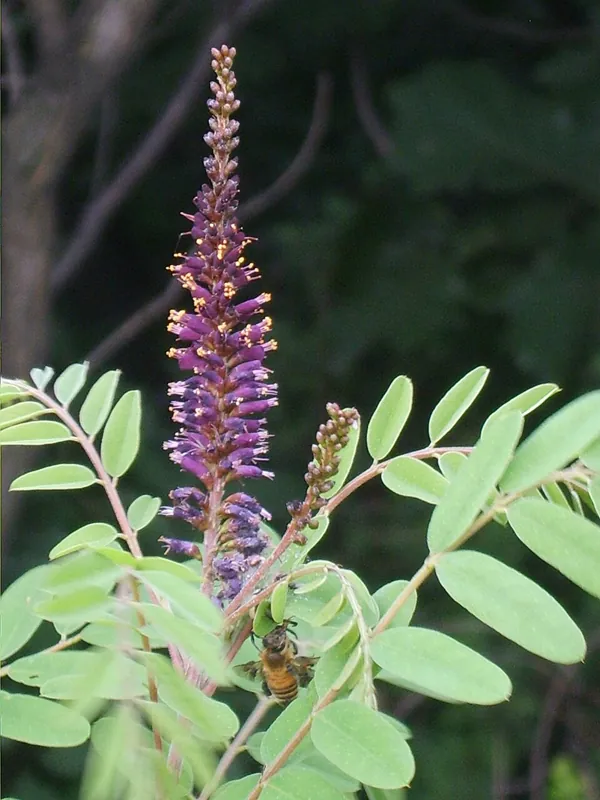
False indigo bush with a purple flower spike
On some state noxious-weed lists — check your state before planting. Photo: Dalgial · CC BY-SA 3.0, via Wikimedia Commons.

¿Cuándo siembro esto? →

Planéala en tu huerto →

Los números

Altura adulta
180–360 cm71–142 in
Ancho adulto
150–300 cm59–118 in
Zona de rusticidad
4–9
Luz
Pleno sol
Nutrientes
Produce su propio nitrógeno
Profundidad de la raíz
Profunda
Tolerancia a la helada
Resistente
Ciclo de vida
Perenne
Forma de crecer
Arbusto
Valor para los polinizadores
Alto
Fija nitrógeno
Sí
Da sombra a las plantas vecinas
Sí
Puede sostener una trepadora
Puede sostener una trepadora ligera

Antes de sembrar

Lo que la semilla necesita antes de brotar.

Temperatura del suelo para germinar
20 °C68 °F
Días para germinar
30–60 días

USDA-NRCS Plant Guide, 'Desert false indigo / Amorpha fruticosa' (L. M. Moore, NRCS National Plant Data Center), plants.sc.egov.usda.gov/DocumentLibrary/plantguide/pdf/pg_amfr.pdf (fetched in-container 2026-09-20, read by the maintainer 2026-09-20 via the batch-3 germination review): 'The seeds normally germinate at 20 C in one to two months.' Stored [20, 20] (20 C). FLAGGED ESTIMATED: NRCS gives a single germination temperature and does not label it a soil temperature. The seed_treatment soak that was held during the batch-3 review is now recorded (see the seed_treatment pointer below) at the maintainer's follow-up instruction. [read]

USDA-NRCS Plant Guide, same page and fetch as germination_soil_temp_c (read by the maintainer 2026-09-20): 'The seeds normally germinate at 20 C in one to two months.' One to two months = [30, 60] (stored). [read]

SOAK RECORDED as a follow-up to the batch-3 review, which had held it pending a mechanism. Two sources, both read by the maintainer 2026-09-20. The instruction: USDA-NRCS Plant Guide, 'Desert false indigo / Amorpha fruticosa' (L. M. Moore, NRCS National Plant Data Center), plants.sc.egov.usda.gov/DocumentLibrary/plantguide/pdf/pg_amfr.pdf - 'Amorpha fruticosa seeds should be presoaked for twelve hours in warm water'. The mechanism (which NRCS omits): USDA Forest Service Woody Plant Seed Manual, genus Amorpha (Zasada & Martineau), fs.usda.gov/nsl/Wpsm/Amorpha.pdf - 'Indigobush and dwarf indigobush appear to have seed coat dormancy', overcome by light scarification or soaking to let water reach the seed. A hard, water-impermeable seed coat blocking imbibition is a clean physical mechanism, the same shape as wild lupine's scarify. Recorded as kind: soak (the NRCS warm-water method) with that seed-coat-dormancy mechanism. [read]

Números de los que estamos menos seguros

These are estimates from general gardening knowledge, or the sources disagree on them, so treat them as a starting point rather than a firm figure.

Reglas que se aplican a False Indigo Bush

Bien establecido La zona de rusticidad es la variable correcta para las perennes, y solo para las perennes.
Bien establecido

La zona de rusticidad es la variable correcta para las perennes, y solo para las perennes.

si no se sigue, igual funciona, pero peor · el planeador lo sugiere

Mecanismo: Las zonas codifican la temperatura mínima invernal media anual, que determina si una perenne leñosa sobrevive hasta la primavera. Es la magnitud equivocada para una anual, que nunca llega a ver el invierno. Una zona demasiado cálida es un segundo mecanismo, distinto. Los inviernos suaves no matan a una perenne; no le dan el frío que necesita. Los frutales caducifolios necesitan un periodo de latencia invernal para brotar y dar fruto, así que en una zona más suave que aquella a la que está adaptada una planta, esta puede sobrevivir y nunca producir. Solo se aplica el extremo frío, porque solo la supervivencia invernal se deduce de lo que mide una zona; el extremo cálido es un consejo, no un rechazo. Ese límite cálido pertenece a la variedad, no a la especie, y ese es el límite honesto de lo que esta regla puede hacer. El requisito de frío se publica por variedad y varía muchísimo dentro de una especie, así que un techo a nivel de especie dice "el rango modelado no llega a tu zona", nunca "ninguna planta de este tipo te dará cosecha". Por eso, por encima de su rango, el planificador sigue ofreciendo la planta, con el consejo de elegir una variedad clasificada para tu zona, en lugar de rechazarla.

Evidence: confirmed against 3 sources in the research-based literature.

the 3 sources

THE FLOOR IS TRUE BY DEFINITION and needs no citation: the USDA system defines a zone AS a band of average annual minimum winter temperature, so 'a plant colder-hardy than your zone survives your winter' is the definition restated. This rule was `verified_trivially` on that basis alone until 2026-07-26. THE CEILING WAS NEVER COVERED BY IT - a minimum-temperature definition says nothing about a plant failing for want of chill - and that gap is why ISSUES #13 exists. The pointer below closes it.

OSU Extension EC 1303, 'Growing blackberries in your home garden' (Bernadine Strik), catalog.extension.oregonstate.edu/sites/catalog/files/project/pdf/ec1303.pdf (read 2026-07-26). THE CEILING'S MECHANISM, STATED: 'Winter cold-hardy cultivars adapted to the colder regions of Oregon (such as zones 5 to 7), may not grow normally in regions of the Willamette Valley (zone 8) where winters are warmer and plants receive less winter chill.' A plant failing in a WARMER zone for want of chill - which is what this rule's upper bound enforces and what no source said until now. THE SAME PAGE MAKES IT A CULTIVAR PROPERTY: 'Even cultivars within the same type (trailing, erect or semierect) differ in fruit quality and flavor, appearance, tolerance to pests, cold hardiness, and plant longevity', and the remedy it gives is the one this rule's rejection text now repeats: 'Minimize risk by choosing types and cultivars that are adapted to your hardiness zone.' The page then publishes a table of sixteen cultivars EACH WITH ITS OWN ZONE RANGE, which is the strongest available evidence that a species-level band is an approximation. [read]

WHAT THIS DOES NOT SETTLE (amended 2026-09-24). The mechanism is named, but the corpus carries ONE band per species where the source carries one per cultivar, so the warm limit is explained without being precise. That is why, since 2026-07-26, the planner treats the warm end as advice rather than a refusal: above a species' band it still offers the plant and says to look for a cultivar rated for your zone, never that nothing will crop. Every species band now records what its sources say, though most are still marked estimated.

Lee la regla completa → · abrir en el planeador ↗

Prometedor No plantes leguminosas en tierra que tuvo leguminosas en los últimos 3 años; las pudriciones de raíz se acumulan donde se repiten, y las peores sobreviven a cualquier rotación de huerto.
Prometedor

No plantes leguminosas en tierra que tuvo leguminosas en los últimos 3 años; las pudriciones de raíz se acumulan donde se repiten, y las peores sobreviven a cualquier rotación de huerto.

si no se sigue, se pierde cosecha de verdad · el planeador te avisa

Mecanismo: Las pudriciones de raíz del frijol y del chícharo (Fusarium solani, Rhizoctonia, Pythium, Aphanomyces) y el moho blanco (Sclerotinia sclerotiorum) sobreviven en el suelo como esporas y esclerocios y se acumulan donde las leguminosas siguen a leguminosas; un descanso de tres años mantiene a raya las comunes. Fusarium necesita más tiempo, y las oosporas de Aphanomyces y los esclerocios del moho blanco persisten durante muchos años, así que la rotación los reduce pero no puede eliminarlos.

Evidence: confirmed against 4 sources in the research-based literature.

the 4 sources

Cornell Vegetables, 'Do Rotations Matter within Disease Management Programs?', vegetables.cornell.edu/pest-management/disease-factsheets/do-rotations-matter-within-disease-management-programs (fetched in-container 2026-09-02; read by the maintainer 2026-09-02): its rotation table gives beans root rots 3 years, white mold (Sclerotinia) 3 years, anthracnose 2 years; peas root rots 3-4 years, Fusarium wilt 4-5 years.

UMN Extension, Fruit and Vegetable News, 'Crop planning deep dive: Mind your Peas and Beans' (2021), blog-fruit-vegetable-ipm.extension.umn.edu/2021/04/2021-consideration-minding-your-peas.html (fetched in-container 2026-09-02; read by the maintainer 2026-09-02): 'Rotate away from legumes for more than 3 years'; 'More than 6 years is needed for some diseases (Fusarium, some damping off pathogens).'

UConn IPM, 'Molds and Mildews of Beans in Connecticut', ipm.cahnr.uconn.edu/molds-and-mildews-of-beans-in-connecticut (fetched in-container 2026-09-02; read by the maintainer 2026-09-02): white mold - 'Rotate away from susceptible crops for 7 years', it affects beans and 'practically all vegetable crops'; downy mildew - 'Rotate with other crops for 2 years.'

NDSU Agriculture, 'Field Pea and Lentil Root Rot Risk, Diagnosis and Resources', ndsu.edu/agriculture/ag-hub/field-pea-and-lentil-root-rot-risk-diagnosis-and-resources (fetched in-container 2026-09-02; read by the maintainer 2026-09-02): 'Fields with a long history of pulses in close rotations (every 2-3 years) are at greatest risk'; 'Chickpea, soybean, and faba bean are not susceptible to Aphanomyces euteiches and thus can be included in a rotation with pea and lentil to break up the disease cycle.'

solución

Planta las leguminosas en otra tierra, o espera a que pasen 3 años desde la última vez que esta tierra las tuvo. Donde haya aparecido pudrición de raíz, alarga ese plazo, y mantén la tierra con buen drenaje: todas estas pudriciones empeoran en suelo húmedo.

Lee la regla completa → · abrir en el planeador ↗

Prometedor Los frijoles, los chícharos y otras leguminosas solo fijan nitrógeno con las bacterias del suelo adecuadas. Una tierra que no ha tenido su tipo recientemente puede tener muy pocas, así que fijan menos.
Prometedor

Los frijoles, los chícharos y otras leguminosas solo fijan nitrógeno con las bacterias del suelo adecuadas. Una tierra que no ha tenido su tipo recientemente puede tener muy pocas, así que fijan menos.

si no se sigue, igual funciona, pero peor · el planeador lo sugiere

Mecanismo: La fijación de nitrógeno ocurre en nódulos de la raíz formados por bacterias Rhizobium o Bradyrhizobium específicas de cada grupo de leguminosas. En una tierra que no ha tenido antes ese grupo de leguminosas - una cama nueva, una mezcla sin suelo, un largo intervalo en la rotación, un suelo fumigado o muy ácido - la cepa correspondiente puede faltar o ser escasa, así que la nodulación y la fijación se reducen hasta que se forma una población.

Evidence: confirmed against 1 source in the research-based literature.

the source

Penn State Extension, 'Inoculation of Forage and Grain Legumes', extension.psu.edu/inoculation-of-forage-and-grain-legumes (read 2026-08-14): 'Rhizobia bacteria are fairly specific as to which legumes they will infect, form nodules on the roots of, and for which they will fix nitrogen'; 'Legumes effectively nodulated by the same Rhizobia species are termed cross-inoculation groups'; 'Inoculation is recommended when the legume being planted has not been grown in that field in the past three years or with every planting of a high-value crop'; 'Inside the nodule, an enzyme called nitrogenase drives the N fixation reaction.'

solución

En tierra que tiene leguminosas por primera vez, cubre la semilla al sembrar con el inoculante que corresponde al grupo del cultivo (los chícharos y frijoles de huerto, la soja y el trébol llevan cada uno uno distinto). Una tierra que ha tenido esa leguminosa recientemente por lo general no necesita ninguno. Es un paso barato que se hace una sola vez - recomendado donde falta el historial, nunca obligatorio.

Lee la regla completa → · abrir en el planeador ↗

Otras 120 reglas dependen de tu huerto y no de la planta — rotación de cultivos, fechas de helada, sol, distancia entre plantas y suelo. Velas todas.

Cita esta página

Milpa Gardens. "False Indigo Bush (Amorpha fruticosa)." https://milpa.garden/es/plants/amorpha-fruticosa/

A garden-planning corpus: every claim states its evidence grade and links its sources on the page. Cite it with the grade, and add the date you read it.

Todas las plantas